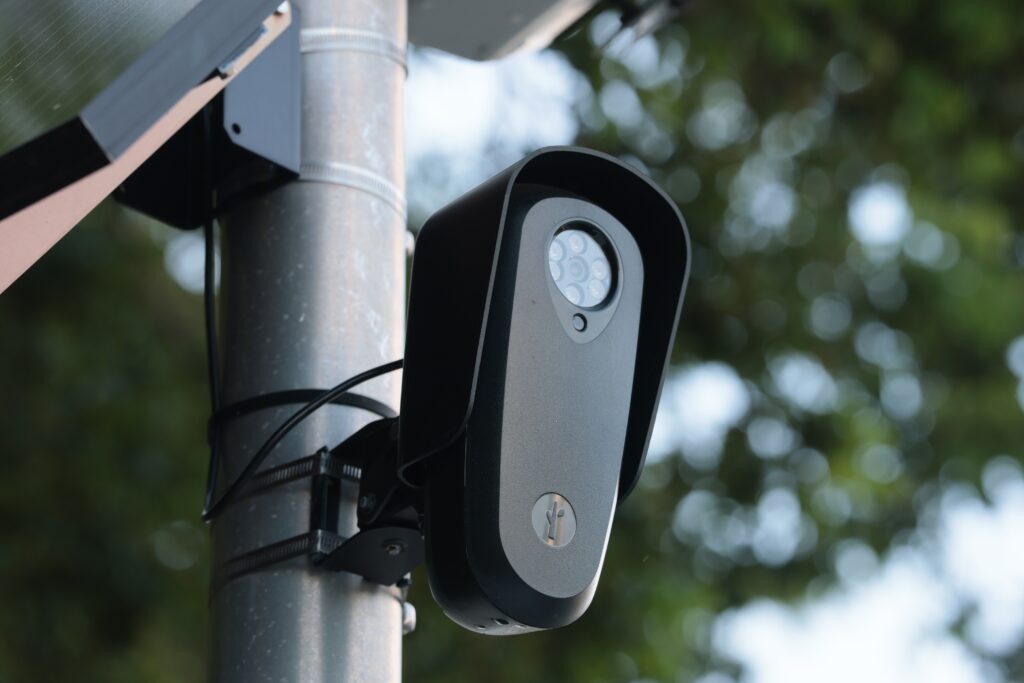
The national blowback against Flock license-plate readers is also hitting the Washington region, with D.C.’s police union and leaders in a Northern Virginia city raising concerns about the use of the technology in recent days.
Gregg Pemberton, president of the D.C. police union, said Friday the city’s department has used license plate readers for many years and is a powerful investigative tool. But he noted Flock’s technology can also create detailed files on people not suspected of any crimes.
“We have a lot of concerns about whether or not there’s a constitutional question that needs to be addressed there,” Pemberton said.
Pemberton’s skepticism of the technology also comes as the union said it learned the police force’s internal affairs department had used the technology to investigate sworn officers.
The union filed misconduct complaints and a grievance about what it said was improper use of the technology, but Pemberton said department leadership has so far declined to investigate. The department has since restricted access to the system, according to the union.
Pemberton called for the D.C. Council to regulate how the tech is used in the nation’s capital.
“Once you start to understand the capabilities of this system, even the proponents of it say there needs to be more public discussion and probably more legislation on it,” he said.
The union’s grievance thrust it into an improbable alliance of groups — which ranges from conservative politicians to leftist activists and civil rights advocacy organizations — raising questions about the technology that can track vehicles across vast geographical areas in real time.
The chorus of skepticism grew especially heated this summer in light of reporting, including an investigation by The Washington Post, that found scores of law enforcement officers have been charged with or accused of misusing the technology, including for spying on wives, girlfriends and exes. Other critics have raised concerned about the data being shared with other law enforcement agencies, including federal immigration authorities.
“People who often are not on the same page on issues, who have all come together around being deeply angry about Flock” and surveillance technology, said Tess McEnery, a local organizer and human rights policy expert in Alexandria.
Use of — and resistance to — readers grows
Many law enforcement agencies across the D.C. region use various forms of license-plate readers. Police in Fairfax Countysaid Flock cameras helped identify suspects connected to a fire this summer at a storage facility that caused upward of $1.3 million worth of damage.
In Maryland, the network of Flock cameras has been expanding, though some of the state’s largest law enforcement agencies — including Baltimore and Montgomery County — don’t contract with the company and use other vendors.
The police department in Alexandria operates 61 fixed Flock cameras along busy public roads, with more used by private businesses and schools, including Northern Virginia Community College’s Alexandria campus, Police Chief Tarrick McGuire told city leaders at a meeting this week. The city also uses automatic license plate readers to enforce parking, speed and red-light violations.
The department has drawn scrutiny in recent weeks after reports of potential improper use of the technology, but the chief said an auditing unit found zero instances of “malicious misuse.” He also said the department may soon get additional oversight help from an outside criminologist.
As McGuire spoke to lawmakers, at least 10 people held signs protesting the readers. The chief told the mayor and city council that he has heard the community’s concerns.
“I am of the opinion [that] as leaders our responsibility is not to choose between public safety and civil liberties,” he said at the meeting Tuesday. “The constitution does not ask us to sacrifice one for another. It requires us to govern in a way that safeguards the rights of individuals while protecting all persons in our communities.”
An Alexandria police spokesperson said in a statement that Flock cameras have helped the department find missing people and have supported 35 criminal investigations, including two armed robberies. “These investigations involve real victims and real harm, from violent crime and its lasting trauma to the broader impact crime has on families and the community,” the statement said.
But some city officials signaled at Tuesday’s meeting that they want the technology gone.
“While I do think there’s a role for technology, and I do think we have seen the role that that has played and the benefit it has, I do not think there is a role for Flock in this community,” said Mayor Aliya Gaskins.
The police chief said the department is in talks with other companies with “stronger safeguards” to address community and policing needs. The department’s contract was signed with Flock in 2023 and can be terminated at any time, McGuire said, adding the cameras were paid for by grant and city funding.
Gaskins and some council members said they worried that, even with a different vendor, the same potential problems could arise.
“Eliminating Flock isn’t enough for me,” said councilwoman Sandy Marks. “Eliminating and moving to a new and similar technology isn’t enough for me without an extended conversation.”
They said they were concerned data collected by the cameras could be used by federal authorities to track immigrants, or even women traveling to Virginia seeking an abortion.
McGuire said the Alexandria department does not share what is recorded on the 61 cameras it operates with law enforcement agencies outside the state or in the federal government. The data is only stored for 21 days, unless needed for an investigation, in accordance to state law, McGuire said.
The department does share data collected by the cameras with more than 150 Virginia law enforcement agencies, 11 of which have 287(g) agreements that allow officers to participate in federal immigration enforcement operations, such as executing administrative warrants for deportation.
At least nine Virginia law enforcement agencies that use automatic license plate readers grant continuous access of their systems with federal agencies, according to a Virginia State Crime Commission Report published earlier this year.
As Alexandria officials pledged to continue public discussions about license-plate readers, other localities across the state have ended their relationship with Flock following public backlash, including Staunton, Charlottesville, and Harrisonburg, according to media reports.
In Hampton Roads, research shows, the presence of the technology is more apparent in communities with higher rates of poverty and Black residents, exacerbating concerns about the potential for racial discrimination through technology.
“I just think that this is opening the door to all kinds of potential issues when it comes to disproportionate treatment or disparate treatment,” said Stephen Keener, director of the Center for Crime, Equity and Justice at Christopher Newport University, which produced the study.
‘A ripe issue for the council’
Back in the nation’s capital, the D.C. police department reported data to the council earlier this year that showed its use of license-plate reader technology was expanding.
As of January, the department said it had 98 “fixed” license plate readers mounted on poles throughout the city, in addition to 68 mobile readers mounted on vehicles or trailers.
At the time, Flock owned and operated 67 of the fixed readers, four of the mobile ones and nine closed circuit television cameras.
The police department said it deployed 111 new cameras in the fiscal year 2025 and in the first quarter of the current fiscal year, during which it anticipated purchasing a total of 51 license plate readers.
The AI-powered cameras produce feeds that are funneled into the department’s “real time crime center,” which draws on more than 1,500 public and privately owned video cameras, gunshot detection technology, facial recognition and other monitoring tools, the department said in response to questions from D.C. Council members.
The department also said it obtained approval earlier this year to “deploy an MPD data platform that leverages Axon Fusus,” an AI-powered technology that would fuse various data streams together for crime analysts to monitor in real time.
Andrew Ferguson, a law professor at George Washington University who specializes in police surveillance, said the unregulated, unaudited nature of tracking systems such as Flock raise real privacy concerns, “no matter how useful the technology may be for investigating crime.”
“This is a failure not just of the police leadership, or a particular tech company, but the D.C. Council that has not regulated the surveillance systems used by MPD,” Ferguson wrote in an emailed statement.
A spokesperson for council member Brooke Pinto (D-Ward 2), chair of the public safety committee, did not respond to a request for comment about the union’s remarks on Thursday.
Council member Charles Allen (D-Ward 6) said Friday he thinks the city should hold a hearing on the issue. “It’s a ripe issue for the council and for the judiciary committee … to set appropriate guardrails and that privacy interests are protected,” Allen said on The Politics Hour.
Ferguson said the positioning of the D.C. police union, one of a handful in the country so far to come out against the way the technology is being used, had a larger symbolism.
“When police unions are demanding guardrails for surveillance technologies,” he said, “you know you have hit a tipping point in the debate.”
The post D.C. police union, Alexandria leaders voice concerns over Flock technology appeared first on Washington Post.