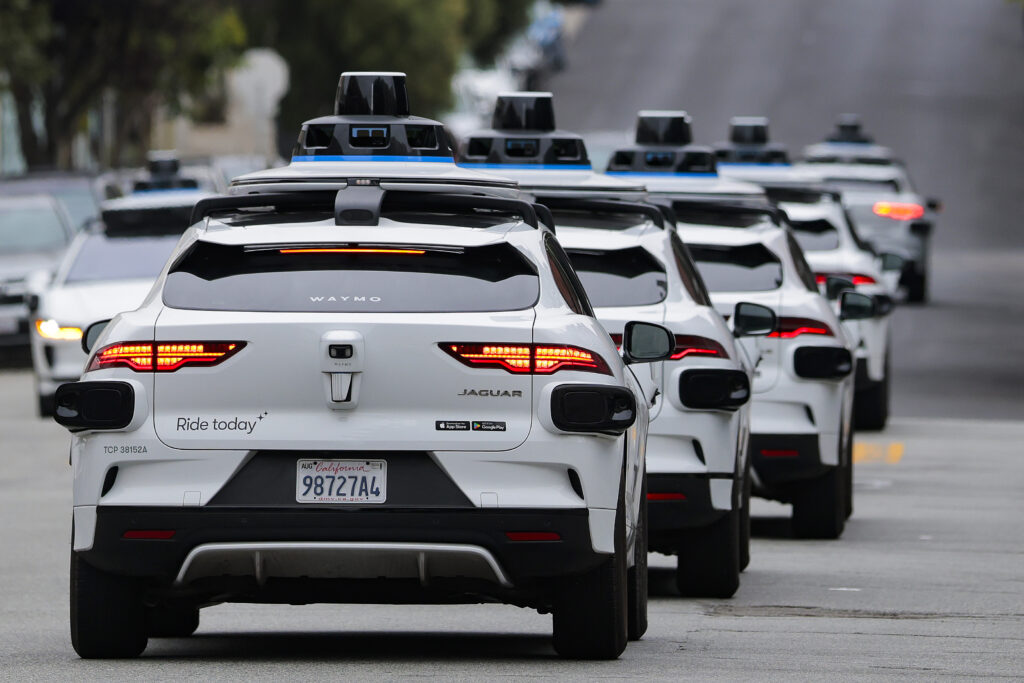
Would Jesus like Waymo? The Rev. A. Michael Charles Durant doesn’t think so.
“Jesus either walked or rode a beast,” Durant said in an interview at the Tenth Street Baptist Church in Washington, where he serves as pastor. “He would be opposed to technology that was opposed to people, and I believe that this is opposed to people.”
There are lots of challenges facing people in Washington: unemployment, high energy and housing prices, what some see as federal interference in local affairs. But at his church, where Durant hosted an association of local Baptist ministers on a recent afternoon, conversation often drifted to Waymo, the robotaxi company.
In recent months, Durant has joined local Baptist pastors and other top leaders in the National Baptist Convention — which bills itself as the largest Black religious organization in the United States — in opposing autonomous vehicles, including in the District, where the D.C. Council is weighing a bill that would legalize their commercial operation.
Although the pastors echo arguments from labor unions that autonomous vehicles will cut into the bottom lines of ride-share drivers, some of whom are congregants, their rationale centers on a more existential concern: that robotaxis threaten what it means to be human.
“God created us to be interdependent,” Durant said from his green-carpeted office. “The greatest danger is not that humans will be not needed, but that we create an environment where humans don’t need each other.”
Their opposition to autonomous vehicles comes as religious communities grapple with artificial intelligence and what the technology means for the human condition and all its messy beauty.
“Automation can dehumanize humanity. The Book of Genesis declares that God created man, and then he breathed into man’s nostrils, and man became a living soul,” said C.H. Johnson, the pastor at Christ Missionary Baptist Church in Maryland. “If we’re not careful, technology can rob us of our humanity, can rob God’s creation of our humanity.”
Noreen Herzfeld, a professor at St. John’s School of Theology and Seminary in Minnesota, who studies the intersection of religion and technology, said she hadn’t previously heard of religious communities specifically opposing autonomous vehicles. But she said many religious groups are worried about artificial intelligence.
“Religious communities are concerned about AI becoming a substitute for the relationships that matter, and that would be human-human relationships and human relationships with God,” she said.
In his first encyclical, published in May, Pope Leo XIV elevates the ethics of AI to a religious imperative. In “Magnifica Humanitas,” Leo argues that the unconstrained proliferation of AI may threaten humanity and foster inequity.
“In the era of artificial intelligence, when human dignity is threatened by new forms of dehumanization, ours is the pressing duty to remain profoundly human. We must lovingly safeguard the grandeur of humanity bestowed upon us and revealed in its fullness in Christ, the splendor of which no machine can ever replace,” Leo writes.
In response to a request for comment on the pastors’ opposition, a Waymo spokesperson pointed to rising road deaths in Washington and positioned its driverless vehicles as part of the solution. Waymo says that its vehicles are involved in dramatically fewer crashes with serious injuries compared to human drivers.
“We are also speaking with communities around the District to earn their trust and understand their challenges. Current options aren’t enough to meet the needs of women and people with vision impairment who report persistent safety concerns, nor do they address the needs of Washingtonians who struggle with transportation purely because of where they live or where they’re going,” the spokesperson said.
Braden Molhoek, director of the Center for Theology and the Natural Sciences at the Graduate Theological Union in California, said he could see a religious argument in favor of driverless vehicles because they may be safer than human drivers. “You could argue that, like a medical technology, this could potentially save lives,” he said, which could reduce suffering.
But that is only part of the picture, he said. Another cost of AI, as outlined in Leo’s encyclical, is job loss, Molhoek said. “That is a concern of religious leaders: What is the human cost?” he said.
Catholic social teaching draws a strong connection between the right to do meaningful work and human dignity, Molhoek said. “There is a fundamental right to be able to seek out fulfillment in the way that you go about your life on a daily basis,” he said.
In 2025, the venture capital firm Bond reported that Waymo had absorbed 27 percent of San Francisco’s ride-hailing market in 20 months.
Johnson said he’s worried the Uber and Lyft drivers in his church could face a similar fate.
“Big corporations come up with technology to rob them of those positions in the name of modernization,” he said. “We’re not against modernization, but I think it has to be ushered in in a way that does not rob mankind of its dignity.”
Although some pastors said that human interactions, even between ride-share drivers and their passengers, are important to preserve, some riders have also described negative interactions with their drivers.
Ride-share companies have faced rising scrutiny in court and from state leaders and U.S. lawmakers over sexual assaults during rides. An Uber spokesperson said it embeds safety practices in its systems and gives women riders and drivers the choice to ride with only other women. Waymo said most female customers it surveyed in 2025 say the service improved their sense of safety.
Meanwhile, some blind activists say ride-share drivers have turned them away because of their guide dogs, even though federal law and ride-hailing policies are supposed to prevent such refusals. Some said they haven’t had that experience with driverless cars.
Not all religious leaders oppose robotaxis. At an April event hosted by the Innovation Majority Institute think tank, the Rev. Thomas Bowen, from Shiloh Baptist Church in D.C., recalled when taxis drove right by him as a Black man in the District and New York years ago. He said he was excited when Uber and Lyft came on the scene but that he has faced similar issues with those services.
“Why should I have to put on a suit to get a taxi?” said Bowen, who is the general secretary of the Washington-based Progressive National Baptist Convention.
Bowen, who did not respond to a request for comment, said at the event he supported autonomous vehicles because he believes they will make transportation more equitable in D.C.
“I wish there were something that didn’t look and all of a sudden just pass me by. I think that became a prayer, and that led to Waymo,” he said.
For years, Alphabet-owned Waymo has lobbied the District to allow it to operate commercially in the city. The legislation would allow driverless vehicles to carry paying passengers in the city. In July, D.C. Council member Charles Allen (D-Ward 6), who introduced the bill, said the best-case scenario would be for commercial deployment to begin in 2028.
Meanwhile, Durant said he and other local Baptist pastors are lobbying council members to oppose the bill, though he declined to share whom he’s met with to discuss it.
For the National Baptist Convention’s annual gathering this week in Florida, Durant, chairman of the group’s board, prepared a video to screen in which he called on his fellow pastors to oppose autonomous vehicles in their communities around the U.S.
“This technology does not serve humanity but is trying to make humanity serve it,” he said in the video.
To explain his opposition, Durant cites the Bible story in which Jesus meets a Samaritan woman at a well. Jesus asks her for a drink of water. They chat, and the woman becomes a believer in him and what he teaches.
That encounter was one of Jesus’s “most effective evangelistic meetings,” Durant said in an interview, and it’s the kind of meeting that Durant worries driverless vehicles would make less frequent.
Evangelical faiths in particular tend to see every human encounter — even between a ride-share driver and their passenger — as a chance to proselytize, according to Herzfeld. But robotaxis take that chance away.
“They’re thinking that they’re losing an opportunity to make disciples,” Herzfeld said. “Waymo is taking away an opportunity for a relationship, no matter how short that relationship might be.”
Beyond evangelizing, Molhoek said a Christian perspective holds that every human interaction, even a car ride, can be an opportunity to show love to your neighbor, through little things like bonding over music.
“Lots of things can occur in those situations that make life a little more humane,” he said.
Boise Kimber, president of the National Baptist Convention, said his concern about driverless cars extends to broader worries about AI.
“I see AI becoming a handicap to humanity. It it does not allow us to practice real life,” he said.
But for now, he’s focusing his attention on robotaxis, in part because he sees driving as an inherently human act.
“Jesus walked on the dusty roads of Jerusalem,” he said. “I think he would say, ‘Let’s have a human being behind the wheel of an automobile.’”
The post Would Jesus like Waymo? Baptists have thoughts. appeared first on Washington Post.