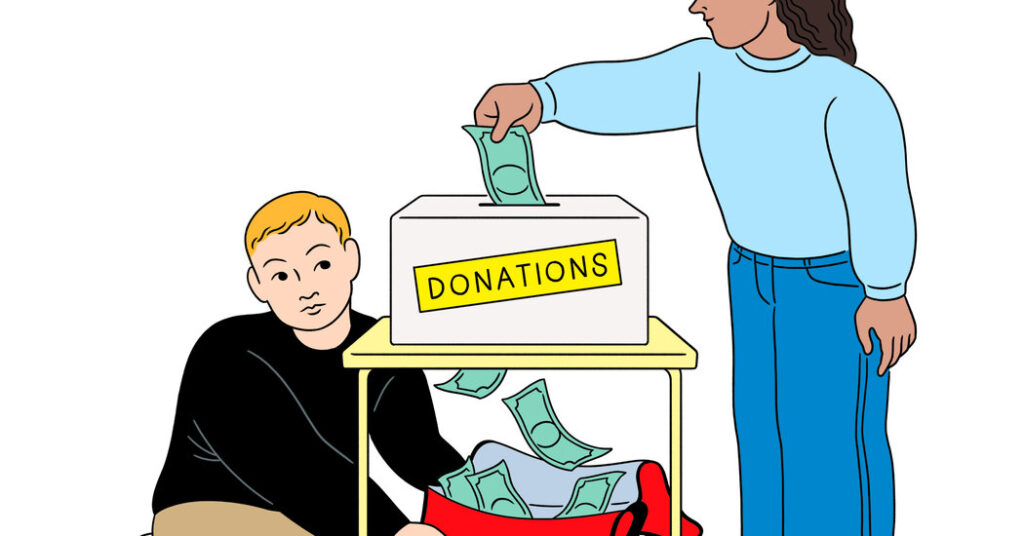
More than a year ago, a friend and I were part of a small organization at our college that occasionally hosted social events, including an annual gathering that was partly an excuse to throw a big party but was also held to raise money for charity. That year, we chose a charity that seemed particularly relevant in the current political climate and would directly help people in our local community.
Leading up to the event, we went all out. My friend took the lead on creating wonderful things for us to sell (in addition to regular donations), and we advertised heavily about the charity we were fund-raising for, which energized everyone to contribute more because of how relevant it felt. All in all, we raised more money than ever. Because we were a small volunteer group, though, we did not have a centralized bank account; we trusted my friend to donate the money after the fact.
He never did. It has now been more than a year, and both he and I and every other leader in that group have graduated and moved away. I did not want to press the issue while he was undergoing a big life shift, so I was willing to allow him to pocket the money temporarily with the promise of donating it later. I don’t think he has gotten a job yet, and I think he is extremely depressed, as he has been ghosting me for the last year.
I feel guilty for keeping this secret, and I don’t know what to do. On one hand, I am trying to show empathy for my friend, who is going through what seems like a very hard time. At the university, the institutional memory is short — most people who remembered the event will be gone soon, if they aren’t already. On the other hand, I feel that we misled everyone. I’m sure people still would have bought what we were selling, but I think the charity part increased sales and donations. The cause is as relevant as ever, and I think what we raised could still make an impact.
What do I owe my friend and what do I owe everyone who donated? Should I, being fortunate enough to have a well-paying job, suck it up and donate the amount myself? Should I let the friendship die, knowing that he essentially stole from a charitable cause? — Name Withheld
From the Ethicist:
Your compassion for your friend is admirable, but personal misery isn’t an excuse for robbing a charity. Nor should you continue to conceal his misconduct in order to preserve your friendship. This man hasn’t just failed to pay up; he has betrayed everyone who organized the event and trusted him to send the money on, and he has let down everyone who bought something or donated, as well as the cause you were all supporting. By the same token, when you say you were “willing to allow him to pocket the money temporarily,” you were implicating yourself in this violation of trust. It wasn’t your call to decide that the charity could be deprived of what it was owed, for however long. You’re entitled to be magnanimous and forgiving about money owed to you. You’re not entitled to be magnanimous and forgiving about money meant for a third party.
Tell your former organization what you know, and make sure that whoever runs it now understands it shouldn’t hold a charity event without a real bank account and real accountability. Write to your friend and tell him you expect him to make the donation immediately. If he can’t, he needs to tell you that. And if he keeps ghosting you, refusing to make this right or even to engage with you about it? Then he’s the one ending the friendship, not you.
You could go on to report what he did to the authorities, but as you appreciate, that’s a grave step. If you’re inclined to go that way, consult your group’s leaders and let them make that call, rather than deciding alone.
Finally, there’s your idea of covering the donation yourself. From what you say, it sounds as if you’re doing well enough, and the sum is small enough, that it wouldn’t be a very great burden. Given that you did keep this secret, wrongly condoning a year of nonpayment, I wouldn’t dismiss the idea. For one thing, it’s the only action you can take that’s guaranteed to cover the charity’s loss. If you do choose to do this, tell your friend what you did and why, and leave it to him whether he ever makes it right.
Readers Respond
The previous question was from a stepmother who wondered how to divide up her will. She wrote:
I married my husband more than 50 years ago, when his three children were young. … The children stayed with their mother until the youngest moved in with us at 12. Years later, the eldest, then a graduate student, lived with us for two years. We saw the middle child mostly at family gatherings. … My husband was devoted to family. … He spent much time with his oldest child’s children who lived nearby, and he visited his youngest child’s children, who lived in a neighboring town. But we rarely saw his middle son’s family. … When my husband died five years ago, I inherited the house and bank account. I also own a small condominium. His other substantial financial assets were divided equally among his three children. My will leaves the house to his youngest child, who hopes to live there, and the condo to his eldest and his spouse, who maintain it. The middle child believes both properties should be sold after my death and the proceeds divided equally among the three children. … Should I change my will and divide the property equally among my three stepchildren? — Name Withheld
In his response, the Ethicist noted:
He left the house to you. It’s yours. How your real estate was paid for makes no difference. If you came to think that your husband treated your middle stepchild badly, this judgment might affect how you choose to divide your own estate. To the extent that you had planned to leave him less simply because you thought he had failed in his filial duties, you could certainly recalibrate as you see fit. But you’re not obliged to set things right between the living and the dead. Your closest relationships appear to be with his siblings and their families, not with him and his. It’s entirely reasonable for your will to reflect that reality.
(Reread the full question and answer here.)
⬥
Leaving an unequal inheritance may create problems for your stepchildren’s sibling relationships. It further cements an outsider status. Consider being generous, and let everyone know that is your plan. Perhaps there is a way to reconcile with the middle child. The high road is seldom a bad choice. — Janet
⬥
You can’t right emotional wrongs with money, let alone other people’s. The middle child got an even split of the actual money. That was fair. Leaving your property to those you have a relationship with is also fair. — N.S.H.
⬥
When her husband died, his “substantial” assets were divided equally among his children. That’s that. Dad took care of his kids. He left his wife with the rest, and it is hers to do with as she wishes. She has absolutely no obligation to her stepchildren. — Robert
⬥
I don’t disagree with the counsel provided in the column, but one aspect of the situation seems missing: input from the other siblings. They might have useful things to contribute. — John
⬥
The letter writer has a unique opportunity to heal a deep wound. She did not cause it, and neither the middle child nor his wife sought her intervention, but she’s aware of it now and has the salve in her hands. This is a family she married into, and all the siblings are part of that family. What a powerful way to make a lasting change when she passes. It costs her nothing. — Sardalla
The post My Friend Pocketed the Money From Our Charity Event. What Should I Do? appeared first on New York Times.