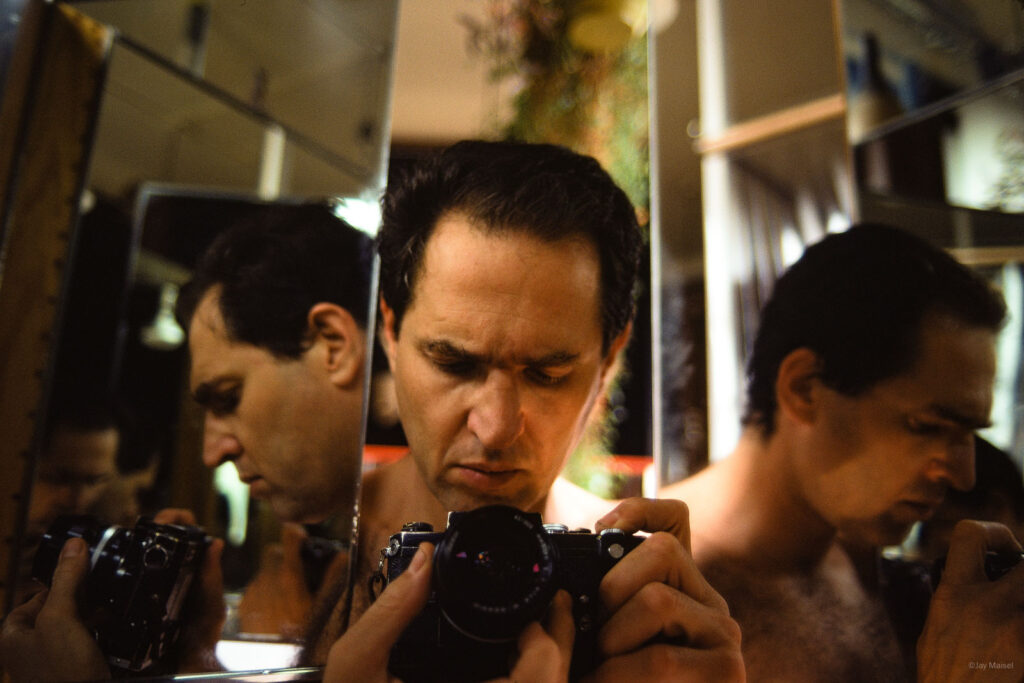
Always bring your camera, photographer Jay Maisel insisted, advising novice photographers and chiding friends who neglected to carry their Leica or Nikon to lunch. Also: Be patient. And don’t overthink it.
“If it moves you, shoot it,” he said. “If it’s fun, shoot it. If you’ve never seen it before, shoot it.”
Mr. Maisel, who died Aug. 20 at 95, was a master of color, light and gesture, a photographer whose wide-ranging portfolio included close-up portraits of Miles Davis and Marilyn Monroe; rugged landscapes shot in Baja California and Jackson, Wyoming; and intimate street scenes captured in Bucharest, Romania, Jerusalem and his hometown of New York, where he lived for nearly 50 years in a graffiti-covered bank building on the Bowery.
“Without a doubt, he was the most prolific photographer I know,” said fellow photographer Arthur Meyerson. “The quantity of images that he has in his archive — just unbelievable. You never saw the man without a camera.”
A Notable Life
This article is part of A Notable Life, an obituary feature telling the stories of remarkable people every Saturday. Read more from the series here:
Her work was key to a landmark experiment. She was credited in a footnote.
Sliman Mansour has died. His art became a symbol of Palestinian resilience.
Mr. Maisel was a giant of photography, a 6-foot-1, cigar-smoking Brooklyn native with a voice like Marlon Brando’s. He had a childlike curiosity, friends said, and while he could be gruff and profane — he used the f-word “as a noun, an adjective, a verb and a few other things that Mr. Webster might not have thought about,” as Meyerson put it — he was also a devoted teacher, advising hundreds of students on the art and business of photography.
“Jay saw things nobody else did,” said photographer Stephen Wilkes, who apprenticed under Mr. Maisel and later filmed him for a documentary.
“He could be in the middle of a conversation with you, and there’s something going on behind your head: the light starts moving, a shadow appears. You’d just lose him,” Wilkes said. “He was hypnotized by visual magic.”
One of Mr. Maisel’s favorite photographs captured the fleeting moment in which a young girl’s head was framed in a halo of light, reflecting off the wheel of a bicycle in New York. Another showed a bird and its reflection against the vibrant backdrop of a mosaic in Iran.
“My basic motivation is to say, ‘Hey, look! This is something I saw and I want to show it to you,’” he explained in one lecture. “I believe that the act of photographing sharpens the vision and gives it greater insight.”
Mr. Maisel launched his career in 1954, making a name for himself while documenting the flourishing jazz scene in New York clubs and concert halls. One of his photos of Davis, playing the trumpet at the Apollo Theater, was used for the cover of the bandleader’s 1959 masterpiece “Kind of Blue,” one of the most influential jazz albums ever recorded.
It was one of many album covers photographed by Mr. Maisel, who also took portraits of Dave Brubeck, Sarah Vaughan, Count Basie, Louis Armstrong and Duke Ellington, perched over the piano with a cigarette in hand.
“It was not only a golden age as far as the stars were concerned, it was a golden age for photographers,” Mr. Maisel recalled on his website. “A dumb kid like myself could pay admission and shoot whatever I wanted. There was no security, no managers, and no PR people, just the jazz people themselves and the music. With rare exceptions, no one ever objected. It was a picnic.”
Grieving a loved one? Tell us what made them special.
The Post is publishing reader-submitted obituaries as part of a weekly feature, What We Remember.
Mr. Maisel went on to bridge commercial and fine-art photography, publishing more than a dozen photography books and exhibiting his work in galleries and museums, all while shooting ad campaigns and magazine covers, including for New York magazine’s inaugural issue.
His commercial work went ahead despite the occasional mishap. Photographing Cheryl Tiegs in the water for a Sports Illustrated swimsuit issue, he accidentally stepped on a sea urchin while barefoot. He went down hard, carrying three of his cameras. “Fortunately,” he said, “I brought six with me.”
Earlier in his career, he was roughed up while shooting uptown in New York. Mr. Maisel resolved to better defend himself, according to his daughter, and became a black belt in karate, advancing to the finals of a martial arts tournament at Madison Square Garden in 1962. (At age 31, he was “the only player to wear glasses in the ring,” the New York Times reported, praising his “dazzling displays of lightning footwork.”)
While looking for a new apartment in 1966, Mr. Maisel discovered the Germania Bank Building, a six-story, 35,000-square-foot Renaissance Revival edifice in Lower Manhattan. He bought it for $102,000 (just over $1 million in today’s money), and continued to live there until it was sold to a developer for $55 million in 2015. New York magazine once described his purchase of the Bank, as the building became known, as “maybe the greatest real-estate coup of all time.”
Mr. Maisel and his family lived on the top floor, looking after their 72-room home while doing their best to fend off vandals and graffiti artists who believed the building was vacant. For a time, he offered space to other artists, becoming a landlord to Roy Lichtenstein and Adolph Gottlieb. Mainly he used the Bank for himself, turning it into a studio and storage space, home to photographs and odds and ends that would have outraged Marie Kondo.
An inveterate collector (or a hoarder, to skeptics), he filled filing cabinets, shelves and entire rooms with objects that he admired for their everyday beauty: shells, champagne corks, monkey wrenches, hunks of wood, animal skulls, mannequin hands, circuit boards, shoe lasts, sanding discs, rubber balls, brass pipes, polished doorknobs, metal letters, plastic floss picks. Some of the pieces were photographed; all were there because they caught his eye or captured his attention.
“I’m for clutter,” he proclaimed in Wilkes’s 2018 documentary “Jay Myself,” which followed Mr. Maisel as he packed up his belongings, sold the Bank and moved to Brooklyn. Before the move, he had been spending more than $300,000 a year on the building’s upkeep.
“It was like a cross-section of his own mind,” Wilkes said, looking back on Mr. Maisel’s time at the Bank. “What was really at the heart of it was the joy of seeing, the joy of looking, and the way he saw these objects. He would lay them out on each floor, and if you were curious, and if you looked, the more you looked the more you saw.”
‘Work could be joy’
A grandson of Jewish immigrants, Jay Nathan Maisel was born Jan. 18, 1931, and grew up in the working-class neighborhood of Bensonhurst. He liked to say that he was the only boy around who knew who Picasso was.
His father worked in the garment industry, and his mother looked after the home. They spoke Yiddish and sent Mr. Maisel to an all-boys yeshiva, a traditional Jewish educational institution. “He hated it,” said his daughter, Amanda Maisel. “He was thrilled when he got to go to a public high school. He always said, ‘It had art and it had girls, so it was a pleasure to go.’”
Mr. Maisel found a mentor in Leon Friend, his art teacher at Abraham Lincoln High School, whose earlier students included the photographer Irving Penn.
“He changed my life more than anyone I’ve known,” Mr. Maisel wrote, dedicating his 2014 book “Light, Gesture & Color” to Friend. “He opened my eyes. He made me understand that work could be joy.”
Mr. Maisel went on to study painting and design at the Cooper Union and at Yale, where he received a bachelor’s degree in 1953. He turned toward photography with encouragement from one of his Yale instructors, artist Josef Albers, who suggested Mr. Maisel might not have much of a future as a painter. Photography, Mr. Maisel decided, “just seemed like more fun.”
Through another teacher, architect Buckminster Fuller, Mr. Maisel got a Kine Exakta camera as a loan. Before long, he was photographing some of Fuller’s geodesic domes and selling pictures to magazines like Dance, which paid him $15 for his first cover.
Mr. Maisel’s marriages to Sarah Linder and Suzanne Housman ended in divorce. In 1989, he married Linda Adam, who goes by L.A., in a ceremony at the Bank. She survives him, along with their daughter Amanda, who grew up in the building.
It was “a bizarre, wonderful privilege,” Amanda Maisel said, aside from a few awkward adolescent years when she grew embarrassed by the family’s “creaky” home and her father’s tendency toward dumpster-diving.
Mr. Maisel had chronic lymphocytic leukemia. More recently, he was diagnosed with bladder and prostate cancer. He died at his home in Brooklyn, where he had unpacked part of his collection at his brick townhouse in Cobble Hill.
Arthritis made it difficult to hold a camera, his daughter said. But he still shot with an iPhone into his early 90s, and retained vivid memories of his decades on assignment.
“Best day I ever had was shooting Ravi Shankar,” the Indian sitar player, he told interviewer Dave Dye in 2018. “He asked what I wanted him to do. I said, ‘Play.’ He played for two or three hours. I shot to my tapping feets’ delight.”
The post Jay Maisel, a cigar-chomping giant of photography, has died appeared first on Washington Post.