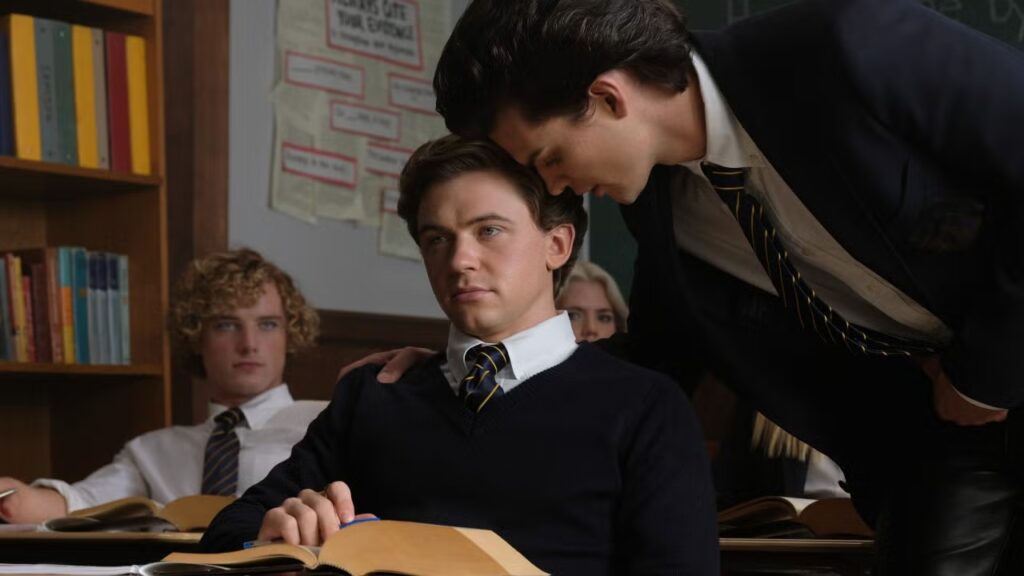
Note: This story contains spoilers from “The Shards” Episode 9.
“The Shards” TV adaptation was never going to end the same way as Bret Easton Ellis’ novel of the same name. That was true when Ellis was trying to develop the project for HBO back in 2023, and it’s true now that FX released the first season finale in what the show’s creators hope will be a multi-season hit.
“[Bret Easton Ellis] always wanted to tell it over multiple seasons and to expand out the time of it. And Ryan [Murphy] had the same instinct, which was we want to tell this over at least two seasons,” Brad Simpson, an executive producer on “The Shards” as well as a partner in the film studio Color Force, told TheWrap.
That longer plan meant that Murphy along with the series’ writers had to introduce new characters into Ellis’ sinister world of prep school murder, add in new storylines and agree on an ending point for Season 1 that would hook viewers for a potential Season 2. That plot point turned out to be Terry (Wes Bentley) being pushed from the top of a staircase, a bloody event that establishes a whodunit for future seasons as the serial killer known only as The Trawler remains at large.
“Terry getting pushed off the staircase, who pushed him off and how and why is a centerpiece of the book, but that seemed like a better finale for this season,” Simpson said. “Hopefully in finishing out the show, we will tell the rest of Bret’s story and maybe more.”
Though “The Shards” may look like another sexy teen drama, it’s more complicated and ambitious than other teen-focused show of its ilk. It’s also the first time Simpson and his Color Force partner Nina Jacobson have ever told an explicitly teenaged story.
“You really feel the lust of youth coursing through the book,” Jacobson, who is also an EP on “The Shards,” said. In the case of Bret’s character (played by Igby Rigney), that meant embodying both the reckless and sexy side of this spoiled California teen and the growing sense of dread he feels as The Trawler runs wild, the AIDS epidemic grows stronger and he has to hide his sexuality. “The parallels between The Trawler and AIDS, which steals people at a time of their life and youth, it just felt really critical to adapt the book to be able to keep the pulse of sexuality that runs through the book in the show.”
A sexy serial killer show as an AIDS allegory shouldn’t work as a show. But that’s par for the course for Jacobson and Simpson.
If you were to go by the conventional wisdom of the time, few of Jacobson and Simpson’s movies and shows “should have” worked. When Jacobson started championing Suzanne Collins’ “The Hunger Games,” no one believed that audiences would watch a female-led movie about children killing children. When the duo went to bat for the rights to Jeff Kinney’s “Diary of a Wimpy Kid” series, no one thought there was a theatrical market for middle school-aged kids. When they were pushing for Kevin Kwan’s “Crazy Rich Asians” to be the next blockbuster, no one believed that a movie with an all-Asian cast would be a massive hit or that the rom-com could be revived. After one pitch suggested whitewashing the female lead, Kwan actually optioned the rights to his book for only $1.
Yet every single one of these properties no one thought would work have gone on to become massive franchises. There have been five Hunger Games movies so far with “Sunrise on the Reaping” set to premiere on Nov. 20. Diary of a Wimpy Kid led to four live-action movies and four animated movies with the animated “Diary of a Wimpy Kid: The Getaway” targeted for a December release. As for “Crazy Rich Asians,” the Jon M. Chu-directed movie stands as the highest-grossing romantic comedy of the 2010s with a TV series in the works.
“In our history, a lot of the books we’ve adapted have been available books sitting on the shelf that weren’t part of a heated bidding war,” Simpson said.
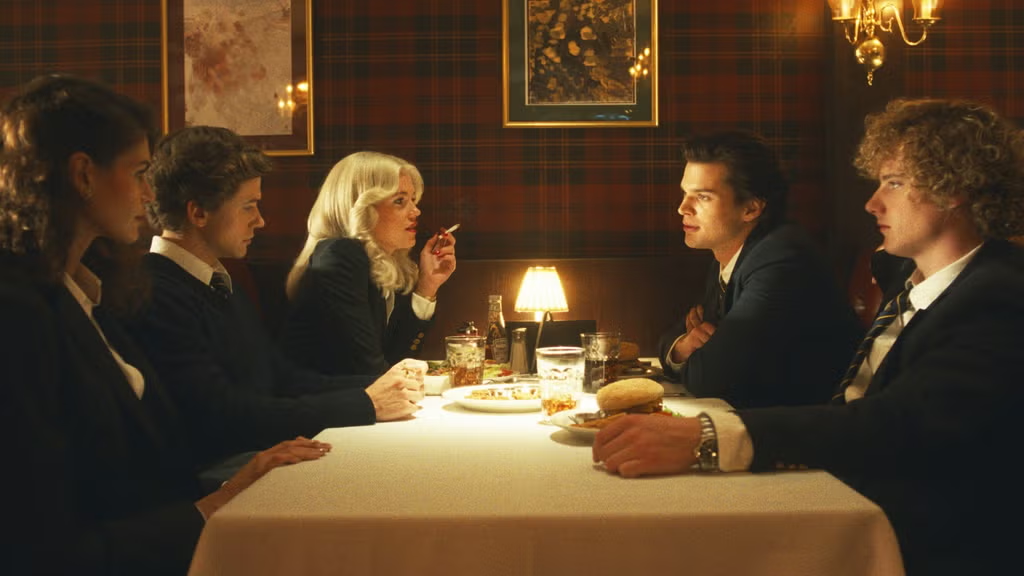
Jacobson described the projects she’s drawn to as “unputdownable,” whether the source material be a book, script or podcast. “It’s that moment when you settle in with something, and then all of a sudden that’s the only place you want to be,” she said. “We both read so much — for pleasure too, not just for work. We’re both very aggressive, hungry readers. So when you have that experience, it’s such a rarity, that kind of seduction. If we have it, then we try to have a conversation with ourselves of not ‘Why won’t it work,’ but ‘How could it work?’”
That conversation led to one of the most impactful shows of the modern era, “The People v. O. J. Simpson: American Crime Story.” When Jacobson and Simpson were looking to adapt Jeffrey Toobin’s “The Run of His Life: The People v. O. J. Simpson,” true crime was seen as a fad of the 1980s or a genre reserved for Lifetime. Not only that, but in the 2010s there was a belief that the O. J. Simpson case had been over-covered and that no one was interested in revisiting a case that happened 20 years ago.
“I remember when we announced that we were doing O. J. all the comments were like, ‘Oh my God, this again? Aren’t we tired of this?’ ” Simpson recalled.
But instead of merely rehashing the well-worn beats of the case, the first season of “American Crime Story” presented a retelling that forced audiences to grapple with how celebrity, race, class, law enforcement and gender clashed to make this trial one of the most consequential media moments in American history. It was a hit. Jacobson and Simpson’s first TV show created alongside Ryan Murphy, Brad Falchuk, Scott Alexander and Larry Karaszewski won nine Emmy Awards and two Golden Globe Awards while becoming one of the most discussed shows of 2016.
“When you have a communal event where you can eavesdrop on a couple of people in the grocery store line talking about a show or movie you’ve made, that’s always the goal,” Jacobson said.
That pursuit of a communal experience is why Color Force often pushes for a weekly release schedule for TV shows rather than a binge-watching model. But more than reviving the O. J. Simpson case, “American Crime Story,” which came out months after Netflix’s culturally-defining docuseries “Making a Murderer,” made the true crime genre hot again.
“Wine and crime is now a thing that people do weekly. They love to sit there with a big glass of Chardonnay and watch a crime show,” Simpson said. “It’s hard because when you’re doing true crime, you’re making entertainment out of what was real tragedy for somebody. You want to feel like there’s a reason for putting it on the air. Part of that is looking for the reason and making sure you have a crime that the audience is guilty of, that we all took part in. But at the same time, as with any TV show, you’re looking for a cacophony of great characters coming together.”
Finding that right balance of social commentary, perfect crime and audience damnation is why there have been so few seasons of “American Crime Story.” Season 2, which premiered in 2017, focused on Gianni Versace’s murder at the hands of Andrew Cunanan. That was followed in 2021 by “Impeachment,” a season that explored the Bill Clinton and Monica Lewinsky scandal. The exacting specifications of the show are also why two previously announced seasons — one about Hurricane Katrina and one about Studio 54 — were scrapped.
“We tend to feel like ‘Is it worthy of the time and space it occupies in the universe, our own and other people’s?’” Jacobson said. “We struggled with Katrina, as an example. We were going to do that, and then I just don’t think we nailed it. We chose it because it was very much about a crime America was guilty of, which is the thing we like to think about when we do ‘American Crime Story.’ But then we didn’t think that we honored it properly, so we euthanized it.”
That degree of care is also baked into the duo’s other two ongoing series set in the “American Horror Story” universe: “Love Story” and “American Sports Story.” Though “Love Story” hasn’t been officially renewed for a Season 2, the team has been having active discussions about how to follow it up.
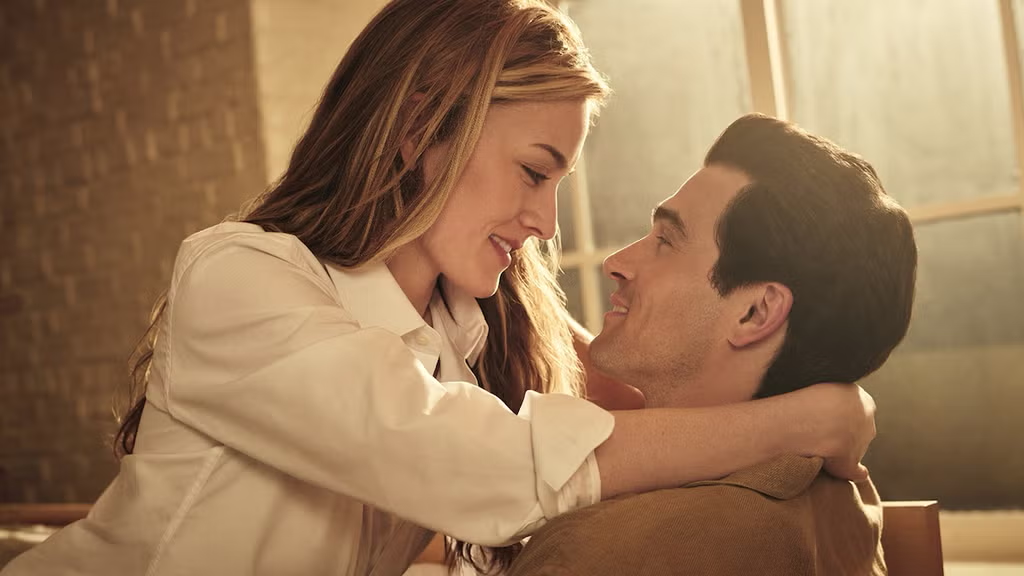
“It’s hard because we started off with one that hit many buttons,” Simpson said, referring to the whirlwind and heartbreaking romance between John F. Kennedy Jr. and Carolyn Bessette-Kennedy. He compared the series to the difference between the O. J. Simpson season of “American Crime Story” and the far more sincere, muted Versace season of the same show.
“We want to make sure we’re not just doing a carbon copy repeat of what we did last time,” Simpson said. “And, unfortunately, a lot of the great love stories are tied to musicians and music rights, so that can be difficult too.”
The future of “American Sports Story” is in a less certain place after the Aaron Hernandez season, a series that explored Hernandez’s sexual identity and history of addiction. Jacobson and Simpson are open to making another installment if the right sports-focused story comes along. But the two were surprised by fan response to the show, especially considering how many series they’ve made based on real life.
“People are really hard on [actors] trying to imitate athletes,” Jacobson said. “When you do past tense, like O. J., we knew that Cuba conjured the qualities of O. J. as opposed to looking just like O. J. But then there are people who, for a current athlete, people really want them to look like that athlete.”
But no matter what Jacobson and Simpson do next, you can expect it’s going to be unexpected.
“We’ve tried, over the years, to go by our own instincts of what we want to see,” Simpson said. “We’re also always are thinking to ourselves that if we find it a page turner that’s unputdownable, as Nina said, then maybe one of the writers or directors we want to work with will have the same experience.”
The post ‘The Shards’ EPs Break Down That Finale Cliffhanger and What Makes a Project ‘Unputdownable’ appeared first on TheWrap.


