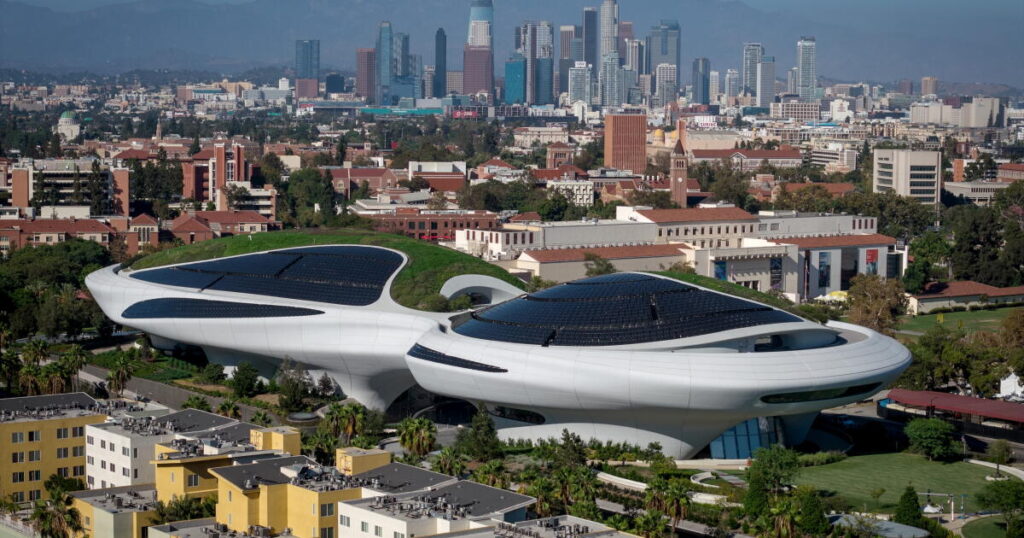
Los Angeles became home to the Lucas Museum of Narrative Art by promising George Lucas something that San Francisco and Chicago could not: that he could actually build it.
The promise came after years of rejected proposals and litigation frustrated Lucas’ efforts to create a museum for the art he and his wife, Mellody Hobson, had collected. The museum’s opening on Sept. 22 in Exposition Park will mark the culmination of Lucas’ long search for a viable site, and L.A.’s campaign to convince him the city would make way for it.
Michael Govan, Lucas Museum board member and chief executive of the Los Angeles County Museum of Art, said Lucas choosing L.A. boiled down to “audience and the location.”
“This is the final jewel in the crown of Exposition Park,” former Los Angeles Mayor Eric Garcetti said in a recent interview.
The museum’s origin story dates to the late 1990s, when Lucas’ production company Lucasfilm Ltd. entered into negotiations to redevelop the former Letterman Army Medical Center in the Presidio of San Francisco. Presidio officials asked Lucas if he would help build a museum as part of the development, but the Letterman Digital Arts Center (now known as One Letterman) opened in 2005 without one.
At the time, Lucas’ growing collection of what he calls narrative art was spread out in a number of locations, including in his home and at the Skywalker Ranch postproduction facility in Marin County. In 2010, Lucas formally proposed a museum on the former commissary site at San Francisco’s Crissy Field, but the Presidio Trust opened the location to competing proposals and ultimately rejected all three finalists. It offered Lucas a different parcel near the Letterman complex; he declined.
Garcetti was already courting Lucas and Hobson, and initially proposed that the museum replace the Los Angeles Memorial Sports Arena.
“Why not bring one of the most creative cultural institutions and what would become an icon to the most creative city in the world?” Garcetti said of the museum.
In June 2014, Lucas and Hobson instead selected Hobson’s hometown of Chicago, where then-Mayor Rahm Emanuel offered a 17-acre lakefront site south of Soldier Field. The advocacy group Friends of the Parks sued, arguing that public-trust parkland could not be turned over to a privately controlled museum. As the project stalled in litigation, San Francisco reemerged with a proposed site on Treasure Island.
Lucas abandoned Chicago in June 2016, his sights now firmly set on either Los Angeles or San Francisco. Architect Ma Yansong created separate designs for Exposition Park and Treasure Island.
Garcetti positioned Los Angeles as a can-do alternative to the bureaucracy and resistance Lucas had encountered elsewhere. He said San Francisco assembled political heavyweights to support its bid; he instead brought department heads to the table — “the people they’re actually going to work with.”
Garcetti’s promise of a smoother process was backed by close attention to detail and constant monitoring inside City Hall. Former Deputy Mayor of Economic Development William “Billy” Chun convened recurring meetings between the museum’s development team and senior officials from Building and Safety, Public Works, the Department of Water and Power and other agencies.
Chun said the city focused on getting the infrastructure for the project right “just to make sure that the city wasn’t going to be the obstacle or have any delays.”
Exposition Park also offered a fundamentally different setting from Chicago and San Francisco. Former Deputy Mayor of City Services Barbara Romero said the museum was compatible with Exposition Park’s existing cluster of museums and public recreational facilities, including the Natural History Museum, the California Science Center and the California African American Museum. It also counted Lucas’ alma mater, USC, among its neighbors. The interests of all these institutions had to be considered as the project moved forward.
“It was really one of those rare things, an empty canvas that we controlled with no community opposition,” Garcetti said of the Exposition Park site, adding that neighborhood groups, including the South Los Angeles Transit Empowerment Zone (SLATE-Z), embraced the project. After what Garcetti called the museum’s “two strikes” in San Francisco and Chicago, he said, “it was a relief to find a place that loved them.”
The Sports Arena was ultimately demolished for BMO Stadium, and the proposed museum site shifted to surface parking lots elsewhere in Exposition Park.
Lucas and Hobson officially selected Los Angeles in January 2017. The museum board said Exposition Park would allow the institution to “have the greatest impact on the broader community, fulfilling our goal of inspiring, engaging and educating a broad and diverse visitorship.” The board also cited Exposition Park’s accessibility and its established cultural community.
In June of that year, the Los Angeles City Council unanimously approved the project. The following month, the museum signed a lease for the land with the state at a rate of $30 annually for 99 years.
Additional land wrangling remained after the museum’s approval. Two city-owned parcels amounting to almost a half-acre of land were needed to build the museum. These parcels, which served as employee parking for the Department Recreation and Parks, were leased to the state for the project after the city was promised replacement parking and land elsewhere in Exposition Park, according to a 2020 report from the Board of Recreation and Park Commissioners.
In a 2017 interviewwith The Times, Hobson said USC’s students and the neighboring museums were central to the couple’s decision to come to L.A. Young people often asked Lucas where his ideas came from, she said. At Exposition Park, he could direct them to the Science Center or Natural History Museum for inspiration. The museum’s website also says that 500 public and private K–12 schools and higher-education institutions are located within five miles of the institution.
Lucas Museum Chief Executive Tracey Bates sees another fit between the institution and its adopted city.
“Los Angeles was the right place for this for so many reasons,” she said. “It is the home of storytelling — or one of the homes of storytelling — and certainly a home of creatives.”
Los Angeles may have promised a smoother path, but it was still not a quick one. “I’m used to doing the impossible,” Lucassaid in remarks at the museum’s press briefing earlier this month. “This one almost broke my will.”
When the L.A. City Council approved the museum in 2017, it was expected to open in 2021. Construction began in March 2018, and Chun described the project as “a well-oiled machine” until the pandemic disrupted work and pushed the anticipated opening to 2023. According to Bates, supply-chain problems contributed to ongoing postponements — first to 2025 and then to 2026.
Organizational upheaval unfolded during the long gestation. The museum’s Director and Chief Executive Sandra Jackson-Dumont stepped down in early 2025 after the museum’s board decided to divide her responsibilities between two positions.
Months later, the museum laid off 15 full-time employees — 14% of its staff — and seven part-time, on-call workers, many associated with education and public programming. A museum representative told The Times that the cuts reflected “a necessary shift of the institution’s focus” to ensure a 2026 opening.
Bates said an announcement about educational programming is expected later this year and that the museum plans to seek a new leader for the department after the departure of Regan Pro, the deputy director of public programs and social impact, who was part of the 2025 layoffs.
The delays had an unexpected silver lining, though, according to Lucas Museum board member and recently retired longtime director of the Norman Rockwell Museum Laurie Norton Moffatt: The time spent building the museum resulted in a collection that “grew and evolved,” she said, now numbering 40,000 pieces.
The post How the Lucas Museum’s epic battle for a home ended in L.A. appeared first on Los Angeles Times.