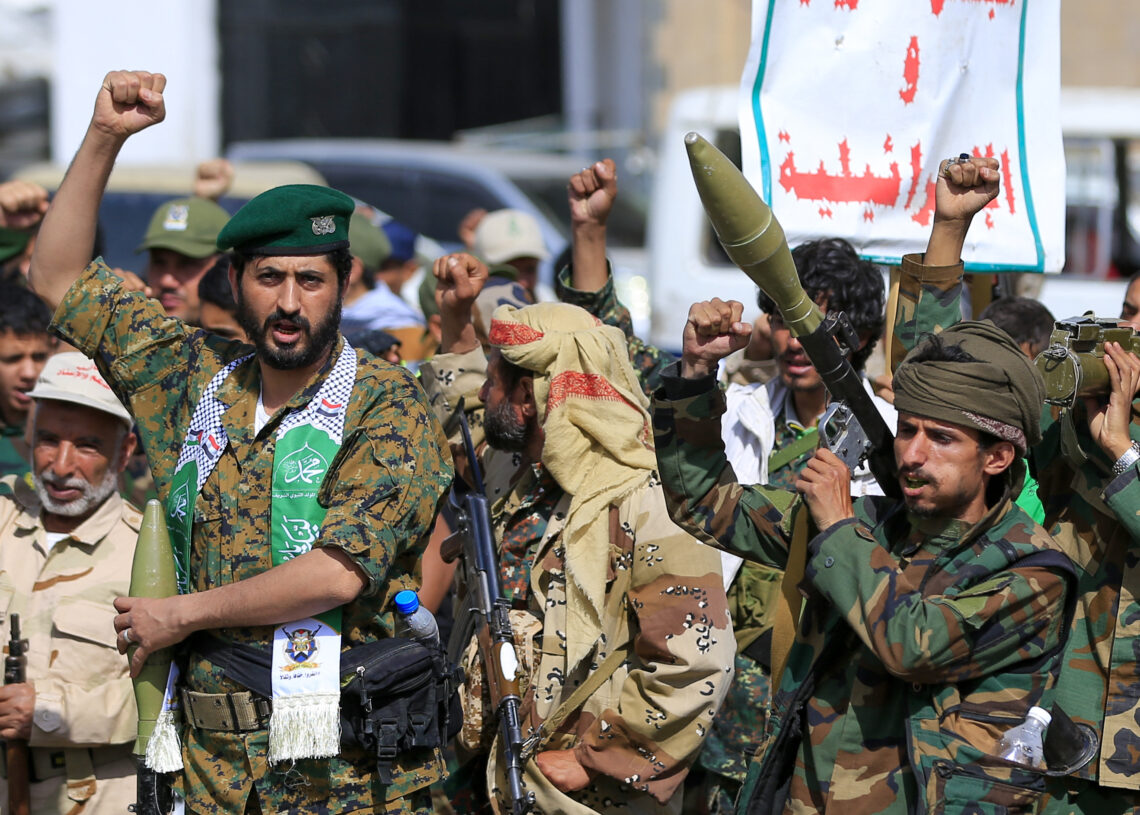
Fierce fighting was reported on Thursday along Yemen’s Red Sea coast as Iranian-backed Houthi fighters pushed to seize control over the Bab al-Mandab Strait — a key alternative to the Strait of Hormuz for Saudi Arabia’s oil exports.
The Houthi advance represents a potentially serious setback for the Trump administration in its ongoing war with Iran and for Saudi Arabia, which has used the Red Sea to avoid the Persian Gulf, which is largely blocked.
Cargo traffic in the Bab al-Mandab Strait had already slowed significantly after the Houthis declared a naval blockade against Saudi Arabia in July.
But on Thursday, regional media reported that the Houthis had reached the strategic port of Mocha, a city that had long been held by Yemen’s Saudi-backed military.
The prospect of a full closure of the Bab al-Mandab Strait sent global oil prices to more than $102 per barrel.
Control of the strait would help the Houthis in their long fight against the Yemeni government, but it would also give Iran added leverage in its standoff with President Donald Trump’s administration.
“They are consolidating control of the Red Sea,” said Adam Baron, a fellow with the Future Security Program at New America, a Washington think tank, who studies the Houthis. “This has implications for the Houthis as the Houthis, but also as a member of Iran’s axis of resistance. … It means that an Iranian ally could take control of a crucial maritime choke point at a moment that Iran is looking for any leverage it can get over the U.S.”
The Houthis on Tuesday also struck oil and civilian infrastructure at multiple locations in Saudi Arabia, and authorities said 73 people were injured in four southwestern cities. The Houthis said that those strikes were in response to Saudi Arabia’s bombing attack on a prison in which 11 people were killed.
Yemen’s Saudi-backed government launched a counteroffensive, including rocket and drone strikes against Houthi positions in multiple provinces.
Yemen’s deputy defense minister, Samir Al-Sabri, said on state television that the government forces aim to “retake Sanaa,” the capital, which has been under Houthi control for more than a decade.
So far, Baron said, the government’s counteroffensive seems to have done little to slow the Houthis’ move toward positions on the Red Sea.
After the United States and Israel started bombing Iran on Feb. 28, the Houthis spent months on the sidelines. But in July, they declared the blockade, and maritime trackers have reported a steep drop in cargo traffic since then.
Baron called fighting to take Mocha “the most significant offensive” that the city has faced for years.
“There has been huge progress,” said Hussain al-Bukhaiti, a pro-Houthi commentator whose brother is a senior political officer in the group. “The west coast of Yemen is just the beginning. We want the liberation of the country.”
Al-Bukhaiti said that the group is not being directed by Iran but that its goals, as always, include free movement at Yemen’s ports and airports, the exchange of all prisoners of war and the use of Yemen’s oil revenue — much of which is under Saudi control — to pay salaries for civil servants and for services across the country.
From 2015 to 2022, Yemen’s Houthi rebels and Saudi Arabia fought a war that brought Yemen to the brink of famine and contributed to the deaths of hundreds of thousands of people, according to findings by the U.N. Development Program. The war ended with a fragile truce in 2022.
The truce left Houthis in control of northern Yemen, including Sanaa, while the internationally recognized government backed by Saudi Arabia controls the south.
The U.S. Embassy in Yemen said in a statement Wednesday that the Houthis “have brought Yemenis nothing but suffering and have made their country a base for the Iranians to undermine Arab unity and security.”
Houthis and their Iranian backers, the statement said, have “miscalculated by underestimating the resolve of the Republic of Yemen’s legitimate government, the Yemeni Armed Forces, and the Yemeni people.”
The post Oil prices surge as Iranian-backed rebels fight to control Hormuz alternative appeared first on Washington Post.