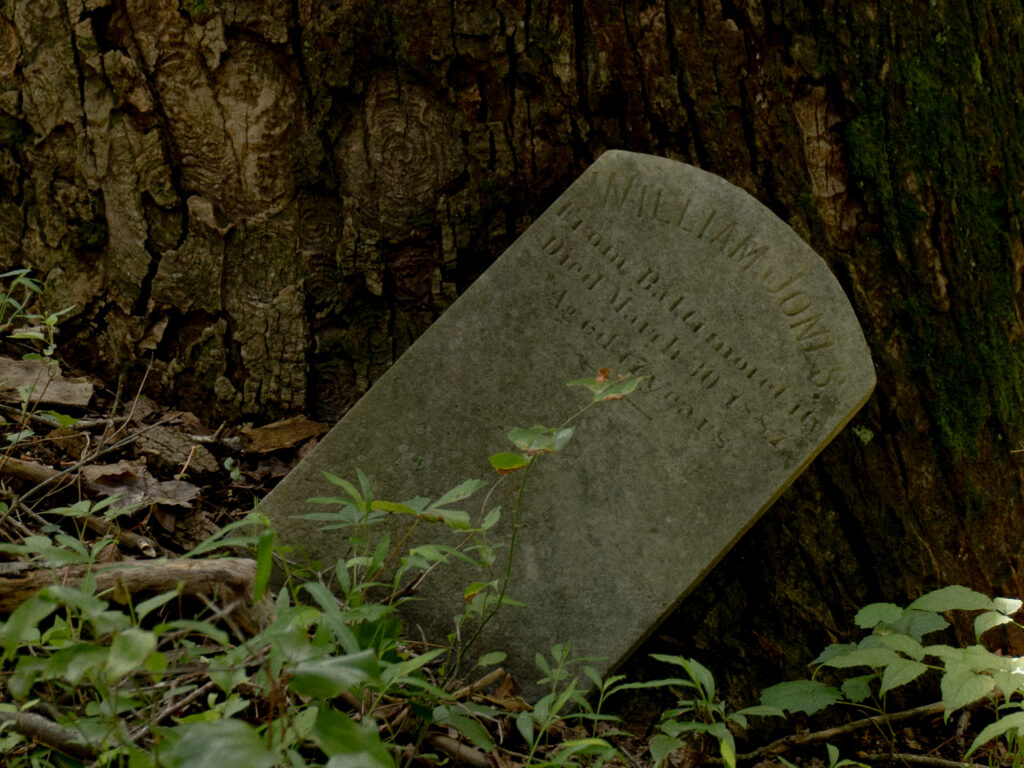
At least 40 burial sites across the United States hold more than 1,000 graves of children who died in state custody and were buried by government officials, often in unmarked or unkept plots, a new study has found — suggesting the deadly toll of America’s first youth prisons is more widespread than previously known.
The study, produced by the Forgotten Children Initiative at Georgetown University, was released Thursday at a forum that assembled legal and policy advocates, community organizers and family members of some of the children who are buried in those abandoned cemeteries.
“What happens when we go looking for children whom history has left behind?” Marc Schindler, the report’s author and a youth legal advocate, said at the forum. “That question is where the Forgotten Children Initiative began.”
When he first conceived of the Initiative earlier this year, Schindler said he knew of at least three states where children had died in state custody and were buried in secret graves — their lives lost to history and their fates lost even to their families.
They were the Dozier School for Boys in Florida, the New York House of Refuge for Women in New York and the House of Reformation and Instruction for Colored Children in Maryland. “Are there more?” Schindler wondered at the time.
“Now we know,” he said this week. A lot more. And we’re not done.”
The 40 burial sites identified so far are connected to facilities in 29 states, the study found, and contain the remains of children who the report says died or were killed in state custody between the early 1800s and the 1950s. The report, which Schindler described as a “conservative” estimate, is the first known comprehensive accounting of these cemeteries.
“At the beginning, this was about trying to find the burial sites and the cemeteries. Then it really became about finding the children. Then it became about finding the families,” Schindler said. “We are investigating whether this is a national tragedy, which I think this report confirms.”
Early research suggests that the children who died in state custody were likely poor and disproportionately Black. The 1,000 figure estimate does not include children who died in state custody but were returned to their families for burial.
The prisons housed boys and girls. Some were integrated, and some were segregated. Many were founded on the idea that children should not be imprisoned with adults but still needed discipline, reform and punishment.
Still, early research shows that many of the children who were sent to the facilities committed no serious crimes, but were incarcerated for being “incorrigible.” The Initiative is still working to determine the cause of death for the children; records suggest many died of diseases like tuberculosis or influenza, but Schindler said those assertions merit skepticism.
The largest burial site discovered so far is located in Maryland, where hundreds of Black boys died and are interred in an overgrown, abandoned cemetery, most in graves without names and marked only by cinder blocks.
The existence of the House of Reformation burial site was publicly revealed in July 2025, after Vincent Schiraldi and Schindler — then the secretary and deputy secretary of the Maryland Department of Juvenile Services — rediscovered it with the help of a longtime state employee. Archival records showed that modern state officials had known about the existence of cemetery for decades, but had done nothing to restore it or memorialize the children.
A subsequent Washington Postinvestigation found that at least 230 children died at the House of Reformation between 1870 and 1939 and are likely buried in those grave sites.
Members of the state’s legislative Black Caucus visited the site last August, and its members later championed a law signed by Maryland Gov. Wes Moore (D) that allocated $1 million to create a commission to investigate the deaths and restore the cemetery, which met for the first time in August.
Three family members of the boys who died at the House of Reformation are serving on the commission: Phyllis Hammond, representing her uncle Amos Hammond, Dorothy Givens, on behalf of her uncle Fred Ames Jr., and Linda F. Gorham, in memory of her cousin Richard Saunders.
At Thursday’s forum, family members of boys who died at the House of Reformation pledged to give them the dignity they did not receive upon their death.
“It’s up to each generation to do what can be done, what is possible. Because we are imperfect, we’re never going to get it right, but we can make it better,” said Givens, who is in her 80s and grew up hearing stories of her uncle. “For as long as I’m breathing, I’m going to try to leave things in a better place.”
Schindler said he hopes the new report will prompt action in the communities where burial sites have been identified.
“People have an absolute right to know what happened to their family members, particularly when it was the state that had custody of these children,” Schindler said. “It’s not just about history. The past is not just the past.”
Schindler said the Initiative has already made contact with people in Connecticut and Missouri who are beginning to work on researching the history of the facilities, unearthing death certificates of the children who died there, and hopefully locating the children’s living relatives.
One of those people is Rebba Omer, who works for the Georgetown School of Law and began researching whether there were burial sites in her home state of Missouri. She quickly identified a site 25 minutes from her home in Jefferson City, the Missouri State Training School for Boys.
The Initiative has since learned that at least 51 children are buried on the site, which now operates as a state prison for adults. Omer said she and her husband — both lawyers who represent and advocate for young people in the juvenile justice system — have taken on this research in a volunteer capacity because it feels “deeply personal.”
“The juvenile justice system is all about holding children accountable,” Omer said. “But the adults, even if we weren’t there in the past making these decisions, we’ve inherited this history. … It’s our ground, and we need to make sure the children who are buried there are honored.”
The post At least 1,000 ‘forgotten children’ who died in state custody are buried across U.S., study finds appeared first on Washington Post.