Rowena He is a research fellow at the Hoover Institution and author of “Tiananmen Exiles: Voices of the Struggle for Democracy in China.”
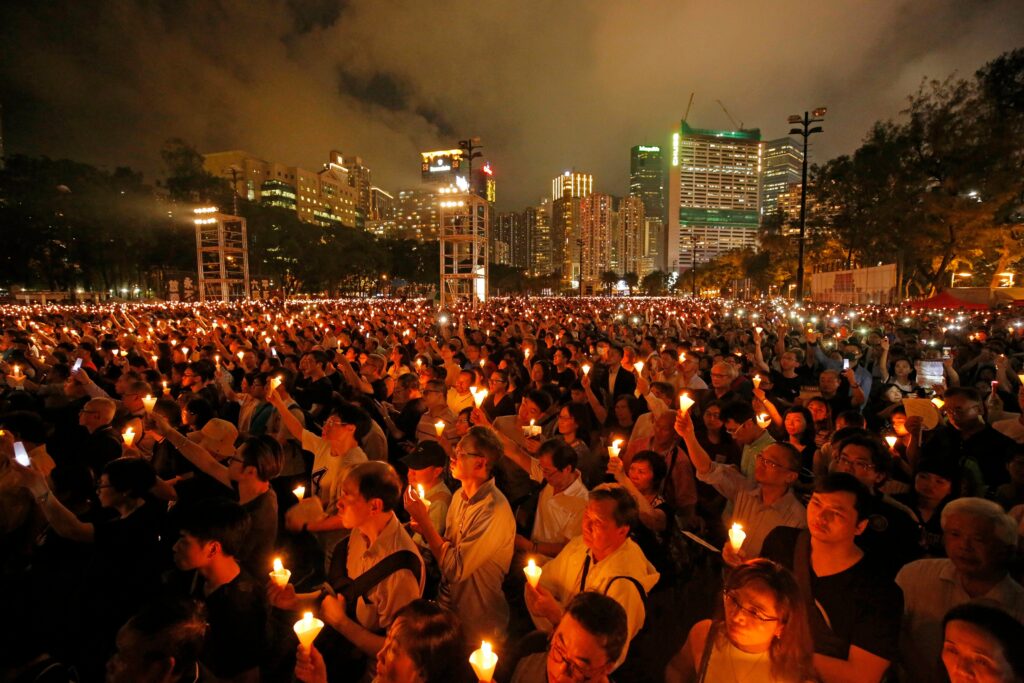
For years, in my classroom at Harvard, I showed my students footage of the Victoria Park candlelight vigil in Hong Kong. They watched in awe as a sea of light filled six soccer fields — an annual commemoration of the Tiananmen massacre and a symbol of the freedoms that made Hong Kong a global financial hub. Today, Victoria Park is in darkness. This Friday, the leaders of the Hong Kong Alliance who organized those vigils — Lee Cheuk-yan, Chow Hang-tung and Albert Ho — will be sentenced for incitement to subversion. Ho pleaded guilty in January.
On Aug. 21, the day of the verdict against Lee and Chow, I waited as if it were my own trial. The ending was not unexpected. Yet I was still hoping for a different one — just as on the night of June 4, 1989, I hoped an adult would tell me the slaughter of my peers was merely a story “fabricated by anti-China foreign forces,” as the official news claimed. Instead, the next morning, my father — who had quit smoking a decade earlier — picked up cigarettes again. He burned his writings and urged me to burn my diaries.
Now, as a scholar of Tiananmen banned from returning to my position teaching history at the Chinese University of Hong Kong, I know my teenage fear was not imagined. In spring 1989, millions of Chinese took to the streets calling for political reforms. The nationwide demonstrations, highlighted with college students’ hunger strike in Tiananmen Square, ended on June 4 with the People’s Liberation Army firing on unarmed civilians throughout central Beijing.
“All guilty!” “Five minutes!” Text messages on Aug. 21 brought me back from the past. They were sent by students and friends, many of whom had recently abandoned their middle-class lives in Hong Kong as freedoms deteriorated under Beijing’s 2020 national security law. Encrypted messaging had become the only space to share thoughts and feelings.
Three judges ruled that the alliance leaders were guilty of inciting subversion, a charge carrying a sentence of up to 10 years in prison. The conviction rests on a slogan used in Victoria Park for three decades: “End one-party dictatorship.”
The judges equated “end one-party dictatorship” with calling for the overthrow of the Chinese Communist Party leadership. History tells a different story. In the late 1980s, Nationalist Party Chairman Chiang Ching-kuo dismantled his party’s monopoly on power in Taiwan. He lifted martial law, ended bans on opposition parties and newspapers, and set Taiwan on its democratic path. Yet the Nationalist Party was not overthrown — it remained in government and continues to participate in Taiwan’s democracy today. Ending one-party rule does not necessarily mean revolution. It can mean reform.
The idea of ending one-party dictatorship to build a democratic China was Mao Zedong’s promise during the civil war — his rallying cry against the Nationalist Party. China’s constitution doesn’t describe its political system as “one-party dictatorship” — instead defining it as a “people’s democratic dictatorship” featuring “multi-party cooperation” under CCP leadership.
Hong Kong Chief Executive John Lee endorsed the conviction within hours, claiming the alliance had long planted “seeds of hatred” and stirred public resentment against the CCP. Yet the alliance’s call for constitutional change demonstrated a belief that the CCP could reform itself. The judges, by contrast, ruled that ending one-party dictatorship could be achieved only through overthrowing the party. The verdict — and the Hong Kong government’s embrace of it — revealed a lack of faith in the party’s ability to improve.
If anything planted hatred and stirred resentment, it was deploying more than 200,000 soldiers with tanks and machine guns against unarmed civilians. The regime lost its legitimacy on June 4, 1989. If it is ever overthrown, it will be because the people could no longer endure tyranny — as demonstrated in the anger and despair of the white paper movement, when a younger generation held up blank sheets in public, defying the official memory imposed on them about their own experience of covid-19 lockdowns.
Following the Tiananmen crackdown, a patriotic education campaign was launched in the early 1990s, imposing official narratives through state-controlled education and media. Decades later, a court in Hong Kong — once the only place on Chinese soil where people could openly remember — prohibited Chow from using the phrase “Tiananmen massacre” in her defense.
The June 4 Museum, run by the alliance and forced to close amid government pressure in 2021, preserved physical evidence that challenged the state-imposed history. When I brought my classes to the museum, students were often struck by a red helmet with a visible bullet hole that had belonged to Wang Nan, a 19-year-old high school student. His cremation certificate stated only that he had “died outside.”
Last week another injustice occurred: Joshua Wong, the young democracy leader who is already serving a prison sentence, pleaded guilty in a separate national security case. In 2012, Wong — then 16 — led resistance against Beijing’s attempt to impose Chinese nationalist education in schools. With media tycoon and activist Jimmy Lai sentenced to 20 years in February, the alliance leaders convicted in August and Wong now awaiting sentencing, the CCP is crushing three generations of Hong Kong’s democracy fighters within a matter of months.
As I await the sentencing of the alliance’s leaders, I am preparing to teach my Tiananmen course again, this time at Stanford University. This will be my first class since my exile in 2023. It has been a lonely journey of memory as resistance, but because of the candlelight vigils in Victoria Park held by Hong Kongers for three decades, I know I am not alone.
History will one day declare Jimmy Lai, Lee Cheuk-yan, Albert Ho, Chow Hang-tung and Joshua Wong not guilty.
The post This slogan infuriates Beijing. Judges have turned it into a crime. appeared first on Washington Post.