Election polls can be fascinating, exciting, confusing and overwhelming. To help readers learn the most from election polls — and avoid getting misled — here are seven simple tips for following midterm election polls.
Want this in your inbox?
Sign up for The Pollwatcher newsletter here.
1. Double the margin of error when sizing up a candidate’s lead
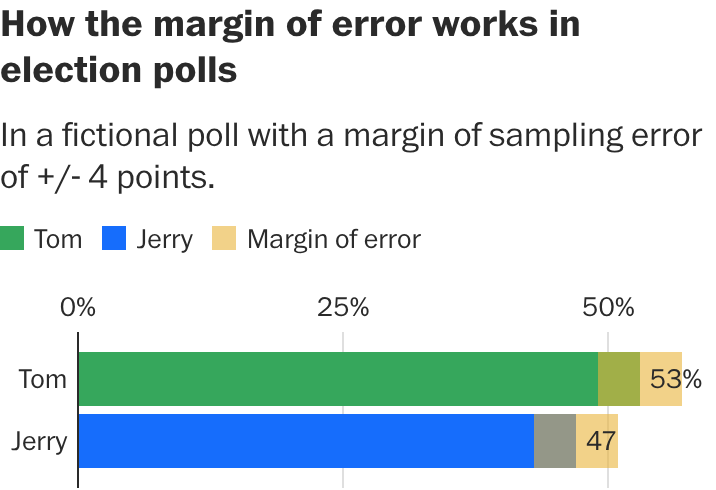
Take a hypothetical poll showing Tom leading Jerry by 53 percent to 47 percent, with a four percentage-point margin of sampling error. Tom leads Jerry by six percentage points — larger than margin of error — but the error margin applies to each candidate’s support, not the gap between their percentages. Tom’s support could range from 49 percent to 57 percent given the error margin, while Jerry’s support could range from 43 percent to 51 percent, ranges that overlap in the chart.
A handy shortcut: Double the margin of error when considering whether a lead is statistically significant. That’s essentially the size of lead that is significant under formal tests in a competitive election with two candidates. You can run that test yourself with this calculator.
2. The average error for Senate and gubernatorial polls is 5.4 percentage points
That statistic is from a Silver Bulletin analysis of polls conducted within 21 days of Senate and gubernatorial elections since 1998, comparing polls’ estimate of the vote margin and the actual election margin. Keep this in mind when you see a candidate leading by five points or less in a poll — it would only take a normal polling error for them to lose.
3. Use aggregators to put new polls into context
See an interesting or surprising result from a new election poll? Check a poll aggregator to see if other polls show similar results. The New York Times, FiftyPlusOne and RealClearPolitics track polls in the vast majority of competitive races. Look for whether there’s been a lot of recent polls in the race — or just a couple — and whether they show consistent results.
While aggregators list polls of widely varying quality, a fake polling episode last month showed poll aggregators vet some aspects of surveys to ensure they are legitimate. None of the three websites included the fake Median Strategies poll in their listings.
4. Ignore polls that don’t include basic details
Legitimate polls don’t have anything to hide. They will report the polling firms and sponsors involved, survey dates, how the sample was drawn, the number of interviews and how they were conducted, how the data were weighted, as well as the exact wording and order of questions. If you can’t find these basics, the poll isn’t worth your time.
5. Don’t ignore the horse race. Look at what’s driving it.
Understanding why people support different candidates is just about the most important aspect of public opinion, and digging into horse race results is one of the best ways to do this.
Look for a poll’s “crosstabs” to see how support for different candidates breaks down across a variety of groups. For example, the crosstabs from a July Washington Post-Ipsos national poll showed more than 90 percent of Democrats and Republicans supported their party’s candidate for Congress, while independents favored Democrats by 47 percent to 35 percent.
6. Winning the national popular vote isn’t enough for Democrats
Polls show Democrats lead in support for Congress nationwide, but control of Congress is determined by results in 435 districts, and Republican redistricting efforts have given the party an advantage this year.
The Silver Bulletin election model estimates that Democrats need to win the national vote by three to four percentage points to be favored to win the House. Similarly, the University of Virginia’s Center for Politics found that the median House district voted about 3.5 points to the right of the nation in the 2024 presidential election.
7. Polls are different from forecasts and prediction markets
It can be easy to confuse polls with other pre-election data. An election poll measures the percentage of voters who support each candidate at a certain point in time — it doesn’t predict a candidate’s chance of winning.
Election forecasts combine polls, historical election results and other data to estimate the probability of an election outcome, often as a 0-to-100 probability. Prediction markets allow people to bet on the outcome of an election and use those wagers to calculate a probability of the outcome, hoping to leverage the “wisdom of the crowds.”
Worth your attention
School satisfaction hits record low — Gallup finds 32 percent of Americans are satisfied with the quality of education students receive in grade schools, down from 39 percent last year and a recent peak of 51 percent in 2019. About 2 in 3 parents (66 percent) are satisfied with their children’s education, but that is also down from 74 percent last year and 82 percent in 2019. People give schools the best grades for helping students adapt to new technologies but give them lower marks for preparing students for the current world of work and to “think critically and solve problems.”
9/11 importance and memories — An Ipsos poll asking Americans to name the “most important historical events in your lifetime” found 47 percent cited the Sept. 11, 2001, terrorist attacks, more than any other event; the covid-19 pandemic ranked second at 31 percent.
Separately, a Pew Research Center poll found 83 percent of Americans who were born before 2001 remember “exactly where they were or what they were doing” when they learned about the 9/11 attacks. That rises to 93 percent of people who were at least 10 years old when the attacks happened.
What do you want to know?
Send your questions, comments and ideas to [email protected].
The post Seven simple tips to understand midterm election polls appeared first on Washington Post.