I spent a week in Provo, Utah, this summer attending the preliminary hearing of Tyler Robinson, the man accused of killing the 31-year-old conservative youth activist Charlie Kirk a year ago Thursday. I was struck to learn that many of the people who had camped outside the courthouse in hopes of grabbing a seat inside had known almost nothing about Mr. Kirk before he died.
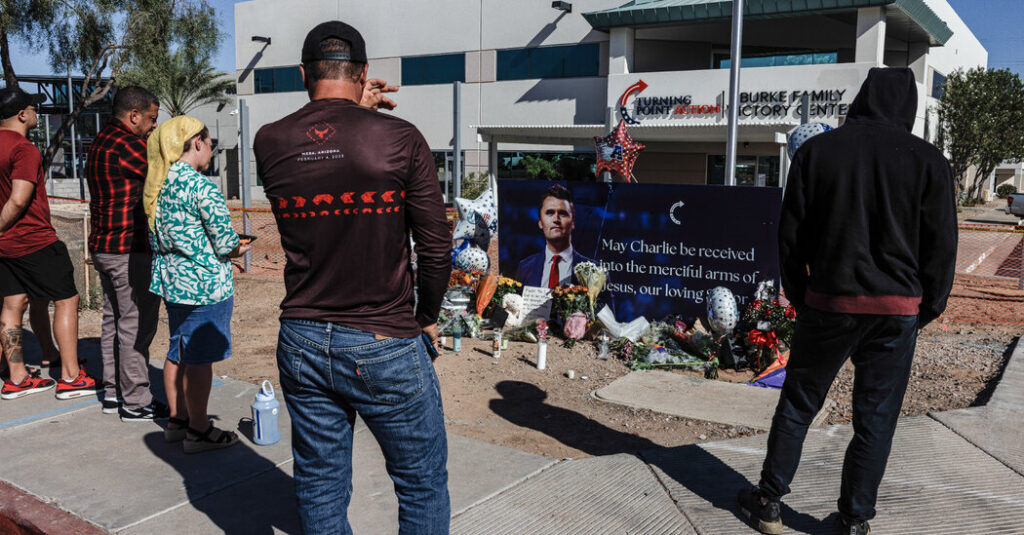
Since his death, however, they have come to regard him in intensely personal terms. They see him as a spiritual leader, a political martyr, an erstwhile son — someone they did not know they had until he was taken away. They and others can now see his image on billboards, on posters affixed to the office walls of Republican members of Congress and in televised political campaign ads. His conservative youth organization, Turning Point USA, continues to disseminate content of its fallen leader, and to stream “The Charlie Kirk Show” daily in his absence.
Many who did know Mr. Kirk have also come to view him in larger-than-life terms. They have often expressed to me that things started coming unglued in the fractious conservative movement after his death. For them, “Charlie would have prevented all this from happening” is axiomatic.
Their sentiment is understandable. Mr. Kirk was widely seen in the political world as a generational talent. Even the macabre dissections of his death from an assassin’s bullet on a Utah college campus amount to a recognition of his reach, the extent of which was perhaps not fully appreciated while he was alive.
In addition to building from scratch the most formidable youth-oriented political operation in the country, Mr. Kirk was a prolific fund-raiser and grass roots organizer. President Trump credited him as one of the handful of allies most responsible for his victory in 2024. He was also one of the president’s closest advisers.
True, not everyone who acknowledged Mr. Kirk’s talents admired him. Some conservatives found his Christian nationalism and his unwavering fidelity to Mr. Trump off-putting. Those further to his right viewed him as a slick insider. The left disdained him for his shock-jock characterizations of Martin Luther King Jr. as “a bad guy,” of the Civil Rights Act as “a huge mistake,” of Islam as “not compatible with Western civilization.”
I had come to know Mr. Kirk in the years before his death while covering the right for The New York Times. I knew that he had received numerous death threats because of his incendiary rhetoric, and that he traveled with a security team. I also know he felt considerable pressure to hit the road and defend Mr. Trump’s increasingly unpopular policies, and that he had predicted his own life would be cut short.
So in his final months, Mr. Kirk came to be seen by those closest to him in a jarring sort of split screen. On one side, here was a young man given to forecasting his death. On the other side he was ascendant: powerful, wealthy, close to the president and closer still to the man next in line, Vice President JD Vance. Mr. Kirk used to insist that he had no interest in elective office, but in the last year of his life had stopped saying so. At Turning Point USA, it was widely assumed that the boss would one day be president.
In either scenario, he was bound to have an impact. But he was not a miracle worker.
He was no more capable of controlling the caprices of Mr. Trump than anyone else. Though Mr. Kirk was a pre-eminent Republican messenger, he struggled at times to lend ideological coherence to the president’s policies. When Mr. Trump suggested an openness to releasing the Epstein files, only to doggedly resist doing so, a clearly flummoxed Mr. Kirk could only say on his show, “Honestly, I’m done talking about Epstein for the time being.”
It is hard to imagine how adroitly Mr. Kirk could have spun a deeply unpopular war with Iran, rising gas prices and the myriad ways the Trump family has enriched itself. Two of the party’s most prominent “America First” members of Congress, Marjorie Taylor Greene and Thomas H. Massie, have been driven out of office and are now leading critics of the president’s.
Other leading conservative voices, like Mr. Kirk’s close friend Tucker Carlson and his former employee Candace Owens, have also turned on Mr. Trump. The party’s hopes of maintaining a majority in Congress are fast dimming. Mr. Kirk’s voice on the campaign trail would surely be welcome. But would it make a difference?
Managing his own ecosystem in 2025 proved to be daunting enough. In the final weeks of his life, Mr. Kirk watched as fellow right-wing media figures squabbled over the MAGA agenda and Jewish donors chastised him for not showing sufficient solidarity with Israel.
He had also become increasingly disabused of Mr. Trump’s infallibility. In June of last year, Mr. Kirk visited the president in the Oval Office in hopes of dissuading him from bombing Iran’s nuclear facilities. After failing in his effort, Mr. Kirk publicly maintained, as he always did, that he trusted the president’s judgment.
Mr. Kirk’s doubt of his own words was evident to his confidants, who could see the sense of urgency that drove him to his final college tour in the late summer of 2025, when he sought to assure young Americans that the future was in capable hands.
By that point, the movement that Charlie Kirk helped create was already showing signs of falling apart. He died trying to hold it together.
The post What Would Charlie Kirk Do Today? appeared first on New York Times.