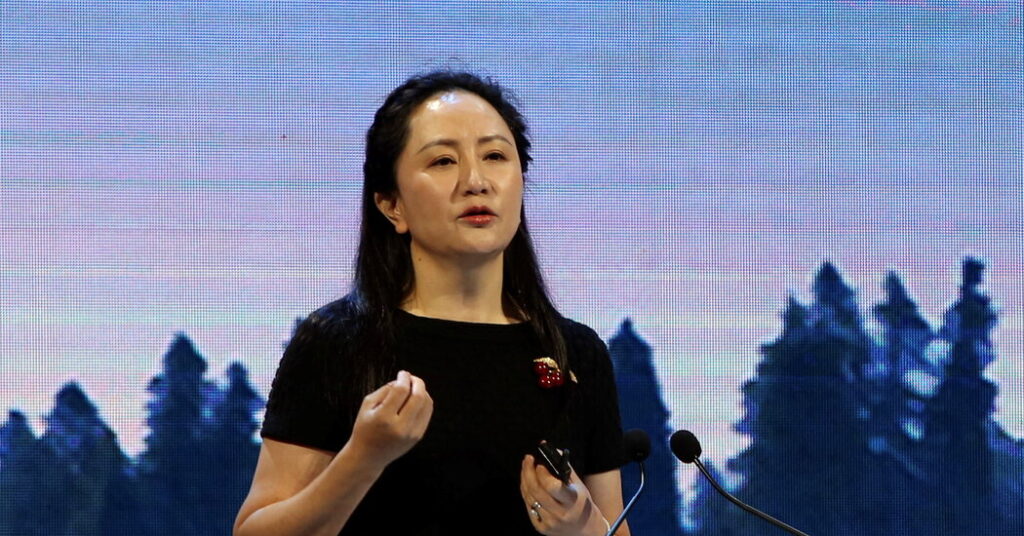
The 2018 arrest in Canada of a senior executive at Huawei, the Chinese telecommunications giant, inflamed already strained relations between Beijing and Washington.
After three years of detention in her luxurious Vancouver homes, the executive, Meng Wanzhou, reached a deal with federal prosecutors and flew back to China. But the agreement did not end the U.S. government’s efforts to prosecute Huawei, which officials say has long defied U.S. law by stealing from American companies and evading sanctions against Iran.
Now, after eight years, the case against the company is being heard in a federal courtroom in Brooklyn.
Opening statements began on Wednesday, and the trial could last four months.
“The entire business operated through a pattern of theft, lies and cover-ups,” Taylor Stout, a federal prosecutor in the Justice Department, told jurors.
The witnesses who are expected to testify include former Huawei employees, experts on telecommunications technology and a banker who Ms. Meng admitted misleading about the company’s dealings in Iran.
Ms. Meng, who is Huawei’s chief financial officer and whose father founded the company, struck the deal with prosecutors in 2021 to avoid jail time. Since 2019, Huawei has been effectively banned from selling its products in the United States; U.S. officials have feared that they could pose a national security threat.
Huawei has continued to sell smartphones and equipment that support telephone and internet networks worldwide. It is also an important part of the Chinese government’s efforts to develop artificial intelligence chips, despite Washington’s efforts to slow China’s progress. A guilty verdict for Huawei may not significantly affect the company’s fortunes.
But federal prosecutors are moving ahead with their case against the technology giant, which U.S. officials have viewed with suspicion for decades. The United States has long accused the Chinese government of sponsoring efforts to steal trade secrets, ranging from sophisticated defense technology to corn seeds in Iowa.
Defenders of Huawei have argued that the case has been fueled by retaliation against China’s efforts to build 5G networks around the world, using Huawei’s technology. Huawei has denied any wrongdoing, saying it operates independently from the Chinese government. It attributes its growth not to stealing trade secrets, but rather to strong investment in research and development.
In a pair of statements, Huawei said the “U.S. government’s overarching narrative is demonstrably false” and that it had “the utmost respect for intellectual property.”
Huawei was founded in the 1980s by Ms. Meng’s father, Ren Zhengfei. Its rise mirrored that of China, which was undergoing a momentous transition toward becoming a capitalist economy.
Brian Heberlig, a lawyer representing Huawei, said Mr. Ren built Huawei through hard work and that he “hired people with the same work ethic.”
As Huawei ascended, U.S. officials worried that the company’s technology could be used to spy on Americans, that Huawei was ripping off American competitors and that it was doing business with Iran, in defiance of U.S. law.
A new indictment filed against Ms. Meng and Huawei in 2020 echoed some of those concerns. Huawei and its affiliates, prosecutors said, used “a pattern of racketeering activity” to steal trade secrets from American companies. Huawei, prosecutors said, stole intellectual property from six companies — identified by The New York Times as Cisco Systems, Motorola Solutions, Fujitsu, Quintel Technology, T-Mobile and CNEX Labs.
The stolen information included source code and operating system manuals, according to an indictment. The company even launched a bonus program for employees who stole information from competitors, according to the indictment.
In one particularly brazen example of theft from 2004, prosecutors said, a Huawei employee was caught trying to steal from a competitor at a Chicago trade show. The employee, prosecutors said, was discovered late at night trying to photograph the inside of a networking device.
And through working in Iran with a subsidiary known as Skycom, prosecutors say, Huawei gave Iranian intelligence services the means to spy on its own citizens. Huawei hid the fact it was doing business in the country, said Mr. Stout, the federal prosecutor, including by removing Huawei’s logo off packaging shipped to Iran.
Huawei’s lawyers have argued that the charges are part of a misguided effort by the Justice Department to target Chinese people and businesses. Competition over 5G and the U.S.-China trade war “made Huawei a prime target for the Justice Department and other federal agencies,” lawyers for Huawei wrote in a filing last year.
On Wednesday, Mr. Heberlig said that prosecutors had provided a “distorted picture” of Huawei, arguing that they had described ordinary business as crime and unfairly focused on a few instances of trade theft among a company with hundreds of thousands of workers.
“Huawei’s success did not come from theft, racketeering or fraud,” Mr. Heberlig said in court.
The case burst into the open with the arrest of Ms. Meng by Canadian police in December 2018, which came at the request of the U.S. government. In retaliation, the Chinese government detained two Canadians, charging them with espionage.
The standoff further calcified relations between the United States and China, which were locked in a trade war initiated by President Trump. He at one point suggested that Ms. Meng could be a bargaining chip in a potential trade deal with China.
Yet Ms. Meng remained detained under an $8 million bail in Vancouver until September 2021, when she reached the deal with the Justice Department, then under President Biden, for her to return to China, where she received a hero’s welcome.
Under a deferred prosecution agreement, Ms. Meng admitted that Huawei had misled a bank about its dealings with Iran, which dodged U.S. sanctions. Her admission will be key evidence during Huawei’s trial, after a federal judge ruled in June that it was admissible.
Within hours of Ms. Meng’s departure in 2021, China released the two Canadians from detention, though U.S. officials said their release was not part of the deal reached with Ms. Meng.
The post Federal Trial Against Huawei Begins After 8 Years appeared first on New York Times.