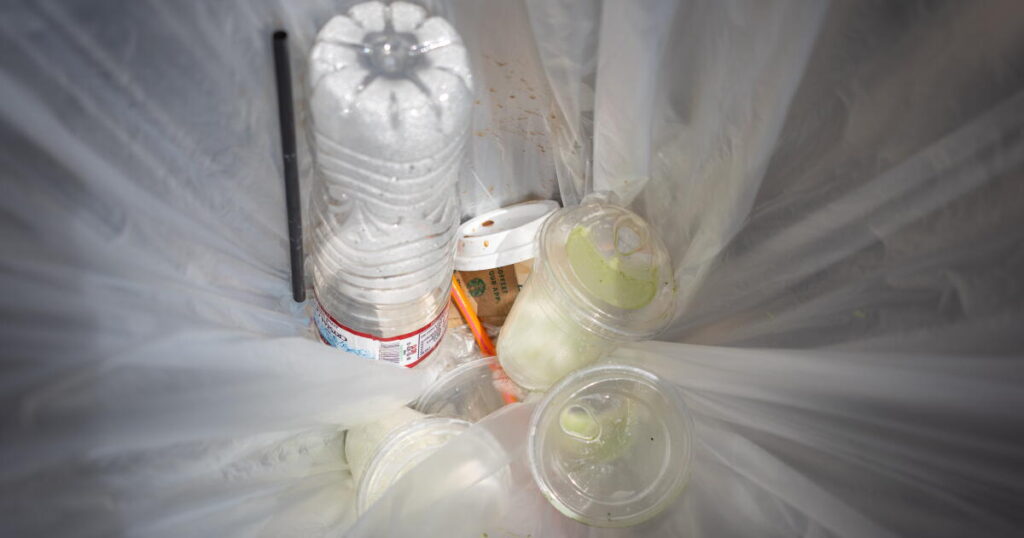
When California’s groundbreaking law on single-use plastic passed in 2022 to address the growing scourge of plastic pollution, it had broad political support. There was the state Chamber of Commerce, the Monterey Bay Aquarium, a powerful ocean advocate and Californians Against Waste.
But now as the law’s deadlines and requirements finally take shape, a hefty industry-oriented consortium is quietly organizing to burn it — and it’s companion law, the state’s Truth in Recycling law — to the ground.
Internal industry documents obtained by The Times show how a group called the Print Creative Alliance and its allies plan to kneecap the laws. The alliance is an industry advocate and resource hub for printers, print brokers, packaging and label businesses, vendors, and creative marketing professionals across 13 western states.
The organization sees the laws as financially perilous for the packagers and producers they work with, and therefore, for their own work.
“From my perspective, a threat to the producers is a threat to the industry,” wrote Lou Caron, president of the alliance, to his member companies in an email. “These businesses, the producers, are customers of our members.”
Caron is also a board member and secretary-treasurer of a new organization, Californians for Affordable Packaging. That organization not only drove a widespread lobbying and marketing campaign this summer to get lawmakers to pause and repeal the single-use plastic law, Senate Bill 54, but were also party to a lawsuit to overturn California’s Truth in Recycling law, Senate Bill 343.
“The goal is to capitalize on the nationwide outcry surrounding affordability and California’s cost of living topping the U.S.,” Caron wrote in a July 13 email to his staff, which he said was drafted by Anthropic’s Claude AI.
Caron confirmed the authenticity of the emails and the internal strategy document. He said they were prepared by him for internal use only.
In an email to The Times, he said members of his organization don’t oppose the idea behind the single-use plastic law — that producers, not the public, should be responsible for what happens to their products — however, “we oppose a law that is largely unworkable and, in certain cases, cannot be understood.”
William Valentine, a spokesman for Californians for Affordable Packaging, said his group had nothing to do with Caron’s emails or documents, although his organization supports “practical, affordable, safe, and sustainable packaging policy in California.”
Asked about the industry push to destroy the laws, Sen. Ben Allen (D- Santa Monica), the author of both plastic laws, said, “I suppose the irony here is that we’re all talking about affordability. The difference is that I’m concerned about affordability for Californians and working families, rather than affordability for corporations who are polluting and who don’t want to make changes.”
He said the laws “will save money for residents because it finally shifts financial accountability onto the polluters who are pushing out all this plastic into the marketplace and creating all sorts of costs for taxpayers and ratepayers.”
He noted this latest industry pushback isn’t universal; it does not include the California Chamber of Commerce or the American Chemistry Council, a national trade group that represents plastic producers and chemical manufacturers.
However, in July, the Teamsters wrote a letter to Gov. Gavin Newsom and the Legislature requesting a “reimagining” and pausing of the single-use plastic law. A spokeswoman, Alexandra Banash, said labor is not involved with the affordable packaging organization and the Teamsters had not seen Caron’s memo.
Senate Bill 54, California’s landmark single-use plastic law, went into effect on May 1. By 2032, it requires a 25% reduction in single-use plastic packaging and foodware sold in the state. All packaging material also must be compostable or recyclable. It puts the cost and onus of waste disposal on the producers and packagers, not the public or local government who have, until now, had the burden of cleaning up plastic pollution.
Senate Bill 343 is the state’s Truth in Recycling law, which requires that all materials that carry a recycling label actually be recyclable as defined by the state. A judge placed an injunction on that law in July, after Californians for Affordable Packaging, and Caron’s alliance — as well as 19 other industry groups — sued over the law’s constitutionality.
Caron wrote in an email to his members that the goal of that lawsuit “is to delay and/or amend SB54 which is a significant threat to business(es) delivering packaged products to California end users.”
But he warned their efforts could lead to “a ballot initiative asking voters to approve draconian regulations.”
In 2022, many groups representing plastic and packaging producers — such as the American Chemistry Council and California’s Chamber of Commerce — supported the implementation of the single-use plastic law as a way to get environmental groups to drop a ballot initiativethat would have reduced single-use plastics in the state.
At the time, some environmentalists warned the industry would use the law as a way to delay plastic reduction before eventually killing it.
“Suffice it to say that we just don’t have confidence that an industry so prone to deceiving the public for so long about the impacts of its products on our communities and our planet will now take the starring role in its own demise voluntarily,” a coalitionof environmentalists wrote in 2022 to the authors of the ballot initiative, who were under pressure to drop it and embrace the plastic law, instead.
The single-use plastic law requires the industry to monitor and police itself while reporting to the state. Despite the industry-friendly construction of the law, Caron and others see it as too costly.
In a section of his July 7 strategy memo titled “Which Legislators Are Most at Risk ” Caron, with the help of Anthropic’s Claude, singled out two legislators and five contested Assembly seats.
Because the single-use plastic law was enacted as an ordinary statute (not a voter initiative), the Legislature retains “full authority to repeal or amend without it going back to voters.”
Caron identified open seats and legislators up for reelection in the Central Valley and Inland Empire, as well as in majority-Latino districts and swing coastal and suburban districts.
The memo targeted Sen. Catherine Blakespear (D-Encinitas), among others, who chairs the Senate’s environmental quality committee and has championed recycling and plastic reduction laws.
Caron noted that although her district isn’t tied to agriculture, “it is exactly the kind of higher-turnout, persuadable swing district where a generalized affordability message — rather than SB 54 specifically — could still be a factor.”
Shown the document, Blakespear said in a statement that her “constituents pull plastic out of the sand at Moonlight Beach and Carlsbad State Beach every weekend, then pay for it again on their trash bills and in the taxes that fund cleanups.”
She said affordability is critical, and it’s why she’s closely watching the rollout and implementation of the single-use plastic law, “and if the numbers do not add up, the Legislature should fix them. That is a very different thing from repeal, and I will not confuse the two.”
“A packaging trade group is not going to scare me off of protecting our coast,” she said.
Caron’s document leans heavily on an economic analysis the packaging organization commissioned this past summer, which suggests the single-use plastic law could cost Californian households $1,000 a year each and up to $78 billion to implement. The report has not been independently validated, and was drafted by Capitol Matrix Consulting — a firm that tends to cater to industry and business groups challenging regulations.
Last year, state economists said the cost of the single-use plastic law to each California household was probably closer to $100 — between $57 and $190, depending on costs passed on to consumers — and suggested after the initial rollout, people would actually save money. They estimated it would cost $21 billion to implement the program, and over 10 years, would save Californians $53 billion by preventing pollution and municipal waste costs.
Brad Williams, senior partner and chief economist at Capitol Matrix Consulting and author of the report, said he thought the state analysis was unrealistic and ignored information from CalRecycle, the state’s waste agency, that suggest costs could be higher.
He said he is sensitive to concerns that because he was hired and paid by an organization that wants to repeal the law, he therefore found problems with that law. He said they didn’t ask him to come up with a specific conclusion, and he wouldn’t have taken the job if he didn’t think they had a point.
“You look at the situation, you look at the numbers before you accept a contract, and you say, ‘Is this something that I believe in? I agree with?’ or ‘Is it something that just goes so against what I believe, or is so unsupported analytically that there’s no way I’m going to do it?’” he said. “Believe me, I’ve turned down a lot of projects over the years.”
He said the objective of reducing “plastic in our waste in our system is a laudable goal. But like a lot of laudable goals, there are costs.”
Caron’s memo also considered possible ways to influence Newsom.
It noted that Newsom leaves office in January, and “has shown a willingness to delayimplementation twice over cost concerns,” Caron wrote. The prospect of Newsom repealing the law was unlikely, he wrote, considering his national aspirations; but they could still use the laws against him.
“A packaging law that Newsom himself delayed twice on cost grounds … but ultimately allowed to take effect, becoming a visible contributor to grocery and consumer-goods price increases in the fall of 2026, would complicate,” Newsom’s messaging on affordability and “hand critics a concrete, state-level counter example during the final months of his term.”
The governor’s office declined to comment.
The post Leaked emails reveal industry plan to kill California’s plastic and recycling laws appeared first on Los Angeles Times.