As relations between Moscow and Berlin reached their lowest point since the Cold War, President Vladimir V. Putin of Russia stood before reporters last week and ripped into his German counterpart, Chancellor Friedrich Merz.
“He lacks the trust of his citizens,” Mr. Putin said, “and the reason is clear: He does not defend national interests, but trades them away.”
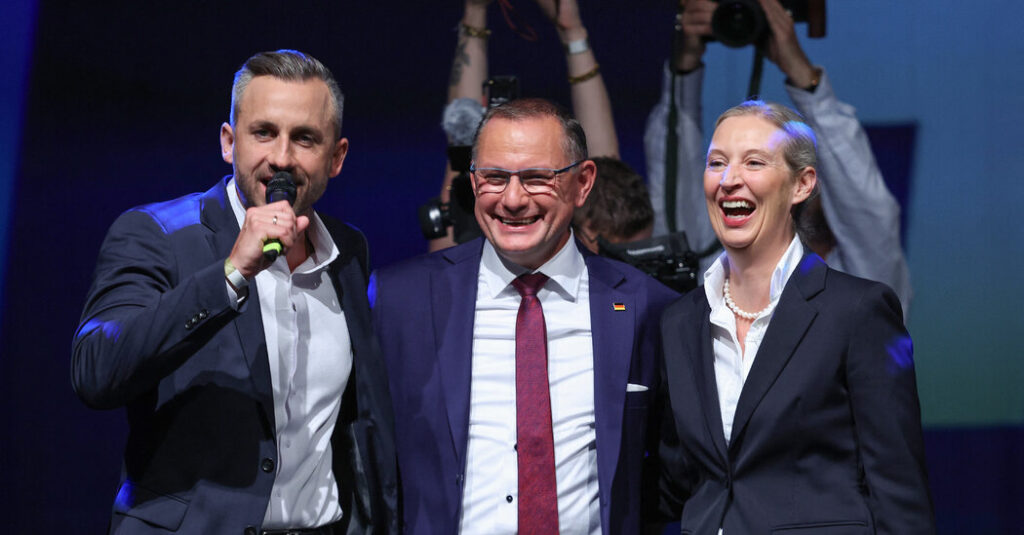
It was a well-known argument to Germans, because it is also a favorite talking point of the far-right Alternative for Germany, or the AfD, and of the Russia-friendly supporters who propelled the party to a blowout victory in elections on Sunday in the state of Saxony-Anhalt.
Overtly pro-Russian messages are gaining traction among German voters, helping to upend domestic politics in the European Union’s most populous and economically powerful country. The change is coming just as Mr. Merz edges toward open conflict with Russia and tries to muster resolve in maintaining support for Ukraine.
In the Saxony-Anhalt campaign, AfD leaders accused Mr. Merz of forsaking Germany’s domestic concerns to send arms to Ukraine and to engage in a risky and costly defense buildup. They have argued that sanctions are hurting Germany more than Russia; that Germany should resume cheap Russian gas deliveries to revive its economy; and that Western leaders are to blame for the war in Ukraine.
It’s all music from Mr. Putin’s hymnbook.
The Russian leader, in both comments and state propaganda, has for years made many of the same arguments heard in last weekend’s German election as he tries to fracture Western unity. His messages are often repeated by figures in President Trump’s MAGA movement or top leaders in the European far right.
“The Kremlin, in a way, is providing a textbook or a framework that is used by these right-wing populists and also the MAGA movement,” said Stefan Meister, a Russia analyst at the German Council on Foreign Relations in Berlin.
“Russia is, in the end, benefiting from the crisis of liberal democracy,” Mr. Meister added. “It is not that Russia is so strong that Russia has created this crisis. But we are in a crisis, and Russia is using this opportunity to fuel the crisis further.”
The vote in Saxony-Anhalt came after German officials said last week that Russia was responsible for undetonated explosive drones that the authorities found at the Leipzig airport. The Germans closed Russian outposts in their country, and Russia responded in kind.
The airport incidents and other suspected acts of sabotage across Europe did not seem to worry AfD supporters in Saxony-Anhalt, where the faction is now on the cusp of becoming the first far-right party to take power in a German state since World War II. It also leads in national polls.
The AfD’s rise has been fueled by voter anger at economic stagnation and a decade of large-scale migration. In states like Saxony-Anhalt, in the former communist East Germany, the AfD’s affection for Russia — voiced in terms that often overlap with Mr. Putin’s — adds another layer to its appeal.
The party draws its strongest support from former communist regions. It has found an eager audience among Germans who believe that the country can solve many of its problems simply by deciding to be friends with Russia again.
“I’m not scared of Russia,” Ulrich Kasch, an 83-year-old voter, explained in Magdeburg, the state capital, saying Germany should not be involved in Ukraine. “We should focus on ourselves.”
Ekkehard Eibs, 62, a heating specialist on disability, balked at spending money on arms for Ukraine when the social services he relied on were on the chopping block.
“We are spending money in Ukraine that we don’t have here,” he said.
Those messages, and the personal ties that many AfD leaders have with Russia, have alarmed Mr. Merz and others in Germany’s political establishment.
But the chancellor, who is fighting for his political survival amid dismal approval ratings, is confronting the limits of his ability to bring German society along in making sacrifices to defend against Russia.
Assessing the Saxony-Anhalt returns this week, Mr. Merz invoked Mr. Putin, declaring that “2,500 kilometers east of here, there is particularly great joy over this election result, and that is surely no surprise when you see who has tried to promote and help bring about this election result.”
Most Germans — some 56 percent, according to a poll released last week by the public broadcaster A.R.D. — remain worried about Russia and support efforts to rebuild their military.
Support for Ukraine and acting against Russia is lower in the former East Germany, where many residents look back to the stability afforded by the communist system with nostalgia. In A.R.D. exit polls, only 31 percent of AfD voters in Saxony-Anhalt called Russia a threat.
Mr. Putin, a German speaker and former K.G.B. lieutenant colonel in East Germany, is particularly attuned to which divisive messages will resonate in Western societies. Germany is not his first target.
In the years before Mr. Trump’s rise, Mr. Putin beamed out culture-war messages designed to appeal to American conservatives, with Pat Buchanan, whose brand of politics paved the way for Mr. Trump, asking in a 2013 column, “Is Putin One of Us?”
Russia hacked and released Democratic National Committee emails in a bid to boost Mr. Trump in the 2016 election. It also mounted online influence campaigns aimed, at least in part, at accelerating the rise of far-right parties in Germany and France.
From the start of the war in Ukraine, Mr. Putin has realized, analysts say, that his authoritarian system may have more staying power than fickle Western democracies backing Kyiv.
Leaders in these countries, he said in a 2024 interview with a Russian TV host, “spent centuries filling their bellies with human flesh and their pockets with money. But they must realize that the vampire ball is ending.”
Some, but certainly not all, of the discontent driving the rise of the AfD is of Mr. Putin’s making.
After Mr. Putin’s invasion of Ukraine, 1.3 million Ukrainians sought refuge in Germany, on top of about a million people who had already arrived from war-torn Syrian. The conflict in Ukraine also caused energy prices to skyrocket and prompted Berlin to refuse Russian oil and gas, triggering some of Germany’s current economic woes.
As the Trump administration pulls back in Europe, Mr. Merz has authorized hefty new government borrowing to rebuild the German military to counter Moscow. Mr. Putin has mocked him for it.
“Businesses are closing, people are losing their jobs, and the standard of living is falling,” Mr. Putin said of Germany during his broadside against Mr. Merz last week. “It is unclear why all this is happening. There is only one explanation offered: the need to counter an ‘aggressive Russia.’ But where is the proof?”
German officials have repeatedly offered evidence from intelligence agencies that Russia is carrying out campaigns of sabotage, including cyberattacks, inside Germany.
Mr. Putin has brushed off these claims. He said last week that Mr. Merz’s government had planted the drones at the Leipzig airport to demonize Russia.
In Saxony-Anhalt, several AfD voters said, unprompted, that they agreed. The more that mainstream German politicians warn about the threat from Russia, the less AfD supporters, skeptical of political elites, tend to believe them.
During a filmed interview days before the election, a tabloid reporter found a Russian Army mug in the office of Hans-Thomas Tillschneider, an AfD leader in Saxony-Anhalt. Mr. Tillschneider tried to remove it, saying it was merely a gift he felt bad about throwing out.
On the night of the election, however, Mr. Tillschneider posted a picture of himself celebrating with the mug, mocking fears of Russia by calling it the “most dangerous mug in Germany.” He then put it up for auction and said the proceeds would go to an extreme ethnonationalist group.
The post With Messaging That Mirrors Putin’s, Germany’s Far-Right Party Gains Ground appeared first on New York Times.