Francis Fukuyama is the author of “The End of History and the Last Man” and, most recently, “In the Realm of the Last Man: A Memoir,” from which this article is adapted.
If you take a university-level course in international relations these days, you will be taught that there are several frameworks for understanding how international politics works: liberalism, realism, neorealism, constructivism and the like. Realism has gotten fresh attention since Russia’s full-scale invasion of Ukraine in February 2022, in particular through the writing and advocacy of University of Chicago professor John Mearsheimer and the work of places such as the Quincy Institute.
There are in fact two types of realism, a “realism of means” and a “realism of ends.” I have known Mearsheimer since we were graduate students, and he has built his career around the latter. Mearsheimer’s realism is seen as a counterpoint to the democratic messianism said to have been infecting American foreign policy over the years, in which the United States has allegedly tried to reshape the world in its own liberal-democratic image through the use of force. But this kind of realism cannot account for why the U.S. behaves the way it does — and it is, in certain respects, profoundly wrong.
In the realism of ends, all states are said to pursue national interest, defined in terms of power and security. They may dress up this drive in the elevated language of democracy or human rights, but ultimately they all seek the same thing: maximization of their power.
This type of realism sees the international system as anarchic, with no overall sovereign or common set of rules to regulate state behavior. Hence one state’s search for security inevitably threatens the security of others; peace emerges only because a balance of power deters any one state from overreaching. States in the international system are like billiard balls. You cannot look inside them to see their goals; what you can know is their mass, velocity and position on the table.
Realism of ends has always struck me as reductionist and oversimplified. In that respect, it is like the rational utility maximizer model of neoclassical economics that reduces all behavior to the pursuit of material gain. Of course power and relative international position matter, but nation-states are complex actors whose behavior is intimately connected to the domestic politics taking place inside them. “National interest” is not a fixed characteristic, any more than is “utility” in economic theory. National interest can be defined in a variety of ways, often reflecting a country’s governing values.
The United States has always seen the promotion of liberal democracy as part of its national identity. It has never pursued this goal single-mindedly and has consequently opened itself up to charges of hypocrisy. But it has often mobilized its own people to sacrifice and international involvement to support a liberal and democratic world order. If the U.S. were simply trying to maximize its power, it would not act this way. In this regard, the realism of ends gets the world wrong.
I subscribe instead to a realism of means. I believe that liberal values and power shape the United States’ role in the world, while being realistic about both the extent to which the U.S. can prioritize democracy and the means by which such a goal could be achieved. Even if America’s national purpose is to assure the survival of democracy and human rights abroad, this cannot be done without power. That power can be economic, social or cultural, but what really matters is military power. Authoritarian leaders such as Adolf Hitler or Russian president Vladimir Putin can be stopped only by military means. Russia has violated countless human rights laws and norms in its invasion of Ukraine, but the one thing that will bring an end to these violations is defeat on the battlefield.
Diplomacy needs to be backed by force or the threat of force. It is not the case that all wars end by negotiation — many conclude with a decisive victory of one side over the other. Consider the federal government’s victory over the Confederacy in the Civil War, or the Allied defeat of Germany and Japan in World War II. The only things that were negotiated in these cases were the terms of surrender. You may not favor the victorious side, but this kind of settlement tends to be much more durable than those in which evenly matched rivals come to a diplomatic settlement. Henry Kissinger shared a Nobel Prize for negotiating the end to the Vietnam War, but the accord was violated the moment the Vietnamese Communists felt they could defeat South Vietnam on the battlefield.
The realism of means, however, does not dictate the ends a state seeks. During the 1991 Gulf War, the United States intervened to uphold the principle of state sovereignty. It sought neither the broad goal of bringing democracy to the Persian Gulf nor the narrower one of access to oil. It used violent means to achieve this goal. But the realism of means is not necessarily a formula for militarism or aggression; rather, it often implies that a great power must show restraint in its pursuit of objectives, however defined.
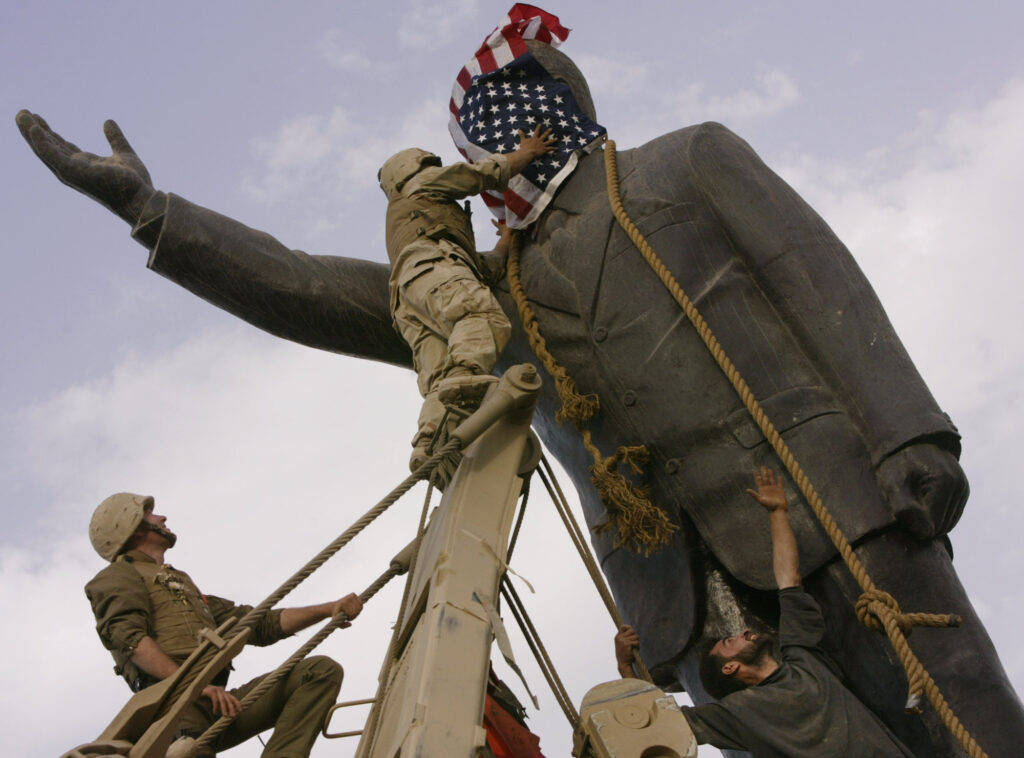
The fundamental problem with the Iraq War, which began with the U.S. invasion of Iraq in March 2003, was that the George W. Bush administration’s goals had broadened to regime change. Its immediate objective was the elimination of Iraq’s supposed stockpile of weapons of mass destruction, and policymakers believed this could not be done as long as Saddam Hussein remained in power. But the U.S. did not have the power to create a stable, friendly regime in Saddam’s place.
When no such weapons were found, the administration turned to democracy promotion to justify what was becoming a bloody and costly debacle. Bush’s second inaugural address presented a soaring vision of a world transformed by universal democracy and laid the geopolitical problems of the Middle East at the doorstep of Arab dictatorships. This rhetoric was a profound mistake: It led people around the world to believe that military force would be the primary instrument for spreading democracy and that American aims in that regard were universal and unlimited.
The United States struggled mightily to stabilize post-Saddam Iraq and was not remotely able to bring about this more expansive end. A realism of means might have accepted a democratic Middle East as a very long-term objective, but it would have abjured the use of raw military power to bring this about in the short run.
No matter how much American foreign policy may be caricatured as overly idealistic, the country’s rhetorical commitment to a liberal international order and support for democracy around the world has provided a principled basis for continuing involvement in international affairs. It has focused U.S. attention on abuses of power abroad that are actually susceptible to U.S. influence. It has also facilitated democratic transitions in places such as Chile, the Philippines and South Korea.
Whereas a realism of ends wishes to disregard ideals altogether, a realism of means guides American principles to where they may actually bear fruit.
The post How realism gets the world profoundly wrong appeared first on Washington Post.