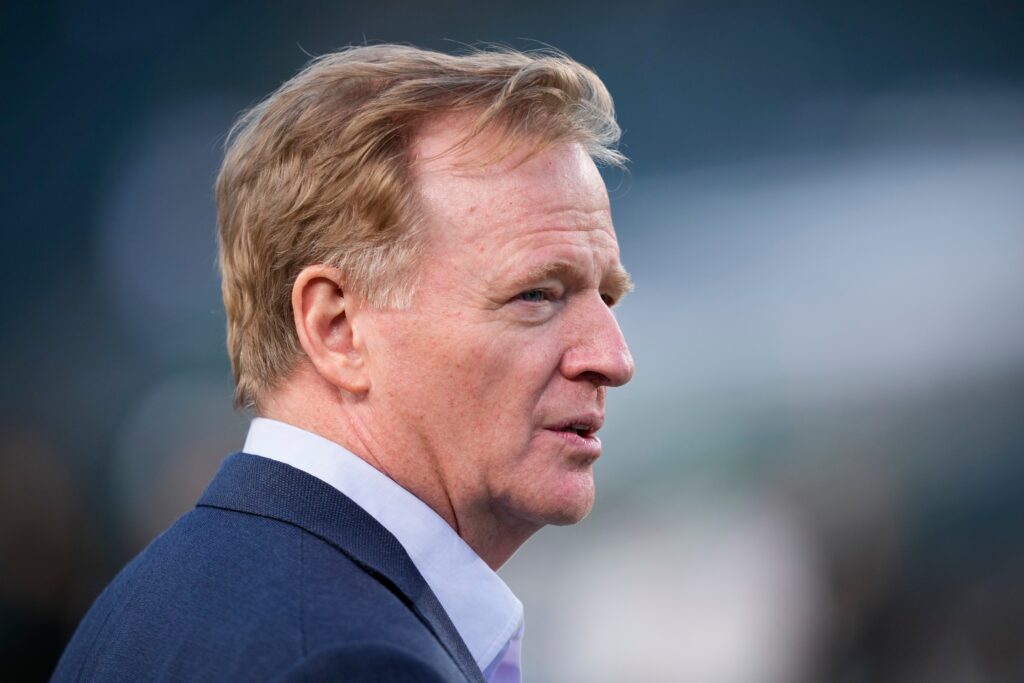
In 2010, NFL Commissioner Roger Goodell announced a goal of reaching $25 billion in revenue by 2027. This struck most as ridiculous. Revenue was only around $8 billion at the time, and the league was enmeshed in controversy, from Spygate to concussion hearings to a pending lockout. The PR headaches would get worse. Bountygate. The Ray Rice fiasco. Deflategate. There would be criticism of the league’s half-hearted (at best) effort to increase the number of Black coaches. There would be conflict over players kneeling during the national anthem. There would be President Donald Trump calling for NFL boycotts and labeling the league “‘sissy’ football.”
Last fiscal year, the NFL brought in $23 billion, and it is widely expected to sail past that $25 billion mark by next year. Goodell was once the most lampooned and lambasted commissioner around. Now he may well be the most powerful person in American sports. He just signed a contract extension that will keep him running the league through 2031, while paying him more than any player in the sport. That’s how Goodell has not just survived but thrived: No matter what, always, always keep the money train moving.
As another NFL season begins this week — on a Wednesday, for the first time in over a decade, as a result of yet another revenue deal — it’s worth marveling at just how much Goodell has cemented his place atop the league.
The job of a sports commissioner, after all, is notoriously difficult. But NFL commissioners have enjoyed remarkable longevity: The league has had only three of them (Goodell, Paul Tagliabue and Pete Rozelle) since 1960. (Major League Baseball has had eight.) How has Goodell done it?
Unlike previous commissioners, it hasn’t been by being a steward of the game or a strong moral arbiter. Goodell’s biggest missteps have always come when he’s been forced to play that role. Instead, Goodell has come to understand that he is not really a “commissioner” of anything. He is an employee of the only 32 bosses who matter: the 32 NFL team owners. If they’re happy — which is to say, if they’re making money — he will be rewarded handsomely. That’s his sole focus, and it has served him well.
That’s also what has led to the league becoming such an innovator the transition from traditional television to streaming — it’s why you’d have to subscribe to five services to watch every NFL game this year, which could cost as much as $1,700 a year, and still might need a cable subscription too. It’s also what has led the NFL to expand globally (there are nine international games this year) and make its season last 17, and soon 18, games. The goal is that most American of targets: perpetual expansion.
Goodell’s bet has always been on the sport itself: He clearly believes Americans can never get enough professional football. And in this, he has continuously been proved right. Last year’s NFL television ratings were their highest in 36 years, and 83 of the top 100 shows were NFL games. That has yielded not just that explosion in revenue but skyrocketing team values, too, with the Seattle Seahawks selling for $9.6 billion this offseason. That is a lot of money in the pockets of billionaires, and it makes up for just about anything that goes wrong.
Making those billionaires happy has gotten Goodell raise after raise, and helped make those scandals, perhaps inevitably, fade away. As long as people keep watching, nothing makes much of a dent anymore.
Last month — actually, just about two weeks ago — the New York Times reported on a landmark study finding that at least one in four (and probably more) ex-NFL players suffer from CTE, a degenerative brain disease. Earlier in Goodell’s tenure, that would have dominated discussion heading into a new season. But Goodell hasn’t even commented on it. Fans have voted with their feet: There have been stories like this for years, and ratings keep right on rising.
It is possible, as the years go on, that Americans will one day turn against football. That someday we will look back on our obsession with this sport, and how much money we were willing to give it, and feel embarrassment, or even shame.
If that happens — and I’ve spent more than a decade thinking it might and been wrong every time — perhaps Goodell will be viewed as complicit in, or even as an orchestrator of, an immoral enterprise. But now? Now he’s the most powerful person in sports and, for all intents and purposes, untouchable. He knows a basic fact about Americans and football: We always want more.
The post How Roger Goodell became untouchable appeared first on Washington Post.