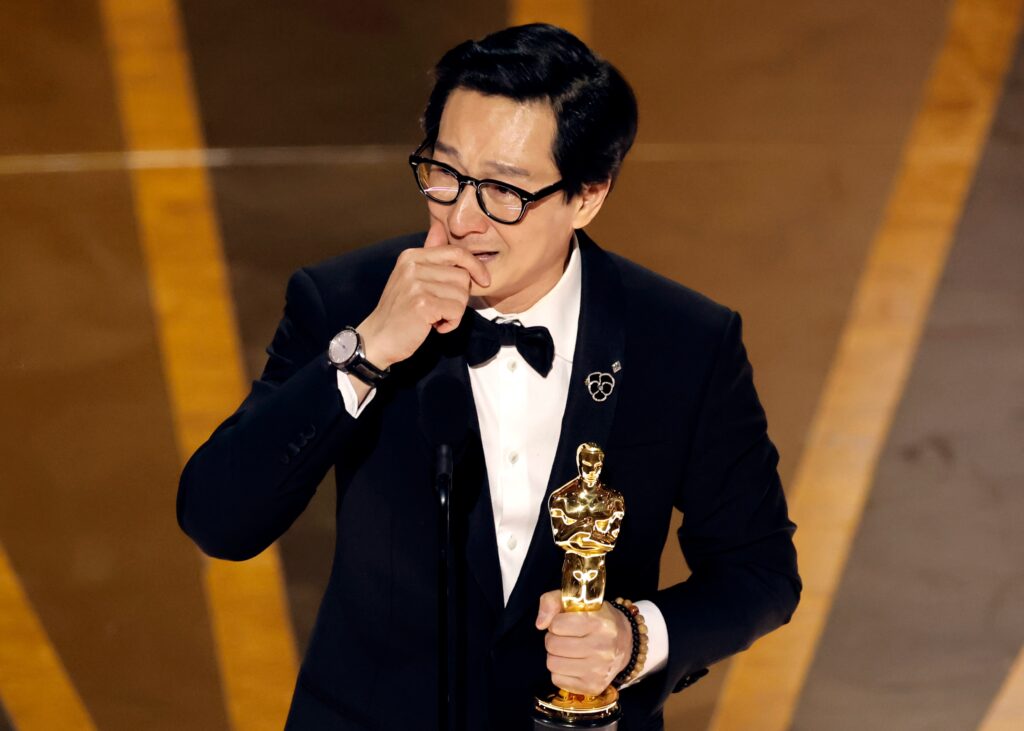
Ke Huy Quan didn’t consciously structure his memoir like an unabridged version of his Academy Award speech. But after finishing “Never Say Die,” the 55-year-old actor realized that the words he had unleashed while grasping Oscar gold — for the 2022 mind-bender “Everything Everywhere All at Once” — covered every thread of his exceedingly improbable tale.
“I spent a year in a refugee camp,” he marveled at the Oscars, “and somehow I ended up here on Hollywood’s biggest stage.”
Quan also recalled the harrowing boat ride as his ethnic-Chinese family fled Vietnam in the late 1970s. The familial sacrifices that set up his American Dream. The sudden child stardom of “Indiana Jones and the Temple of Doom” and “The Goonies.” The decades he spent away from the screen, hoping for a chance he doubted would ever arrive. The acclaimed comeback in the multiverse-hopping juggernaut that was “Everything Everywhere.”
“When I sat down to write, I didn’t know where to start,” Quan says of his memoir, which hits bookshelves Tuesday. “But when I made the decision to start when I was 7 years old, and being carried over the shoulder by my dad, and going to that beach for the first time, and ending it on the Oscars stage, I realized, ‘Oh, wow, that’s what my Oscar speech was about.’ So now [readers] just get to have the full version of it.”
“Never Say Die” delivers the behind-the-scenes dish and anecdotes that define many a Hollywood memoir. Quan vividly recalls the happenstance audition and Cantonese improvisation that helped him land the role of Short Round in “Temple of Doom.” Michael Jackson’s visit to the “Goonies” set and subsequent Neverland Ranch invitation also loom large in his memory. The same goes for his 15th birthday, when Steven Spielberg and George Lucas showered him with trucks of toys, and the time Harrison Ford taught him how to swim.
But perhaps more important, Quan’s story is also one of resilience. The opening pages describe his failed attempts to flee Saigon with his father and the weeks he subsequently spent behind bars. Chapters recounting his father’s declining health are particularly devastating. Quan’s reflections on his teens and early 20s, when friendships proved as elusive as acting work, are heartbreaking. And there’s a bittersweet acceptance to the 19 years between his on-screen appearances, when he worked as a stunt choreographer and booked other below-the-line gigs.
“I’m really excited,” says Quan, who will discuss the book Wednesday at D.C.’s Lincoln Theatre. “But I’m also terrified that pretty soon the whole world is going to know way more about me than I’m comfortable with.”
Speaking last month via video chat from Los Angeles, Quan discussed his initial resistance to penning a memoir, his thoughts on the refugee discourse and how he feels about the challenges of child acting.
(This interview has been edited for length and clarity.)
How did you decide now was the time to write a memoir?
My initial thought was, “No way, I’m not doing it.” When “Everything Everywhere” came out and during the whole awards season, I shared quite a bit of my story, and there was that part of me where I felt like I’d shared too much. Being so vulnerable in those Q&As was not something that I was comfortable with. I was raised to hide my feelings, shove off anything negative that I was going through and be a man. But then the more I thought about it — and also remembering some of those wonderful encounters that I’ve had with people and fans in person — really made me sit down and think, “Perhaps if I were to do this, it could give strength and encouragement to those people who need it.”
What did you learn about yourself writing this book?
First of all, I had to confront my own identity as a refugee and what that label really meant — the stigma and the shame that I had to carry all these years. For a long, long time, I felt like I was rootless. I didn’t belong anywhere. In fact, the term “fresh off the boat” was coined to describe people like myself and my family. So we were constantly reminded that we were unwanted or inferior or insignificant. Writing this book really made me dig deep into trying to find out why I am the way I am. Why do I feel this incredible sense of gratitude with every opportunity that came along? And it was that urge to fit in.
What do you hope your story contributes to the conversation around refugees in this country?
I’m not a political person, but I will always stand on the side of humanity. When I was born in Vietnam, my family was doing really well. They were middle-class people, and my parents had every intention of building a future for all of us there. Then the Vietnam War happened, and it changed everything for all of us, for so many people. They had no choice but to flee a place we called home. So I hope when we talk about refugees or immigration, we can look at it through a lens of empathy. If we can just be a little kinder to one another, the world will be a better place.
You candidly discuss the difficult years when the work dried up, and you decided to abandon acting. How tough was it to revisit that time?
I didn’t even know some of the feelings I had. I sat in front of the computer for a long, long time and just relived some of those moments and some of those thoughts that were going through my head at that time — specifically the loneliness that I felt, and then also the failure that I felt. I was seeing my older siblings moving out of the house and building a future. My colleagues — [“The Goonies” co-stars] Sean Astin and Corey Feldman, and some of the kid actors that I was familiar with — were all doing so well. I felt like the world was still turning, and everybody was moving forward, but I was stationary. Once I really dug in, then those feelings started coming out on the pages.
What do you hope your book does for people’s understanding of child actors and what’s demanded of them?
A lot of child actors do amazing — they’re given great roles, and they’re so talented, and they’re able to showcase it on the screen, and we love them for it. But one thing that people rarely tell them is that once you go through puberty, that transition is very hard. After “Indiana Jones” and “The Goonies,” I thought: “Oh, my gosh, this is only the beginning! How great is my life going to be?” When that cute-kid image is no longer there, all of a sudden you’re an adult now, and that’s not what the audience fell in love with. That phase is very hard, and a lot of the negative feeling starts creeping in. So I don’t suggest people starting out that young. If that’s what they want, fine, but be prepared for it.
The book concludes with your Oscar win. What does that moment mean to you, now that you’ve had the chance to consider it in the context of your life story?
I’m no longer afraid of failure. For many, many years, I thought my better days were behind me, and I was so fearful that nothing good would ever come after that. That accomplishment, standing there and holding the Oscar, was not something that I thought would ever happen. But after that moment, I realized — now looking at my entire life and being more mature and having this growth — where that growth comes from. Writing this book and getting an opportunity to be a little bit more introspective and understanding my journey, I no longer allow outcome to define who I am. I failed before, and I got back up. I failed again, and I got back up. To be who I am today is an incredible feeling, and I’m just grateful for it.
The post From refugee to Oscar winner, Ke Huy Quan is ready to tell his tale appeared first on Washington Post.