One of the best firsthand accounts of the Sept. 11 attacks I’ve read is a short essay titled “Diary of Disaster” by Nicholas Spangler, at the time a 25-year-old journalism-school student and today a reporter for Newsday on Long Island. Spangler happened to be downtown that morning, close enough to the World Trade Center to arrive on the scene between the first and second planes. Like many early recollections of the first hours at ground zero, written before memories had been corrected to fit the dimensions of history, his is as strange as it is horrifying.
He hears the bodies of the north tower’s jumpers hitting the pavement, and also the easy-listening music still drifting out of the building’s outdoor speakers. Under a tree newly stripped of its leaves lies a severed leg wrapped in burlap. Barely an hour after the second tower’s collapse, onlookers enlist Spangler to take a souvenir photo of them posing in front of the wreckage with a disposable camera. It’s the end of the world, or at least of a world, and people have not yet figured out how they are supposed to act.
Days later, trying to make sense of what he has seen, Spangler writes: “I believe that our present way of life ended in those minutes or hours. The American ethos — the way we see the world and our place in it — fractured and will perhaps have to be discarded.”
When he revisits that passage three months later, however, it feels wrong to him. “Our way of life did not end so much as it was interrupted,” he writes, “and if there is such a thing as an American ethos, it has not been significantly altered. There are those relative few whose lives bear the permanent bloody brand of that day but most of us continue to be shaped by much more banal events.”
Did 9/11 change everything? For years, people who agreed on nothing else about the attacks’ aftermath would have agreed that the answer was yes. Arguing otherwise would have been an affront to the victims, to the war on terror’s civilian and military casualties and to the common sense of anyone who has had to take off their shoes at airport security. But question and answer alike have always been colored by the assumption that 9/11 was supposed to change everything: that in being attacked as it was, the United States was being presented with a test that it could pass or fail.
A quarter-century on, it is possible to consider the question with at least some critical distance. Far too much of our current reality stems directly from 9/11 for anyone to argue credibly that it was not a hinge point in our recent history: the ubiquity of surveillance technology, the vague open-endedness that all American military operations now acquire, the general up-armoring of everyday life. At the same time, considering the most dystopian facets of this reality, 9/11’s influence is not as singular as it might have once seemed. It is a middle chapter in the story of American fracture rather than the pyrotechnic beginning.
Nearly every account of 9/11 mentions the weather. It was a perfect morning in New York, we are invariably told, the sky an almost unnaturally pure blue, unmarked by a single cloud, unless you count the thunderhead of dramatic irony that sits over everything.
In his 2024 book “Homeland,” Richard Beck notes that minutes before American Airlines Flight 11 hit the north tower, “Good Morning America” was airing an investigative segment on faulty G.E. appliances, interviewing a man identified in the chyron as a “dishwasher fire victim.” This is the cartoon of the world before 9/11: a place of sunlight and tranquillity, where nobody knows how good they have it and how bad it is about to get.
But the pre-9/11 era was a nervier time in America than the popular imagination remembers it to be. Both the left and the right were itchy amid the comforts of the end of history. Our retrospective understanding of the nation’s immediate reaction to the attacks is influenced by footage of stunned TV news anchors narrating them in real time, but shock is not quite the same thing as surprise: The United States was only eight years removed from the first World Trade Center attack and only six from the Oklahoma City bombing, and the new tragedy was almost immediately slotted into old arguments.
In the left-liberal intellectual class, to consider the attacks unthinkable was to admit an unacceptable ignorance: of the resentment that American hegemony had stirred throughout the world, of the conflicts that had persisted in much of that world even as the United States enjoyed its post-Cold War peace dividend. “A few shreds of historical awareness might help us understand what has just happened, and what may continue to happen,” Susan Sontag wrote in The New Yorker.
On the right, the attacks stirred a hope that the softness of post-Cold War America, and the liberal ambivalence toward out-and-proud patriotism that had lingered since Vietnam, might have come to a welcome end; to call it a new Pearl Harbor was both a description and an aspiration. In a recent podcast conversation, Darryl Worley, the singer-songwriter whose bullying Iraq-invasion anthem “Have You Forgotten?” is one of the essential cultural documents of the early 2000s, recalled his wonder on 9/11 at seeing American flags flying along a side road outside of Nashville. “It had already turned into, like, a parade route,” he said. He recalled thinking to himself: “It had to come to this for us to fly the red, white and blue?”
Of course, in the end, the United States got neither self-awareness nor self-actualization. What it got, a decade and a half later, was Donald Trump, whose election in 2016 has often been cast as a culmination of what the journalist Spencer Ackerman, in his 2021 book “Reign of Terror,” describes as the “decadent phase of the war on terror.”
Trump’s path from reality-TV celebrity to the presidency ran through the Islamophobic fever swamps of the post-9/11 right — the ground zero mosque panic, Obama birth-certificate conspiracism — but also through an increasingly bipartisan discontent with the war on terror that had, by 2016, curdled into cynicism. Trump was the first Republican presidential nominee to break the formidable taboo against affirming what most Americans by then believed, that the country’s post-9/11 military adventurism had been a mistake. He also did little to seriously curtail it in his first presidency and has enthusiastically expanded it in his second.
It has long been tempting to view Trump’s presidencies as the logical conclusion of the folly of the post-9/11 era, and as support for the liberal contention that the right’s calls for patriotism in that era were always really about seizing domestic power. But Trump has also enabled a re-examination of history, and even recent history, that complicates the tale of 9/11’s primacy.
The right-wing extremism unleashed in the last act of his first presidency borrowed aesthetically from the special-operations chic of the post-9/11 militarized state, but it owed a more substantive debt to the 1990s: to Ruby Ridge, Waco and the decade’s sundry militias. Trump’s second-term reinvention of the Department of Homeland Security as an unaccountable interior ministry realizes the direst predictions of civil libertarians in the first days of the war on terror. But it is working in the service of an anti-immigration vision that draws less obviously from post-9/11 terrorism panics than from the nativist paleoconservatism of the preceding decades, figures like Pat Buchanan and Sam Francis.
Trump’s 2016 election “represented the crystallization of elements that were still inchoate” in the early 1990s, John Ganz writes in “When the Clock Broke,” his recent history of the period’s underappreciated malaise. In retrospect, 9/11 was paradoxically both a respite from and accelerant of polarizations and pathologies that were already well underway by then. It allowed Americans to ignore them for a moment, until they came roaring back with redoubled force.
To claim 9/11’s singularity is also to assume that demarcations of eras in public life are most naturally drawn around geopolitics. This was an understandable assumption for Americans who lived through the end of the Cold War, or Vietnam, or World War II. It holds less true for anyone born after the 1980s.
If you do not remember the Berlin Wall but had an adolescence shaped by social media and cellphones, the brightest dividing lines in recent history are technological — and, with the rapid acceleration of artificial intelligence, are becoming more so. This is clear in the borrowed nostalgias of Gen Z, the bits of the past that 20-somethings have recently pressed into service as emblems of a lost golden era: “Friends,” John F. Kennedy Jr. and Carolyn Bessette Kennedy, ’90s high-school-class home videos, music videos and concert footage from bands like Alien Ant Farm and Puddle of Mudd.
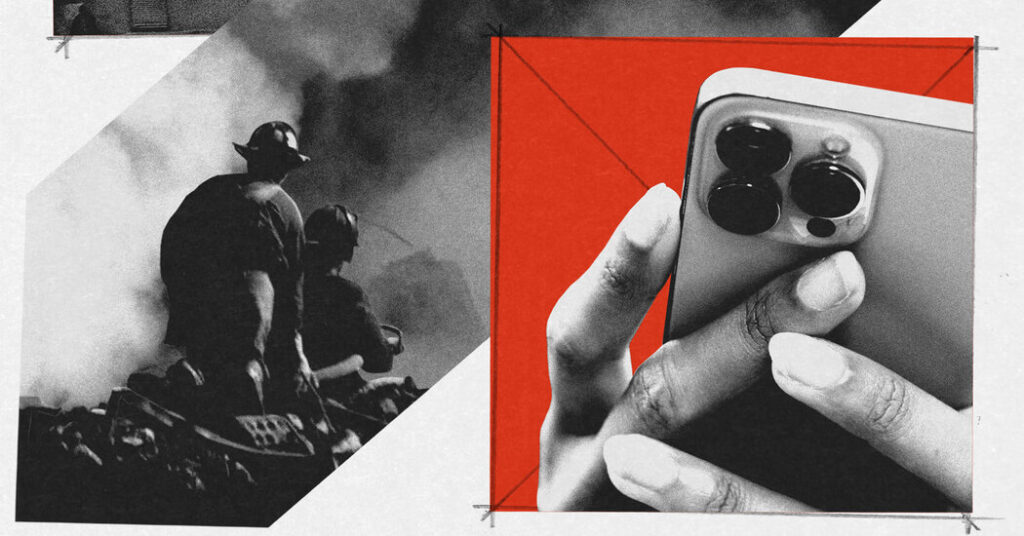
These artifacts span the pre- and post-9/11 years, and the lost innocence they represent has nothing to do with the attacks. Their interest comes from their evocation of a period when people hung out with friends in person and sweated alongside strangers at clubs and music festivals; teenagers goofed un-self-consciously for cameras rather than posing for them like jaded celebrities; and popular culture could be loud and dumb and not picked apart in the digital panopticon for its social politics. The shape that looms ominously over them isn’t the Twin Towers. It’s the iPhone.
But it is hard to disentangle 9/11 from even the societal shifts that don’t obviously relate to it. When I visited the 9/11 Memorial and Museum for the first time recently, I spent the better part of an hour in the museum’s central exhibit, a minute-by-minute reconstruction of the events of the day of the attacks. In the videos and still images, the relics preserved under glass, I found myself less drawn to the terrible but familiar story they told of the attacks than I was to the more unremarkable evidence of life in New York a quarter-century ago that the exhibit preserved — a life that I had lived myself but that suddenly seemed very far away.
I lingered in particular on a pile of floppy disks recovered from the World Trade Center rubble, caked in dust like the remnants of an ancient civilization. I tried to remember the last time I had used a floppy disk myself; it was probably not long after 9/11. It occurred to me that the world the disks represented, in which a digital life was present but not yet omnipresent, is at least as unimaginable for my children as a major terrorist attack on American soil.
I have been thinking since then about what, specifically, people my age know about the moment documented in the museum that my children will never know. It is most likely nothing particular to 9/11 itself, exhaustively chronicled as it has been. But it is visible in the record of that day, if you look closely: in the police officers not yet encased in Kevlar and equipped with drones and Palantir software, in the video footage taken by professionals and dedicated hobbyists rather than thousands of autonomous digital eyes, in the public spaces not yet studded with bollards, in the handwritten fliers of people trying to find loved ones at a time when disappearance is, for worse or for better, still a possibility.
This is a picture of a country on the brink of enormous change — some of it a direct result of 9/11, some of it not, some of it hard to sort out at this distance, the echoes of the attacks blurring with the echoes’ own echoes. But if you were there then, you see it now: a world where so much we live with today was in motion but did not yet seem so inescapable. The many narrators of 9/11 aren’t wrong to talk about the sky that morning. It really was something. The air was so clear.
The post Did 9/11 Really Change Everything? appeared first on New York Times.