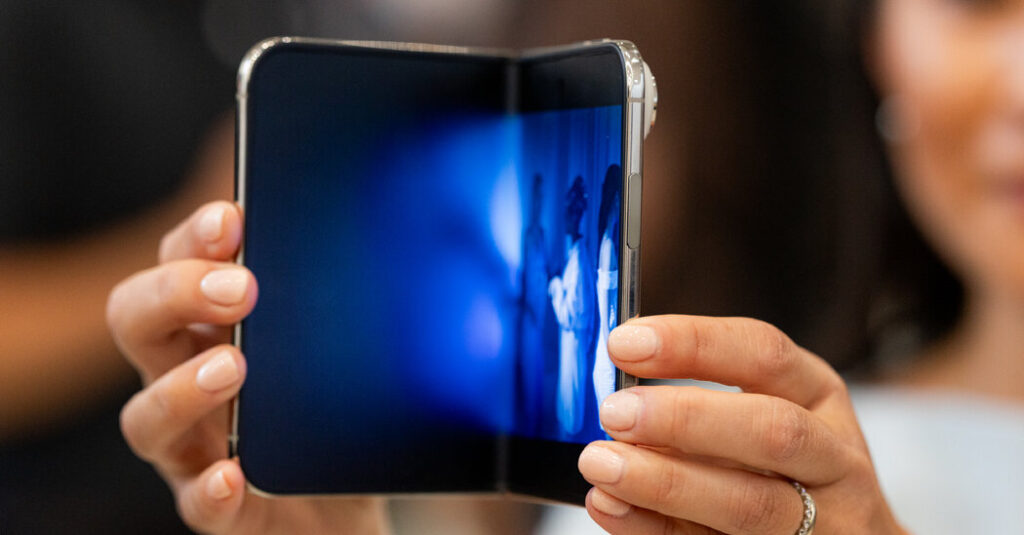
Apple this week unveiled an iPhone that unfolds like a book to expand its screen size and closes up to fit in your pocket. It’s the biggest physical change to the iPhone’s design in nearly two decades.
But even though they’ve been around for years, foldable phones aren’t particularly popular. They’re expensive, awkward and not as durable as regular smartphones. So why did Apple build one?
The simple answer is that the novel design of today’s foldable phones could help re-establish the high end of the phone market. They are meant to stand out in a sea of standard-issue, if-you’ve-seen-one-you’ve-seen-them-all smartphones.
The quintessential rectangular smartphones have gotten so good over the years that the most expensive models priced upward of $1,000 have become nearly indistinguishable from their cheaper counterparts. (Carrying a phone with three camera lenses versus two probably won’t impress people at parties.)
Foldable phones, on the other hand, are attention getters. And for their price, they’d better be: Apple’s iPhone Duo will cost $1,999 when it arrives in October to compete with Samsung’s $1,900 Galaxy foldable.
“Whenever something is exclusive, limited and luxurious, automatically consumer psychology wants it,” said Nabila Popal, a director at IDC, a market research firm. “It’s like handbags. Why is someone buying a Chanel versus that? It’s not because of the leathers. It’s to show that they have a Chanel and they can afford it.”
Apple and its competitors are following a path that television makers took about a decade ago. When high-definition TVs became commoditized, anyone could buy a bright TV with a large, sharp screen for as little as $500. To find more ways to increase profits, companies like Panasonic, LG and Sony experimented with quirky new designs, like TVs with curved displays and the ability to play movies in 3-D, and charged $3,000 for them.
Those TV concepts turned out to be flops. But in later years, TV makers found success with a different type of high-end television featuring OLED technology, or organic LED, which had more accurate colors for making movies look better and cost upward of $1,000.
Apple’s foldable handset is arriving at a moment when people will need extra persuading to upgrade to a new phone. The costs of most consumer goods, and especially electronics, have skyrocketed.
In response to an industrywide memory chip shortage driven by the artificial intelligence boom, Apple increased prices this year for many of its popular products, including Macs and iPads, by as much as 29 percent. Apple’s new iPhone 18 Pro phones will cost $1,199, a $100 increase from last year’s model. The chip shortage has also forced companies to raise the prices of video game consoles and phones.
Foldable phones, which account for less than 2 percent of the handset market, may be the only part of the phone industry that will grow this year. IDC said it expected the chip-shortage-induced price increases to contribute to a 17 percent drop in worldwide smartphone sales this year — the steepest annual decline in history. However, sales of foldable phones could grow 12 percent to 22.9 million because of the iPhone Duo’s arrival, the research firm said.
Still, a foldable phone could be a tough sell even for a company as influential as Apple. Consumers have generally avoided buying foldable phones not only because of their cost but also because of their trade-offs. Their bendable screens are less durable than normal phone displays, which are protected with hard glass. Folded up, they can feel bulkier and heavier in a pocket.
Dan Frommer, a writer for The New Consumer, a tech research publication, said he had long been skeptical about the usefulness of foldable phones because so much online content, including the vertical videos on TikTok and Instagram, was produced for the small rectangular screens of normal smartphones.
“They’ve been used that way for 19 years now,” Mr. Frommer said. “What would you actually want a square, big screen for?”
Apple’s iPhone Duo appears to be addressing some of the shortcomings of previous foldable phones. The device’s name refers to two screens. Closed up, it has a 5.4-inch outer screen that people use as a normal rectangular phone; it opens up to reveal a 7.6-inch inner screen. The larger inner display shows pictures in the same aspect ratio as traditional phone screens. Apple also said the phone’s foldable inner screen was composed of a tougher material than competitors’.
In my tests, when opened, the iPhone Duo was extremely thin, measuring two-tenths of an inch. I liked that a Netflix video took up the full screen instead of showing black bars on the sides, which has been the case with other foldables. Closed up, the phone felt dainty and was about the size of a passport. It also felt less chunky in my pocket than other foldables I’ve tested, such as the $1,900 Google Pixel 11 Pro Fold. The more compact and lightweight, the better.
The inner screen has a matte texture to reduce glare. Still, I occasionally noticed the crease in the center where the screen folds. I didn’t mind it, but that might bother nit-pickers.
Apple also had to leave out some components to make a phone this thin — the iPhone Duo lacks the advanced camera system featured in the $1,199 iPhone 18 Pro phones. It also doesn’t have a face scanner for unlocking the device, relying instead on a fingerprint sensor on the side of the phone.
Though Mr. Frommer predicted that the Apple foldable wouldn’t be the right fit for him, he admitted he couldn’t resist trying one out in a store.
“When Apple makes something, there’s an allure to it to encourage people to at least check it out,” he said.
The post Foldable Phones Are Unpopular. Why Is Apple Selling One? appeared first on New York Times.