It’s a blockbuster almost 1,000 years in the making.
On Thursday, the British Museum opened its exhibition of the Bayeux Tapestry — the first time the priceless 220-foot-long 11th-century embroidery has returned from France to the country where it is believed to have been made.
And while most museum blockbusters attract only art lovers, this show, which runs through July 11, has gripped the wider imagination of the British public.
Michael Lewis, the exhibition’s curator, described the fervor as “Bayeux mania.”
When the first tranche of tickets went on sale this summer, over 80,000 people at a time waited online to buy them, the museum said in a news release. Such was the clamor to see an object that depicts William the Conqueror’s invasion of England of 1066, a foundational moment in the nation’s history.
When it arrived at the British Museum in mid-July from its home in Bayeux, northern France, news channels covered the tapestry’s return as though it were a returning war hero rather than an embroidery inside a crate in the back of a truck. The interest has barely let up since.
King Charles III came for a special early viewing last week, and British art critics raved after media previews. One said it was “shivers-down-the-spine, tell-the-grandchildren sort of stuff”; another called it a “universal depiction of the madness of war” to rival Picasso’s “Guernica.”
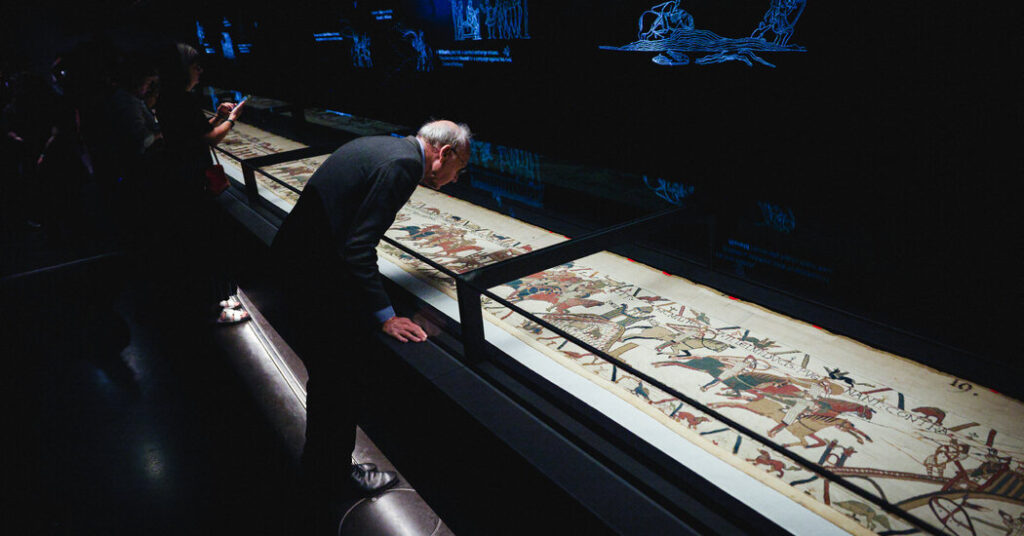
Now, members of the public who were lucky enough to secure tickets can enter the show’s darkened exhibition hall, where the tapestry is laid flat in a display case. Its 58 scenes culminate in a bloody battle between the armies of Harold Godwinson, England’s last Anglo-Saxon monarch, and William the Conqueror, the duke of Normandy.
Inside the exhibition on Thursday morning, the first visitors made their way along the tapestry, snapping photos as they went. They were all quiet until one spotted some of the nude figures in the tapestry’s borders and laughed loudly. Occasionally, a message played on speakers in English and French telling visitors to keep moving along. “Please do not stop,” it said.
Venetia McDade, 50, a carer who had traveled more than five hours to see the tapestry, said that her children had seen it in France on school trips, but that this was a remarkable moment. “They didn’t understand the relevance, I don’t think,” McDade said. “It’s so old — how can you not be excited?” she added, “and to see it on home turf where it belongs is great.”
Mary Beard, the historian and British Museum trustee, said in an interview that it was actually the second time Britain had been gripped by “Bayeux fever.”
She recalled seeing “images of the tapestry everywhere” in 1966 when the country celebrated the 900th anniversary of William the Conqueror’s invasion. The beer-maker Guinness riffed on the tapestry in its advertising, the Winnie-the-Pooh illustrator Ernest H. Shepard created a Bayeux Tapestry-themed tote bag featuring his characters, and the postal service issued commemorative stamps.
With the tapestry now back in Britain, the mania this time feels even stronger, Beard said. It is an event that Britons can celebrate regardless of political persuasion, she added, because the events it depicts are deep history. It’s “a fantastically safe space,” she said.
The embroidery’s narrative simplicity also adds to its appeal, Beard added: “There’s no gatekeeper here saying, ‘Before you look at the tapestry, here’s 25 things you need to know.”
There is also a sense that viewing it at the British Museum is a once-in-a-lifetime chance to see an object that every child here studies in school.
At the museum on Thursday, John Hopkins, 81, a retired archivist, said it was his second time seeing the tapestry, having once seen it in Normandy. “But it’s well worth seeing it again, a wonderful work of art as well as an incredible piece of history,” he said.
Hopkins said the events it depicted left him feeling a little sad, though, because it showed a time when “the English lost their country to a bunch of foreign mercenaries.”
Despite the widespread enthusiasm for the British Museum show, the tapestry’s transit to Britain has upset some art experts. Although it made it to Britain without any major damage, Thalia Bajon-Bouzid, one of the tapestry’s conservators, said in an email that her team had discovered two new “small breaks” among its millions of threads while checking its condition after it arrived in England. She said those thread breaks were both “a few millimeters long.”
Didier Rykner, the founder of La Tribune de l’Art, a French art publication that campaigned against the loan, said by phone that although the damage appeared to be minor, the French government had still taken an unacceptable risk by moving the tapestry to Britain at all. And the priceless embroidery still has to return to France once the exhibition closes, he pointed out.
A spokeswoman for France’s culture ministry said the government would soon issue a full report on the tapestry’s condition.
The British Museum hopes the show will attract about a million visitors during its 10-month run. That is short of the 1.6 million who flocked to its 1972 “Treasures of Tutankhamen” exhibition, although conservators have limited the number of hours the museum can expose the tapestry to light.
Either way, the Bayeux Tapestry exhibition is expected to be a moneymaker for the museum at a time when it is trying to raise at least 1 billion pounds, or $1.35 billion, for a major refurbishment. Visitors are expected to fill the show’s gift shop as much as the exhibition hall itself.
Among the dozens of items for sale: Bayeux Tapestry-themed crochet kits, beer tankards, calendars, replica battle helmets, chocolates and commemorative plates. That final item will set visitors back £1,350.
The post A Nation Gripped by ‘Bayeux Fever’ Finally Gets to See the Tapestry appeared first on New York Times.