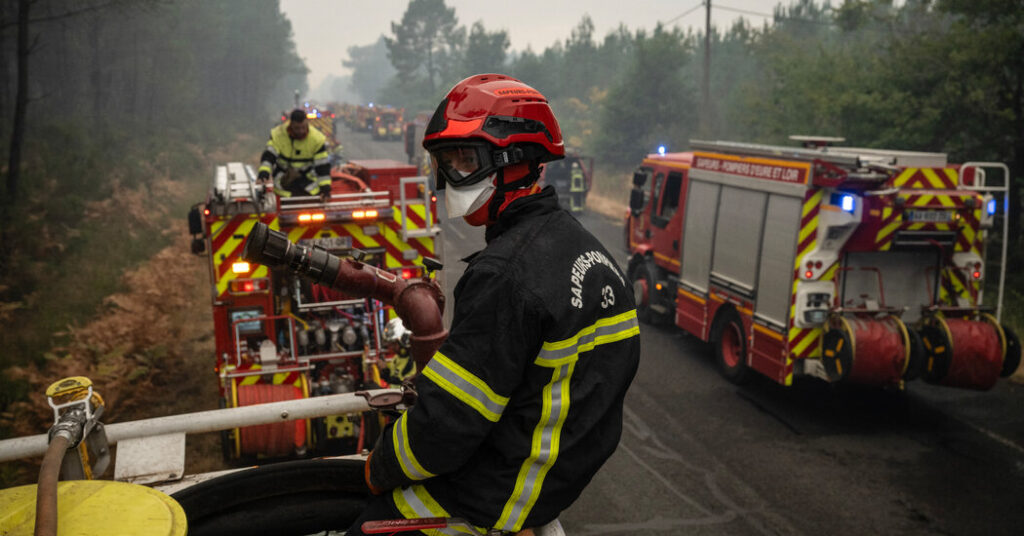
This summer, sweaty Estonians doused fires in Sardinia and Romanians fought flames in France as part of an urgent bid to save a burning continent.
The European Union is more familiar with trade policy than fighting infernos. Yet faced with ever-longer fire seasons across a widening territory, Brussels is stepping up, in part by positioning firefighters on loan from other European countries in high-risk regions.
The program started in 2022 with 236 firefighters and has expanded to include nearly 800 this summer. They are coordinated from a round-the-clock emergency response hub in Brussels.
A small team there also answers calls for backup when fires grow too big for one country. The European Union coordinates help from around the region, and it is building its own fleet of firefighting helicopters and planes, creating a backup force that nations can call on.
The question is whether Europe can scale up its capacities fast enough to combat the fires burning through Spanish forests, along French coastlines and across Greek islands each year.
Both national governments and the E.U. are trying to rapidly increase their capacity to respond. The Italian island of Sardinia, which faces many fires, formally used the program to preposition firefighters for the first time this year.
On a swampy day in mid-August, a team of Estonian and French firefighters milled about at a dusty base camp on the southern part of the island. The Estonians wore lightweight gear bought specifically for the trip.
Daniela Pani, a local Italian who coordinated the force, said working with international teams helped volunteers on the ground and gave the professionals from abroad a chance to share firefighting skills.
For Grégory Fabre, who had left France during a historically bad fire season to lead his unit’s Sardinian tour, the experience of battling flames on the island could soon be useful back home. Sardinians have strategies for fighting fires when water resources are scarce, he said, like lighting opposing fires to suck up oxygen and help snuff out the uncontrolled blaze.
“The techniques are different,” he explained in French. He had a language barrier with his hosts, as did most of the French team — but they didn’t seem bothered.
“When you are fighting a fire,” Ms. Pani explains, “you don’t need to make fluent conversation.”
Backup From Dozens of Countries
As Europe heats up and dries out, fires are getting so big and lasting so long that nations often do not have enough planes, helicopters and firefighters to tackle them alone.
To get help, they can call the emergency center in Brussels, where a small team coordinates across the European Union’s 27 member nations and 10 other partners. That team can dispatch help from other countries, and can send help from the union’s small fleet of planes and helicopters to provide backup if needed.
“We are the last resort,” said Maria Zuber, who leads the center’s emergency response operations unit.
There have been 11 calls to activate E.U. help this season. That’s down from a record 19 last year, but the fire season is ongoing and it remains intense by other metrics.
In terms of damage, this year is not far below last year’s brutal fire season, which was the most destructive year on record in Europe.
By the end of August, the area burned across Europe was about twice its typical size. And experts like Ms. Zuber have said that this year’s fire season could stretch into November.
It is taking time to scale up the response, especially when it comes to air power. While the European Union earmarked 600 million euros (nearly $700 million) in 2024 to buy its own fleet of planes, helicopters and water-dumping aircraft, such vehicles are not an off-the-shelf item — and they are in demand all around the world. The order is not expected to be completed until after 2030.
France and other nations are facing similarly long timelines. That has left Canadairs — planes that can scoop up water from lakes or the ocean to dump on fires, and that don’t need to be landed to reload — in limited supply.
Industry experts warn that trained pilots and technicians will also be in short supply as fire seasons worsen.
“The bigger issue is not necessarily the aircraft, but the people — the pilots and technicians,” said John Boag, group chief executive of Avincis, an emergency aerial services operator that has dozens of aircraft in Europe, noting that strict regulations limited working hours even during high season.
And an expanding response costs money. The European Union’s executive arm has asked for a large pot of cash to pay for emergency preparedness and response in its next seven-year budget — €10.7 billion — but it is unclear whether it will actually receive that much as military spending and other issues compete for resources.
A Principle of Solidarity
In Belgium, where record-shattering fires last month blazed across more than 7,000 acres in the Hautes Fagnes nature reserve outside the city of Liège, critics have been accusing the government of underinvesting in firefighting abilities.
Belgium relied on the E.U. emergency center for help during the August disaster. Its leaders, who have defended the response, say the problem was simply too big for one small country to handle.
“It’s as if we were saying: ‘Do you really think that every NATO country should have a full-fledged army complete with aircraft carriers and all that?’” Bernard Quintin, the Belgian interior minister, told lawmakers on Aug. 20. “This is the very principle of the European Union. It’s this principle of pooling resources. It’s this principle of solidarity.”
In Sardinia, Kaarel Langemets, the boss of the Estonian firefighting team, explained that he sees participation in the E.U. firefighter sharing program as an important show of unity.
“It’s getting worse year by year,” said Mr. Langemets. “No country itself can handle this.”
Koba Ryckewaert contributed reporting.
The post How Fighting Fires Became an All-of-Europe Project appeared first on New York Times.