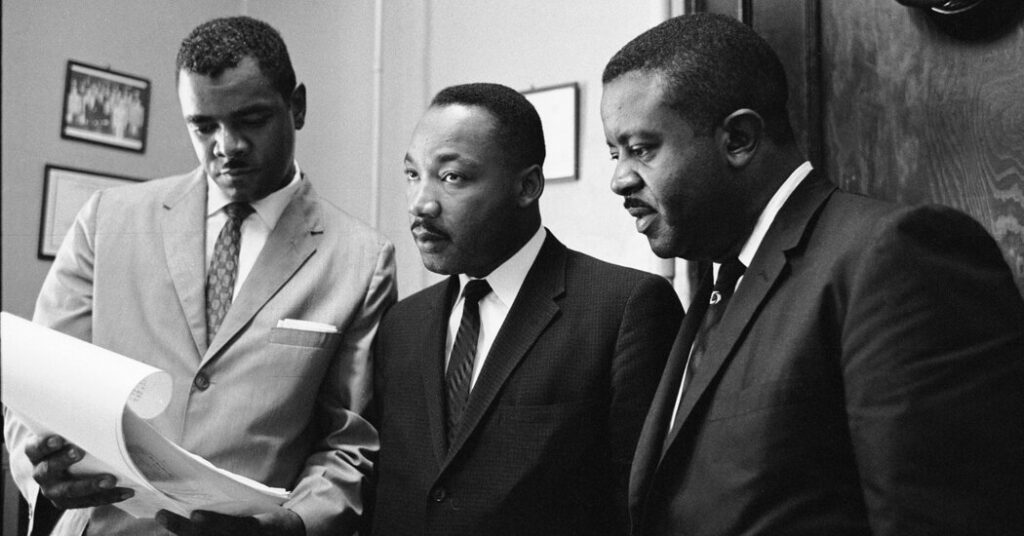
William G. Anderson, a doctor who in 1961 set aside his medical practice in Albany, Ga., to lead a movement against the city’s entrenched system of racial segregation, attracting national attention and the involvement of the Rev. Dr. Martin Luther King Jr., died on Aug. 16 at his home in Detroit. He was 98.
His daughter Valé Henson confirmed the death.
The Albany Movement, a coalition of the city’s Black and civil rights groups, appeared at a pivotal moment in the struggle against Jim Crow segregation, coming between early successes like the Montgomery bus boycott of 1955-56 and later triumphs like the Birmingham campaign and the March on Washington, both in 1963.
With Dr. Anderson, an osteopath, as its leader, the movement in Albany pushed for integration of local businesses and tested federal laws against discrimination in interstate bus travel. Over the course of a year, the police arrested some 1,200 demonstrators who belonged to the movement, including Dr. Anderson, who was briefly jailed.
As the arrests mounted and national news media swarmed into town, Dr. Anderson decided to call an old friend, Dr. King, for assistance. “I realized that I got all these people into jail; now how am I going to get them out?” he told the McClatchy news service in 2009. “I realized, I’m in over my head.”
Dr. King and his lieutenant Ralph Abernathy spent months organizing in Albany and were arrested alongside Dr. Anderson.
Although Dr. Anderson had been born in the nearby city of Americus, he had received his medical training in the north and had only recently returned to Georgia to practice. He chose Albany because it had few Black doctors.
He had not been active in the civil rights movement until that point, but he felt compelled to address the blatant racial injustices that hindered his ability to provide medical treatment. As a Black man, he could not practice at the hospital, the only one in town — even though white doctors often refused to see Black patients or did so only reluctantly.
He did most of his work through house calls, visiting homes that often lacked running water and electricity. On one occasion, he delivered a baby at night, under the illumination from the headlights of his car parked outside.
In early 1961, a group of young activists from the Student Nonviolent Coordinating Committee came to Albany to organize a movement. Though they faced resistance from the Black establishment, they found ready recruits among Albany’s restive youth, who began testing segregation through actions like sit-ins and were arrested in the process.
“I came out of my office and, after watching these kids be intimidated, I went and started marching,” Dr. Anderson said in a 2019 interview with The DO, a publication about osteopathy. “They weren’t marching for themselves; they were doing it for myself, my family, my patients and my community.”
That fall, several Black organizations, including the N.A.A.C.P., met to discuss an alliance, which they called the Albany Movement. They elected Dr. Anderson as its president; the gathered leaders felt that, as a doctor serving exclusively Black patients, he was somewhat insulated from white reprisals.
Dr. Anderson proved an effective spokesman for the Albany Movement. He undertook an extensive speaking tour of the West Coast, and in 1962 he went on the NBC Sunday talk show “Meet the Press” to explain the movement’s goals to millions of viewers.
When one panelist, James J. Kilpatrick, an ardent segregationist who was editor of The Richmond News Leader, asked him whether Black protesters had “invited” their arrests, Dr. Anderson pushed back.
“Yes,” he said, “if expressing your constitutional rights is inviting arrest, then yes.”
When Dr. King and Mr. Abernathy left Albany in the summer of 1962, Dr. King said that the movement had failed in the face of a wily local white police chief, Laurie Pritchett, who refused to be baited into using violence against protesters.
Dr. Anderson and other organizers saw things differently. Over the next few years, away from the glare of national attention, Albany’s white establishment quietly dismantled many of the city’s most flagrant segregation laws and allowed Black candidates to run for local office.
William Gilchrist Anderson was born in Americus on Dec. 12, 1927, to John Anderson, who worked in insurance, and Emma (Gilchrist) Anderson, who was an administrator with the school system in Sumter County, where Americus is located.
He was 15 when he entered Fort Valley State College (now Fort Valley State University), a historically Black institution in Fort Valley, Ga., but in 1944 he left to enlist in the Navy, where he served as a medical corpsman during World War II.
After his discharge, he married Norma Lee Dixon, who also became a civil rights activist, in 1946, and attended the Atlanta College of Mortuary Science. During that time, he befriended Dr. King, who was studying at nearby Morehouse College and had been a childhood neighbor of his wife.
In 1949, Dr. Anderson received a bachelor’s degree in biology from the Alabama State College for Negroes (now Alabama State University). Seven years later, he received a doctorate in osteopathy from Des Moines University in Iowa, and, after a year’s residency in Flint, Mich., he settled in Albany.
His wife died in 2007. In addition to Ms. Henson, Dr. Anderson is survived by four other children, A. Laurita Faison, William Anderson II, Frank Anderson and Darnita Anderson Hill; 10 grandchildren; and seven great-grandchildren. Three of his children and three of his grandchildren have degrees in osteopathic medicine.
After the Albany Movement ended in 1962, Dr. Anderson and his family moved to Detroit, where he became the city’s first Black surgical resident and later opened a surgical practice. He taught at the Michigan State University College of Osteopathic Medicine and, in 1994, became the first Black president of the American Osteopathic Association.
As a result of his conviction for obstruction of justice during the Albany protests, Dr. Anderson was a felon — a mark of distinction, he said, for his service to the movement.
“My involvement with Martin Luther King Jr. and Ralph David Abernathy earned me this dubious distinction,” he wrote in his 2025 memoir, “The Making of a (PARDONED) Felon During the Civil Rights Movement in America: The Physician Who Helped Heal American Democracy.”
“It is a badge I have worn proudly, as have many others who participated in the civil rights movements of the 1950s and 1960s,” he wrote.
The post William Anderson, Doctor and Civil Rights Leader in Georgia, Dies at 98 appeared first on New York Times.