The fast-moving legal battle over Missouri’s congressional map returned to the U.S. Supreme Court on Wednesday, with the question of which House districts would be used in November’s general election still unresolved.
Opponents of congressional districts redrawn last year to give Republicans an advantage asked Justice Brett M. Kavanaugh to swiftly halt a lower-court ruling that would require Missouri to use the newer boundaries.
The request followed an intense 24 hours of legal twists that spanned four courts, including Missouri’s Supreme Court, which signaled just before midnight on Tuesday that it was considering whether to hold the state’s top election officer in contempt and scheduled a hearing for Thursday.
The uncertainty over the state’s maps followed back-to-back contradictory decisions on Tuesday night from Justice Kavanaugh and a federal district judge in St. Louis.
The State Supreme Court’s decision to call in Secretary of State Denny Hoskins for a contempt hearing reflected a new juncture in a rising battle over what appears on Missouri ballots and which judges’ orders should be heeded.
Mr. Hoskins and his fellow Republican officials said Tuesday night that they would keep using congressional districts redrawn last year at President Trump’s request to benefit Republicans, following the federal district judge’s order instead of the State Supreme Court’s.
“I look forward to my day in court,” Mr. Hoskins said in an overnight social media post that cited the Supremacy Clause of the U.S. Constitution.
The redrawn boundaries were used in last month’s primary election, but they were deemed invalid last week by the Missouri Supreme Court. The court’s order said that the previous lines must be used until a referendum was held on whether to switch to the redrawn districts.
Missouri officials warned of a constitutional breakdown and appealed that decision to the U.S. Supreme Court, but Justice Kavanaugh denied their appeal on Tuesday evening. For a moment, it seemed that the old boundaries would go back into effect, positioning Democrats to hold onto the Kansas City-area House seat that Republicans had hoped to flip.
But soon after Justice Kavanaugh’s decision was announced, word spread that a federal district judge in St. Louis had entered a conflicting order that instructed Mr. Hoskins to not change back to the old lines. Mr. Hoskins, along with Missouri’s governor and attorney general, quickly announced that they would follow the district judge’s ruling, setting off another round of frenzied court filings.
Opponents of the redrawn map immediately appealed the district judge’s ruling to the U.S. Court of Appeals for the Eighth Circuit. A three-judge panel of that court, made up of judges nominated by Republican presidents, declined to block the lower court’s ruling on Wednesday afternoon.
The opponents of the new map then asked Justice Kavanaugh, who oversees emergency requests from Missouri, to intervene. In Wednesday’s filing, they said that the district court judge’s “legally baseless” order “must not be permitted to detonate in the middle of Missouri’s congressional elections to blow up the clear and careful ruling of the Missouri Supreme Court and the fundamental rights of Missouri voters.”
Justice Kavanaugh requested a response from supporters of the new voting districts by 10 a.m. on Thursday.
Tuesday was also the deadline to finalize Missouri’s ballot. Several Missouri county clerks did not respond to interview requests on Tuesday night about the uncertainty.
Mayor Quinton Lucas of Kansas City, a Democrat, described the situation as chaos, adding that it had the potential to confuse voters and diminish their confidence in elections. He blamed the state’s Republican leaders for a series of decisions and court arguments that he suggested had been made in bad faith.
“Usually in politics, we ask ourselves if someone’s actually being nefarious or incompetent,” Mr. Lucas said. “Here is just a magical mix of both.”
The conflicting court orders came after a year of recriminations about Missouri’s congressional map. The state, which is led by Republicans, was among the first to join the redistricting arms race last year as Mr. Trump sought to boost his party’s odds of holding the U.S. House in the midterms.
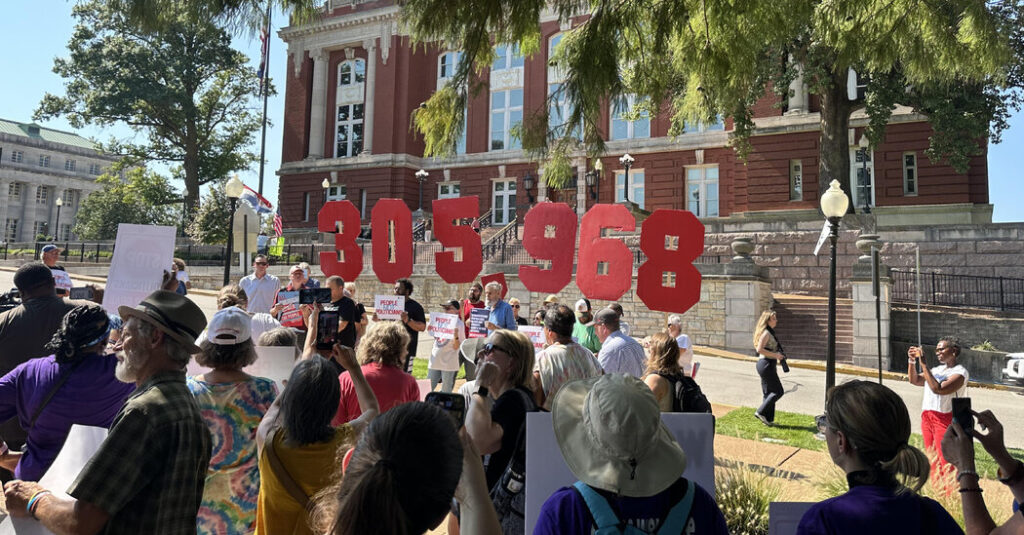
By redrawing the lines outside the usual once-a-decade cycle, Missouri Republicans saw an opportunity to unseat one of the two Democrats in their state’s congressional delegation. State legislators passed the new map in a special session last September despite large protests and pleas from Democratic legislators.
In the months since, opponents of the new map have clashed repeatedly with Republican officials in court. The two sides have sparred over the legality of the redistricting effort, over the validity of a petition drive to force a statewide vote on the new lines, and over which court should have the final word on the boundaries.
In posts on the online forum Election Law Blog, election law experts generally agreed that the order requiring the state to use the map favoring Republicans was — at least for now — the controlling decision because it was based on federal and not state law. In general, federal laws trump conflicting state laws under the Supremacy Clause.
But those experts suggested that the district judge, Stephen R. Clark of the Eastern District of Missouri, did not have the authority as a federal judge to intervene after the Missouri Supreme Court’s ruling that deemed the new map invalid.
It complicated matters, they said, that Justice Kavanaugh did not provide any reasoning for his order.
Judge Clark, who was nominated to the bench by Mr. Trump, noted in his opinion that he was aware of Justice Kavanaugh’s order. But Judge Clark still directed the state to use the 2025 map that it relied on in last month’s primary.
After Mr. Hoskins, Missouri’s secretary of state, said on Tuesday that he would forge ahead with using the redrawn boundaries — complying with the federal district judge’s order — redistricting opponents filed a motion seeking to have Mr. Hoskins held in contempt by the state’s high court.
“This court should make clear that regardless of other orders (except from the United States Supreme Court) the Missouri secretary of state must comply with this court’s injunction,” Charles W. Hatfield, a lawyer for the redistricting opponents, wrote in his motion with the State Supreme Court.
That court, which has five judges appointed by Republican governors and two appointed by Democrats, ruled unanimously against Mr. Hoskins last week.
Late on Tuesday night, Chief Justice W. Brent Powell scheduled a hearing on whether to hold Mr. Hoskins in contempt and instructed the secretary of state to appear in person.
Chief Justice Powell, who was appointed by a Republican governor, also asked Mr. Hoskins to reply in writing on Wednesday to concerns about his instructions to county election officials and his willingness to abide by court rulings.
“Denny Hoskins is hereby ordered to show cause, if any, why he should not be held in contempt for violating this court’s injunction,” Chief Justice Powell wrote in the single-page order.
On Wednesday afternoon, lawyers for Mr. Hoskins urged the Missouri Supreme Court to stand down, arguing that any sanction “would be profoundly unlawful and unjust.” His lawyers also asked Judge Clark, of the Federal District Court, to order the Missouri Supreme Court not to move ahead with the matter.
“The court must not take the radical step of holding the secretary of state in contempt for following a federal court order,” lawyers for the Missouri attorney general’s office said in their filing with the state’s high court.
The post Fight Over Missouri House Map Returns to U.S. Supreme Court appeared first on New York Times.