President Trump declined to say on Wednesday whether the United States opposed new European and Canadian sanctions against Israeli settlements, the latest in a notably muted U.S. response about penalties against America’s most important ally in the Middle East.
Speaking to reporters as he was about to depart Washington for Texas, Mr. Trump said that he was aware of the wide-ranging economic restrictions announced by Britain, Canada and France targeting Israeli settlements in the occupied West Bank over settler violence against Palestinians.
Asked whether the U.S. opposed them or remained neutral, Mr. Trump dodged the question.
“I’ll be speaking to Israel,” he said. “I’ll be speaking to them, and I’ll find out what they, what’s their thinking. I understand exactly what’s going on. But I want to find out why all of a sudden does that happen.”
Three officials with knowledge of the situation said that Mr. Trump, during a call with Prime Minister Andy Burnham of Britain, was briefed on the sanctions before they were announced, and that he did not push back on them. The people spoke on the condition of anonymity to discuss a private call.
Taken together, Mr. Trump’s response on Wednesday and his reaction during the call with Mr. Burnham speak to the president’s growing frustration with Prime Minister Benjamin Netanyahu of Israel as the war in Iran grinds on.
The White House did not respond to questions about where the United States stood on the sanctions, whether Mr. Trump’s response signaled tensions with Israel, or its position on settler violence. Instead, a White House official, who spoke on the condition of anonymity to discuss sensitive diplomatic relations, said Mr. Trump has a strong relationship with Mr. Netanyahu and commended the country’s military.
The United States and Israel jointly launched the conflict in Iran earlier this year.
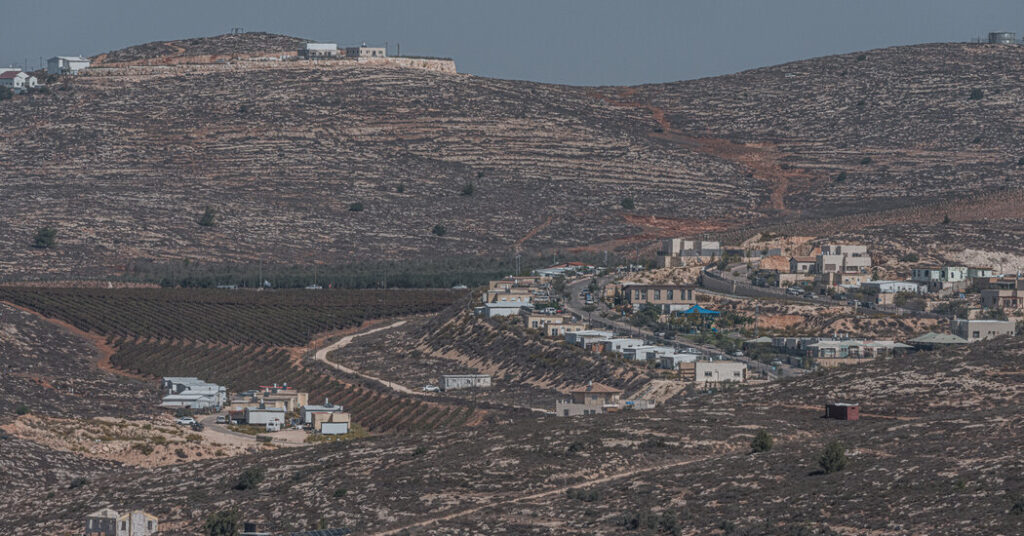
Britain, Canada and France on Tuesday announced sanctions on Israeli settlements in the occupied West Bank, a remarkable rebuke to Israel from once-staunch allies. The pact was led by Britain, which accused Israel of committing “ethnic cleansing” in the West Bank.
The measure risked a rift with the United States, which supports Israel militarily and diplomatically. But thus far, U.S. officials who are usually quick to defend Israel have been restrained in their sparse remarks on the matter.
Secretary of State Marco Rubio, who notably has criticized nations who issued Gaza-related sanctions against Israeli officials, said that the United States was given a heads up about the decision, but suggested that it was theirs to make.
He told reporters on Tuesday that the United States “obviously” would not join the other nations, but stopped short of criticizing them.
“We heard their argument as to why, but look, we share the goal of stability,” he said. “We don’t want to see some uptick in violence or an uptick in conflict or tensions in the West Bank at a very tenuous time. In the region, there’s always tenuous times.”
Mike Huckabee, the U.S. ambassador to Israel, was the only U.S. official to denounce the sanctions, just days after he had a rare meeting with Palestinian Americans in the West Bank, where he denounced Israeli extremists’ attacks on Palestinians and called them “terrorists”
In an interview with the BBC, he called the British trading bans “discrimination against the Jewish people” and “irrational.”
A White House official said Mr. Huckabee’s comments were not coordinated with the White House or State Department.
William F. Wechsler, the senior director for Middle East programs at the Atlantic Council, said the potency of settler violence in the West Bank was probably driving the Americans’ ambiguity.
“There are few policies that have the potential to bring together a wide coalition in the United States, across both parties, than what is seen to be terrorism in the West Bank,” Mr. Wechsler said.
While Mr. Trump has rarely addressed settler violence, and in fact lifted sanctions placed on extremist Israeli settlers by President Joseph R. Biden Jr. upon his return to office, he has said that he would not allow the annexation of the West Bank.
The administration has also reiterated the need for stability in the region in order to implement Mr. Trump’s peace plan for Gaza, which he has described as the linchpin for peace in the wider Middle East.
Lucy Kurtzer-Ellenbogen, a senior fellow with the Middle East Institute, said the administration might see the ongoing settler violence as an impediment to Mr. Trump’s ambitions.
“They’re seeing more and more of the interconnectedness of those two fronts, and can’t let one deteriorate without the precipitous deterioration of the other,” Ms. Kurtzer-Ellenbogen said.
“If we look in the context of what this administration has said at the highest level before and what they’re not saying now,” she added, “it does credibly paint a picture of an administration that may be willing to let allies do some work here that it’s not fully opposed to. It would not be a stretch for the Israeli government to be reading less support than they may want in the silence.”
Adam Rasgon contributed reporting from Tel Aviv.
The post Trump Takes No Position on Allies’ Sanctions Against Israeli Settlements appeared first on New York Times.