Canada is aggressively courting new trading partners as relations with the United States grow increasingly tense, in a move that could deliver economic consequences for U.S. businesses and consumers.
Canada has an ambitious goal to double its exports to countries beyond the U.S. by 2035, a target that has become more urgent in the face of hefty new tariffs — from both sides — taking effect. President Donald Trump imposed 50 percent levies on a long list of Canadian products this summer and has needled Canadians by suggesting the country should become the 51st U.S. state.
“This time it’s more than just feelings being hurt,” said Carlo Dade, director of the New North America Initiative at University of Calgary’s School of Public Policy, of Canada’s renewed interest in trade diversification. “There’s also an appreciation for the permanence of change in the U.S.”
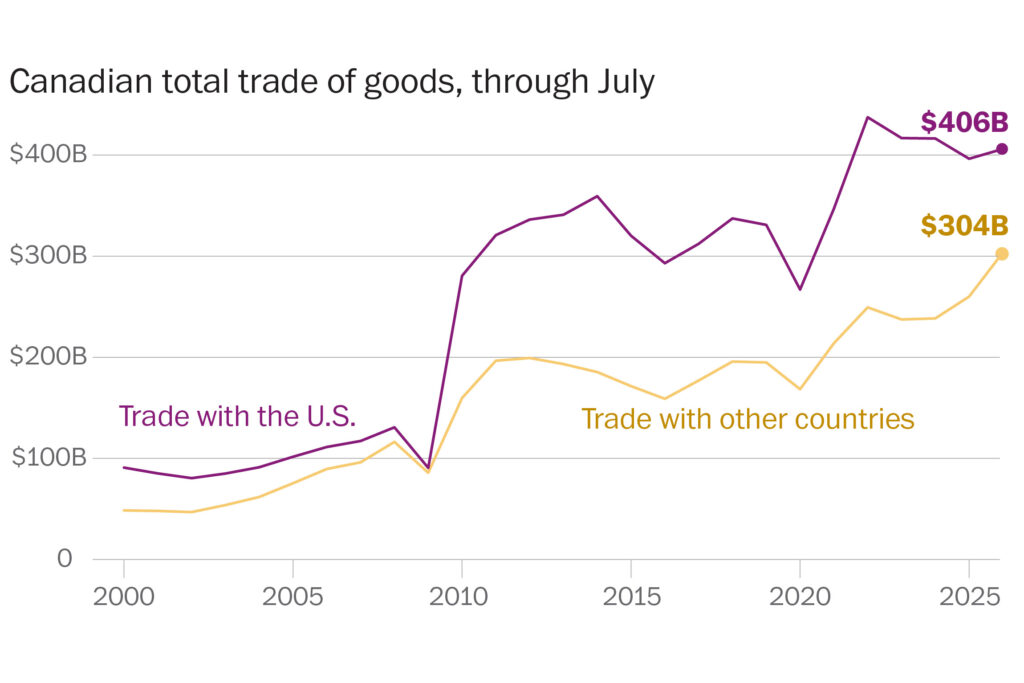
Canada made significant progress last year in closing the gap between U.S. and non-U.S. exports; the share of goods that went to other countries around the world made up about 28 percent of total exports.
International Trade Minister Maninder Sidhu detailed Canada’s extensive plans to diversify trade in an emailed statement and said that he is receiving “more calls than ever from partners around the world” seeking Canadian goods.
Canada has signed more than 20 trade and security deals over the past year, Sidhu said, and has secured about $12 billion in commercial deals. The country is also evaluating dozens of infrastructure projects to help facilitate trade, including new ports and mines.
“It’s proof that in a rapidly changing world, our new government is focused on what we can control: diversifying our trading relationships to build a stronger economy that supports Canadian workers and industries,” he said.
The U.S. is Canada’s largest trading partner by far — Canada exported $556 billion worth of goods in 2025, and 72 percent went to the U.S.
For decades, the U.S. and Canada had a peaceful and mutually beneficial trade relationship; the proximity and mostly free trade between the countries contributed to U.S. businesses’ ability to easily import groceries, lumber and oil. U.S. automakers rely on a supply chain that often involves building components of cars just over the border in Canada.
If Canada significantly diversifies its trading partners, it could increase U.S. competition — making it harder and more expensive for U.S. businesses to get some materials, eventually driving up some costs for American consumers.
“More demand happening without change in supply — that is a classic situation in economics where prices go up,” said Brett House, an economics professor at Columbia Business School. “You’ve got more competition for the same goods.”
It could take years before Canada’s diversification affects the United States. Already Canadian exports to countries other than the U.S. grew by more than 14 percent in 2025 compared to the year before, according to a Washington Post analysis of customs-based Canadian trade data. Exports to the U.S. fell by nearly 8 percent in the same time.
The shifts show that businesses and governments are taking the push for trade diversification seriously, especially in a year that brought the shock of tariffs after years of mostly free trade.
Trade economists and experts say that significantly expanding beyond the U.S. is a path full of hurdles for Canadian businesses. The U.S., which shares a border, language and many business practices with Canada, is the country’s largest and most logical trading partner.
“The biggest, richest market in the world is right next door,” said Jock Finlayson, senior fellow at the Fraser Institute, a free-market Canadian think tank.
The U.S. market is huge, rich and convenient for Canadian businesses, and trade routes — both physical and business partnerships — are long established.
“We’ve built irreplaceable assets, or high-cost assets, that will take decades to replace,” said Dade of University of Calgary.
Expanding into new markets means building out or expanding new physical infrastructure, such as pipelines and ports, and cementing new relationships.
Canada’s government has been working on this. Led by Prime Minister Mark Carney, it has opened trade discussions with countries around the world, including India, Indonesia and Ecuador.
“Even though the United States’ trade actions will cause us some challenges in the short term, we are going to just move faster,” Carney said in a recorded videoTuesday, as Canadian’s countertariffs on about $20 million worth of U.S. imports took effect. He acknowledged the pivot will “come at a cost.”
Diversifying trade does not mean Canada will exit the U.S. market.
“I do believe that the U.S. is always going to be our largest trading partner because gravity dictates that,” said Meredith Lilly, an international economic policy professor at Carleton University in Ottawa who advised former prime minister Stephen Harper on international trade. “Succeeding at trade diversification may also mean increasing trade both with the U.S. and with other countries.”
The gap between Canada’s total trade volumes with the U.S. and with all other countries is the smallest this year that it’s been since the beginning of the pandemic.
A significant amount of the increase in non-U.S. Canadian exports last year came from an uptick in demand for gold — especially from the United Kingdom — a material that is coveted during times of geopolitical uncertainty. Gold has been in the top five of Canadian exports since 2009, during the Great Recession.
Canada, a country rich in natural resources, exports a lot of oil, gold, petroleum gases and motor vehicles.
Despite the barriers to trade diversification, overreliance on a single market is risky, and expanding trading partners could increase Canada’s leverage and power in trade negotiations, Lilly said.
Tariffs are increasing the cost of trade with the U.S. and making Canadian firms question the stability of the U.S. as a trading partner, she said.
In the absence of that instability, she said, Canada might not be pushing quite as hard for other trading partners.
About the data
The Post analyzed Canadian trade data obtained from the data supplier Trade Data Monitor. All the data is custom based and not seasonally adjusted. The gold data uses the four-digit level of the Harmonized System, an international method used by countries to classify goods traded.
The post See how Canada is shifting its trade beyond the U.S. appeared first on Washington Post.