This story appeared in Today, Explained, a daily newsletter that helps you understand the most compelling news and stories of the day. Subscribe here.
A growing chorus of teachers, parents, and education experts is worried that American students can’t read. But, hear me out, silver lining here: At least the students are in good company. (Okay, maybe that’s not exactly a silver lining.)
A new report from the Programme for International Student Assessment, or PISA — a standardized global test of 15-year-olds’ math, reading, and science skills, administered by the Organization for Economic Cooperation and Development — finds that scores in all three subjects have dipped to their lowest levels in OECD countries since testing began in the early 2000s.
Reading scores fell especially sharply, by the equivalent of more than a year of education, between 2015 and 2025. In the US, reading scores fell by roughly 14 percentage points between 2022 and 2025.
These results, based on a sample of more than 760,000 students from 91 countries, are among the most-watched educational metrics in the world. And the million-dollar question — as always — is why those metrics continue to fall.
The report gestures at the usual suspects: the lingering effects of the Covid-19 pandemic; an attentional crisis that makes it difficult for kids (and adults!) to stick with long texts.
PISA also surveyed students about their use of generative AI, the first time it’s done so since the technology became widely available. But as I’ll explain more below, anyone looking for clear takeaways on classroom AI and its effect on learning will probably be disappointed.
Go a little deeper
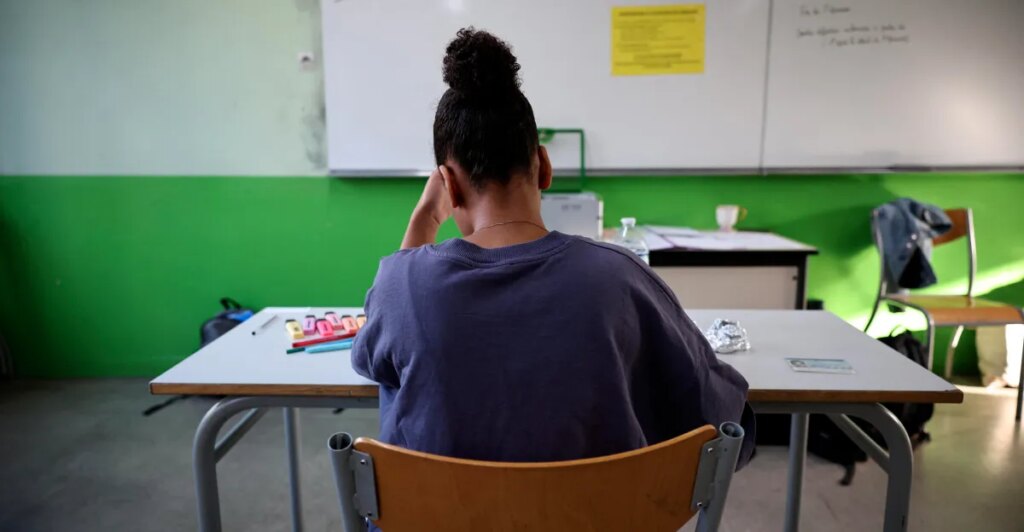
If you know a high school student, chances are they use AI for school. In the PISA report, 86 percent said they use it at least occasionally, and roughly one in 10 use it every day.
But whether that helps or hurts learning seems to depend on how students use it. In this report, the small minority of students who never use AI generally outperformed those who do. But weekly users who used AI to “help them learn,” as opposed to using it to complete specific tasks, performed about as well as nonusers. And frequent AI users who were also taught AI literacy skills scored slightly higher.
In other words, the unsatisfying answer to the question “Is AI good or bad for learning?” is probably…“it depends.” My colleague Adam Clark Estes took on this question last year, and found several promising applications of the technology in education: tools that free teachers from grunt work, for instance, and educational chatbots designed to provide personalized tutoring.
In upstate New York, where I’m based, a federally funded research center is developing AI tools for children with learning and language disorders. One mother told me she credited an AI reading app with dramatically improving her autistic son’s communication.
That nuance complicates the policy discussion around AI and education. Some of these applications would likely be disallowed under New York City’s new, one-year AI moratorium, for instance, which bans student-facing generative AI tools in public elementary and middle schools in the country’s largest district.
In announcing the ban, schools chancellor Kamar Samuels argued a pause would allow the district to evaluate which tools, and which use cases, truly help students learn. That’s the assignment now facing educators and policymakers the world over — presumably, they won’t ask ChatGPT to do it for them.
One link for later
➨ Fight for your right to leave your phone at home. An ever-larger range of everyday tasks now requires a smartphone: reading a menu, parking a car, taking public transit, etc. But while the QR-codification of daily life can sometimes be convenient, it also locks many elderly and low-income people out of services and locks the rest of us into a cycle of digital dependence. The fix might lie in public policy. Or consumer resistance.
Before you go…
- Did you know…that almost all of America’s walkable urban neighborhoods date back to before World War II? In other words, you can live in a new house or apartment, or you can live in a walkable place. But most people won’t have the option to do both until the US builds denser urban housing.
- Today’s trivia: In Greek and Roman mythology, who was the legendary founder and first queen of Carthage? (You can find this and other brain puzzles in Vox’s daily crossword. Look for the answer in tomorrow’s edition.)
- Yesterday’s trivia: Yesterday we asked you for the archipelago that includes the Isle of Skye. That would be the Inner Hebrides, off the coast of Scotland, whose landscapes have inspired a wide range of cultural works: among them, the Enya song “Ebudæ,” the original screenplay for Peter Pan, and George Orwell’s 1984.
The post A grim report card for the world’s schools appeared first on Vox.