The invasion of Canada was to be swift and overwhelming.
U.S. forces would take the port city of Halifax before seizing power plants near Niagara Falls. More American troops would storm across the border to capture Montreal, Quebec and other key cities. The secret U.S. military plan, known as War Plan Red, even authorized the use of poison gas.
The assault was never seriously considered. Drafted in 1927 and declassified decades later, it was a contingency plan for a highly unlikely war.
History took the opposite path: In the century since, the United States and Canada have been two of the friendliest and most integrated nations ever to share a border.
Until recently, that is.
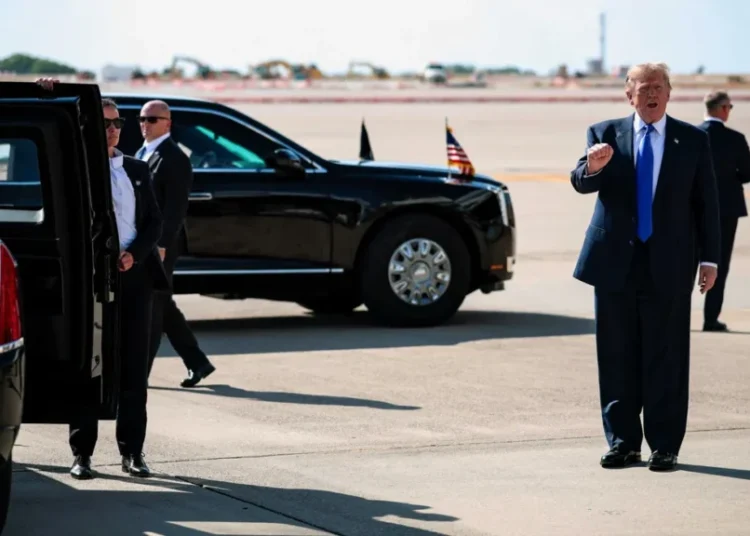
President Trump has thrown the U.S.-Canada relationship into its greatest crisis since his country’s northern neighbor became self-governing in 1867. Accusing Canada of unfair trade practices, Mr. Trump has instigated a trade war that on Tuesday led Prime Minister Mark Carney of Canada to retaliate with tariffs targeting roughly $20 billion in U.S. imports. Mr. Trump in turn escalated with bans on imports of some Canadian motorcycles, alcoholic beverages, dairy products and molasses.
Mr. Trump is hardly the first U.S. president to feud with Canada, especially on economic matters. Trade disputes shook relations for much of the 20th century, though they became far less common once the 1994 North American Free Trade Agreement came into force.
Other heated cross-border disputes have flared on matters ranging from Alaska’s Yukon border to whether Canada would allow American nuclear weapons on its soil.
But Mr. Trump’s hostility toward Canada features a nationalist streak that goes well beyond economics. He has taunted its leaders as weaklings, denigrated its military as ineffective and even challenged its sovereignty. In particular, his talk of claiming its 3.9 million square miles of territory as a “51st state” has inflamed longtime Canadian anxieties about American domination, and even invasion.
At times he even intimates violence, as in a recent Truth Social post depicting himself and Mr. Carney in hockey gear, with Mr. Trump standing over a fallen Mr. Carney as though he has just body-checked the Canadian leader.
“I think it’s actually impossible to find a period where things were as bad,” said Robert Bothwell, a professor emeritus at the University of Toronto’s Munk School of Global Affairs who specializes in U.S.-Canada relations. “There’s never been an occasion, ever, where an American president has said the annexation of Canada was his objective.”
Before Mr. Trump came along, the popular American image of Canada was one of a friendly, harmless and perhaps somewhat dull junior partner to the United States. The notion of cross-border conflict was the stuff of satire. The 1995 Hollywood comedy “Canadian Bacon” imagined an unpopular U.S. president who whips up popular resentment toward Canada to distract from his domestic struggles. Now Canadians ask whether the movie was prescient.
Canadians have always been warier of the United States, according to Christopher Sands, the director of the Center for U.S.-Canada Relations at Johns Hopkins University’s School of Advanced International Studies.
Canada was formed by several British colonies that had never broken with London, unlike their American counterparts. Seeing the growth of U.S. economic and military power as a potential threat, they joined together in the name of collective strength while remaining part of the British Empire well into the 20th century. (War Plan Red did not reflect such a threat: It imagined a U.S. attack on Canada as a defensive response to war with Britain.)
Quarrels over a common 5,525-mile border were largely settled in a 1908 agreement, one that Mr. Trump has called invalid.
But economics still roiled the relationship. After Congress approved a 1911 agreement to drop tariffs on major Canadian imports, conservatives in Canada attacked it as a threat to the country’s independence — not entirely without justification.
“I look forward to the time when the American flag will fly over every square foot of British North America up to the North Pole,” Representative Champ Clark, a Missouri Democrat who would soon become speaker, declared during a House debate on the measure.
A backlash resulted in Canada. According to Mr. Bothwell, some Americans were stopped on the street and forced to sing “God Save the King.”
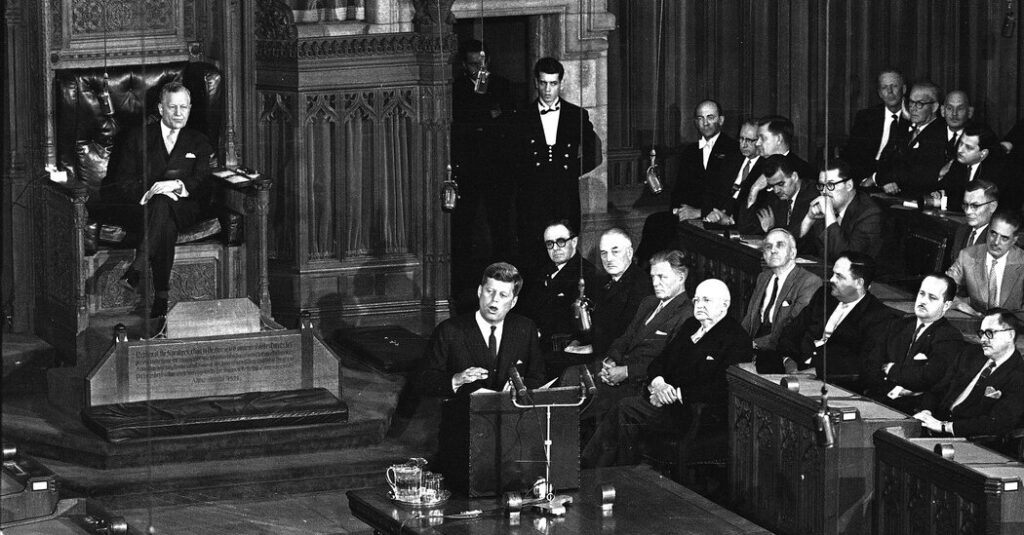
Cold War politics produced more clashes. Canada fought alongside the United States in both world wars and joined the United States as a founding member of NATO. And President John F. Kennedy celebrated the relationship in a grandiloquent 1961 address to Canada’s parliament: “Those whom nature hath so joined together, let no man put asunder,” he declared.
But Mr. Kennedy lashed out at Canada’s prime minister when he resisted the placement of certain U.S. nuclear weapons on Canadian soil that were intended to deter the Soviet Union, and when he hesitated to place Canada’s military on heightened alert during the Cuban Missile Crisis in 1962.
An even greater shock came in the form of Richard Nixon’s 1971 move from the gold standard and imposition of 10 percent tariffs on all imports, including Canadian ones. While many countries were affected, none were quite so dependent on the U.S. economy as Canada.
After a heated December 1971 meeting at the White House between Mr. Nixon and Prime Minister Pierre Trudeau, Mr. Nixon declared the Canadian a “pompous egghead” and a “son of a bitch.” Mr. Trudeau later responded that he had “been called worse things by better people.”
Mr. Nixon abandoned the plan months later. Mr. Sands said the economic disruption it created wound up driving support for greater free trade across the border, culminating in the 1994 NAFTA agreement. (Mr. Trump has derided that Clinton-era pact as a “nightmare,” and renegotiated it during his first term under the rubric of the United States-Mexico-Canada Agreement, or U.S.M.C.A.)
The shock of Mr. Nixon’s economic gambit also boosted Canadian mistrust of U.S. economic intentions. In 1973, the Canadian political thriller “Ultimatum” depicted an American president’s demand for free access to Canada’s vast oil and gas reserves.
Canada’s prime minister resists, but the American president refuses to take no for an answer.
“As of this moment, Canada will become part of the United States of America. The government of Canada is hereby dissolved,” he declares at its conclusion.
“Ultimatum” became the year’s best-selling book in Canada.
Few expect Mr. Trump to go that far. Mr. Sands said Mr. Carney could still strike a deal to defuse the crisis. But he also warned that the dispute had unleashed forces that may take on a life of their own.
“Trump has pushed the nationalist buttons in Canada,” Mr. Sands said. “As long as Carney resists, it’s good for his politics.”
“The Canadians have really been shocked by this,” he added. To restore relations, he said, “we have to win the Canadian public back over — and that’s going to take a long time.”
The post A Hostile Trump Reopens Old Wounds in the U.S.-Canada Relationship appeared first on New York Times.