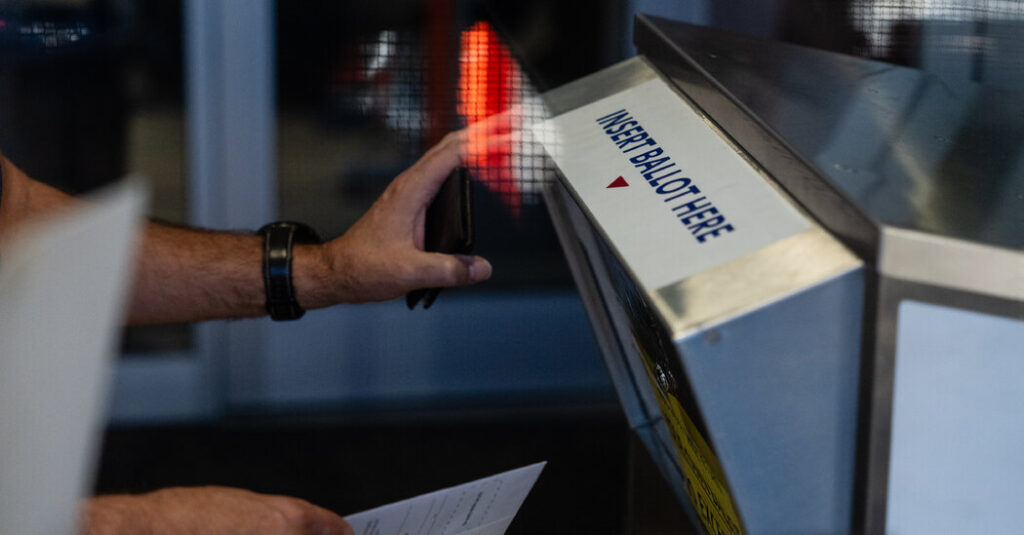
Election officials in Madison, Wis., mailed 18,000 ballots on Tuesday, more than a week ahead of the state’s targeted date, just to get them out the door. In Weber County, Utah, officials are considering setting up distribution centers for voters to retrieve their mail ballots and bypass the Postal Service completely.
Across the country, election officials are grappling with the confusing implications of the Trump administration’s proposed mail ballot screening plan, which would allow the Postal Service to determine which ballots can be delivered to voters.
A federal judge has halted implementation of the system, which has been challenged as unconstitutional by two dozen states. The Trump administration has asked the Supreme Court to intervene and allow it to go forward.
While they wait for the court’s order, local election officials are trying to sort out how they would comply with the new rules, which would require states to use federally approved envelopes with bar codes unique to each voter and upload voter data to an online Postal Service portal, which is not yet operational.
“Quite frankly, we don’t even really have a way to prepare because we don’t know when that ruling is going to come down, and then we’re going to get state guidance, and then we are crunching up closer and closer to Election Day,” said Lisa M. Deeley, the Democratic vice chair of the Philadelphia City Commissioners, which runs elections and voter registration for the city. The city is planning to start mailing ballots next week.
“It’s just chaos,” she added.
Some states, including North Carolina, Delaware and Alabama, have already mailed out their ballots, raising serious questions about how they could retroactively comply with the new system if it is put into place.
It is not clear whether or how the Postal Service would verify previously mailed ballots if the new rule goes into effect.
“We have not been provided any further information regarding their process for verifying the ballots,” said Kristin Mavromatis, the spokeswoman for the board of elections in Mecklenburg County, N.C.
Many election experts say the plan could make it nearly impossible for some Americans to vote by mail because it would create impediments to the delivery of their ballots.
“It would be massively disenfranchising, and it would serve no real purpose, because the government didn’t make any showing that this rule is actually going to prevent any fraud, or even that they could put their rule in place,” said Richard L. Hasen, a professor at the University of California, Los Angeles, who specializes in election law.
Mr. Hasen said that the rule would especially hurt rural, disabled and elderly voters who cannot easily get to polling locations.
Under the Constitution, states are responsible for carrying out elections. The states that are challenging the Trump administration’s new plan say that it creates a federal role in elections because the Postal Service would reject ballot envelopes that do not comply with the new standards and send them back to local and state officials to fix.
“That comes dangerously close to playing a role in the administration of elections, which the Postal Service has always, always eschewed,” William Hensley, a former Postal Service official who worked with local election officials on best practices for ballot delivery, said.
The Postal Service has denied taking on a new election administration role, saying that states have complete control over voter registration data.
The agency did not respond to requests for comment this week. In a statement on Friday, the postmaster general, David Steiner, said, “Regardless of political party or perspective, we share a common goal: ensuring that Americans can have confidence that their election mail will be handled securely and delivered reliably should their election officials choose to use the mail for ballot delivery.”
Some of the requirements in the rule — such as those that would standardize federal ballot envelopes and create unique bar codes for voters that the Postal Service can easily read automatically — could improve the process, some elections officials and lawyers said. But, they added, it is impossible to accomplish those changes in time for the Nov. 3 elections.
“These are all good things,” said Eric Fey, the Democratic elections director in St. Louis County, Mo. “But if people haven’t been doing it, it can’t be implemented overnight.”
Missouri is one of 12 states that joined the Postal Service in defending the rule in federal court. The state has said it would be able to comply if the Supreme Court gives the Trump administration the green light, although Mr. Fey said he told the state’s top election official that some counties could not comply because they do not have federally approved envelopes or Postal Service bar codes.
In Utah, a deeply red state that votes almost exclusively by mail, some local officials are discussing abandoning mail voting entirely if the Supreme Court allows the Postal Service to restrict the practice.
With envelopes already printed and ballots coming soon, Ricky Hatch, the Republican clerk in Weber County, Utah, said that it is too late for his county to comply with the proposed federal requirements. Officials are considering setting up backup ballot distribution centers.
“We’re going to have to figure out how are we going to get these ballots into the hands of the voters,” Mr. Hatch said, adding: “It will be expensive and challenging and some voters will be disenfranchised, and it will be confusing.”
Some election officials have also expressed alarm about the Trump administration’s requirement that states upload their voter data to a Postal Service portal. The Postal Service would then only deliver ballots to those on the lists.
Elections are usually administered by individual counties, and standardizing voter registrations even within a single state is a challenge, local officials noted.
Some Texas counties have struggled with the state’s election management system that was launched last summer, said Dyana Limon-Mercado, the Democratic clerk in Travis County, one of the largest in the state.
Ms. Limon-Mercado said that certain voter registrations have been disappearing from the state system. At one point, the state system did not accept hyphenated names, she said. “I have no confidence that this state system that is also unstable and still buggy is going to connect to some federal system that we haven’t seen yet or tested yet,” she said.
Zach Montague contributed reporting.
The post Election Officials Grapple With Uncertainty as Supreme Court Considers Mail Ballot Plan appeared first on New York Times.