Where were you on 9/11? Every American old enough to remember the day has an answer to that question. President Trump has several.
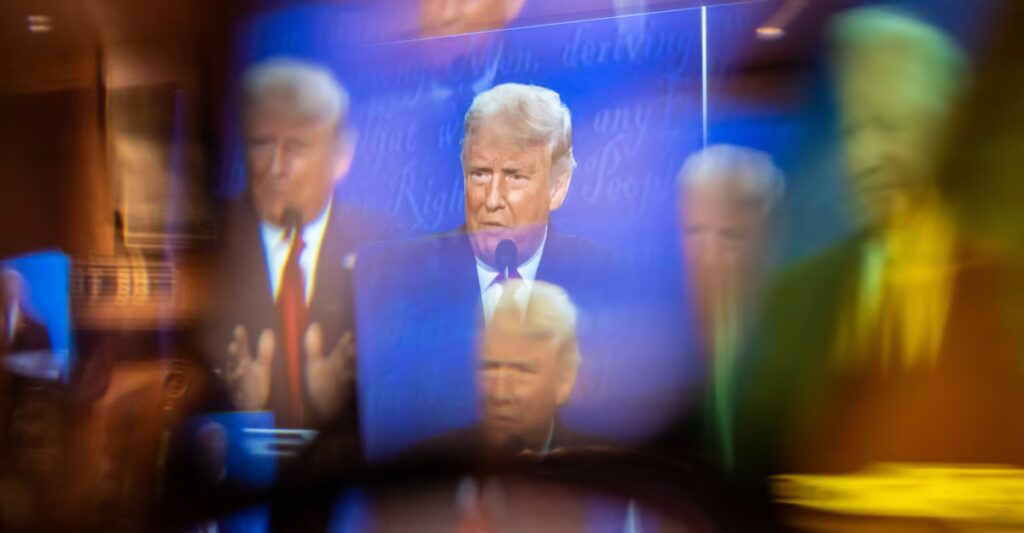
At a ceremony honoring first responders and victims’ families yesterday, Trump offered an elaborate account of where he was in the hours and days after nearly 3,000 Americans were killed. “I was building a big building in New York, and I took the whole crew down there right after this happened, and they had no hesitation; everybody went down with me. We went down as a big group of people. Wasn’t too much we could do, I’ll be honest. It was raw—nobody had seen anything like it, ever.”
The story presents significant problems in terms of its relationship to reality. Listeners could be forgiven for interpreting Trump’s remarks as a reference to his whereabouts on the day of the attack itself. (The president clarified that timeline last night: “I was there, obviously not on the same day as the collapse, but shortly thereafter, with a large group of Construction Workers,” he wrote in a Truth Social post.) It is true that two days after the attack, on September 13, Trump was interviewed by reporters while walking in Lower Manhattan. The president has previously made variations of the same claim—that he and the employees he sent downtown helped clear rubble in the days following the attack. “Everyone who helped clear the rubble—and I was there, and I watched, and I helped a little bit,” was his version of it on the 2016 campaign trail. But supporting evidence is scant, and the whole account is likely an exaggeration. Richard Alles, a retired New York City Fire Department deputy chief, who had a supervisory role in the efforts, said in 2019 not only that he never witnessed Trump at the site, but that the account doesn’t add up: “He was a private citizen at the time. I don’t know what kind of role he could have possibly played.” And, Alles added, if Trump had indeed sent workers, as he has claimed, there would be record of it: “Is there a chance he was ever down there by himself and I didn’t know it? It’s possible, but I know of no one who ever witnessed him there.”
Nevertheless, Trump pressed on, veering into territory even further detached from verifiable fact. The U.S. Steel Building—a skyscraper in Lower Manhattan known today as One Liberty Plaza—was “really creaking,” Trump said at yesterday’s ceremony. “I’ll never forget: two firemen. We thought it was coming down on top of us and two firemen—big, strong guys. And I’m not the smallest guy in the world. They grabbed me under the arms, said, ‘Gotta get outta here.’ And they literally lifted me up—this is not easy to do; I’m big. They lifted me up, and they started running with me. I said, ‘Fellas, I can run myself.’ But they were amazing, but they thought it was coming down. It didn’t come down: U.S. Steel.”
There was, in fact, public concern in the days following the attack that the building at One Liberty Plaza could collapse. But the notion that Trump was inside the building and rushed out by firefighters has not been corroborated by any evidence. The president has offered versions of the same account before, though in less colorful form. In 2016, he told a story about being evacuated by firefighters—but in that rendition, it took place “a couple of days” after the collapse, and the U.S. Steel building was “not so far from us” when the two “massive guys” grabbed him. “I never knew I could run that fast,” he said then. In 2021, Trump likewise recalled two firemen grabbing him after hearing “creaks.”
Trump’s whereabouts on September 11 are no mystery. They are fairly well documented by his own prior statements about watching the attacks unfold from his home in Trump Tower, about four miles north of the Twin Towers. For those who have reason to doubt Trump’s statements, his whereabouts are also documented on video. “I have a window that looks directly at the World Trade Center, and I saw this huge explosion,” he said in a phone interview with a New Jersey news channel on 9/11. “For years, I’ve looked right directly at the building—I’d see the Empire State Building in the foreground and the World Trade Center in the background—and now I’m looking at absolutely nothing. It’s just gone, and it’s just hard to believe.”
Trump’s view may have been clear, but his recollection of September 11 has been murky, as reporters have tracked for more than a decade.
Sometimes, in his accounts, he watched the second plane hit the World Trade Center from his apartment in Trump Tower; when he called into the live broadcast that day, he did not mention having witnessed the second jet. Sometimes, he claims to have personally seen people jumping from the Twin Towers. “I have a window in my apartment that specifically was aimed at the World Trade Center,” he said in 2015 on the campaign trail, “and I watched as people jumped.” In his TV interview the day of the attack, he didn’t see those scenes himself but talked to someone who had. “I have somebody that was down there who witnessed at least 10 people jumping out of the building from 70 and 80 stories up in the air,” Trump said.
The president has also embellished what he saw in news coverage on that day, most notoriously claiming to have seen widespread celebrations by Muslim residents in New Jersey. “I watched when the World Trade Center came tumbling down,” he said in a 2015 stump speech. “And I watched in Jersey City, New Jersey, where thousands and thousands of people were cheering as that building was coming down.” That claim has been thoroughly disproved. A professor who spent months combing through news reels and video archives from that day found one possible instance that could slightly resemble those events—a few Arab American teenagers who briefly gathered in front of a library in South Paterson in a way that could be seen as celebratory.
Even the live phone interview Trump participated in on the day of the attack contains inaccuracies. On the call, Trump said that one of his buildings was now the tallest in downtown Manhattan: “Forty Wall Street actually was the second-tallest building in downtown Manhattan,” he said when asked whether his property had been damaged. “When they built the World Trade Center, it became known as the second tallest. And now it’s the tallest.” But as The Washington Post documented, using data from the Council on Tall Buildings and Urban Habitat, neither claim was true. Forty Wall Street was the tallest building for only about two years and that was in the 1930s, before Trump was born.
At the center of yesterday’s ceremony was an important honor—one that Trump had promised to bestow months prior. Welles Crowther, who was first identified as “the man in the red bandana” in a 2002 New York Times story, rescued more than a dozen people from the south tower before being killed when the building collapsed. His parents, who had given him a red bandana as a boy and knew that he always carried it with him, were able to recognize him by that detail and confirmed through the survivors that their son had helped them. Crowther was an equities trader and a volunteer firefighter, and he was 24 years old when he died. While posthumously awarding the Presidential Medal of Honor to Crowther, Trump drew the focus to himself, comparing his own fame to that of the fallen hero: “The Man in the Red Bandana, he’s become more famous than me—I don’t like it. Very unhappy. But he’s become much more famous than me.”
Read: Trump is putting his face on everything
When the president has brought up 9/11 lately, the remark has usually been severed from the attack, its victims, or its perpetrators. This year, Trump has tended to mention the day in the context of lambasting political opponents. He’s invoked it on several recent occasions—alongside World War I, World War II, and Pearl Harbor—when arguing that the attack and all three of those historical calamities are dwarfed by the danger communism poses to America today.
Critics have noted that other presidents, both Republican and Democrat, might have faced months of blowback—if not the end of their political careers—were they caught exaggerating or outright inventing aspects of their experience on one of the most catastrophic days in American history. But Trump has rarely if ever paid a real political price for misleading statements. In a second term marked by his fixation on his legacy, Trump’s relationship with history has often involved “taking bits and pieces from a grab bag and turning it into a story that’s useful to him—either politically useful, as in the case of his fabrication about Muslims celebrating 9/11, or making himself the center of a story that obviously he was not the center of 25 years ago,” Tim Naftali, a presidential historian at Columbia’s School of International and Public Affairs, told me. The fabrications are unlikely to stop, he said, especially as the president ages. “It doesn’t happen the same to all men in their 80s, but we may see more of this: new recollections about the past that we’ve never heard before because they never happened,” Naftali said. The White House did not address my specific questions about the president’s most recent claims, but Davis Ingle, a White House spokesperson, said in a statement that the president “was relaying his experience of a city reeling” from the attacks.
September 11 continues to be a point of tension about what the government owed, and continues to owe, those who were most affected. The mayor’s office released more than 170,000 pages of city records this week showing that city officials misled New Yorkers about air quality following the attacks. And the health toll continues to grow; the number of 9/11 survivors receiving assistance for cancer treatment roughly tripled over the past five years, according to a Washington Post analysis of reports by World Trade Center Health Program, which funds health care for responders and survivors. Twenty-five years later, Americans everywhere will pause to remember what the nation lost that day—both those who suffered directly and those who lived through it by watching the tragedy unfold from the safety of their homes, much as Trump did.
The post All the Places Trump Was on 9/11 appeared first on The Atlantic.