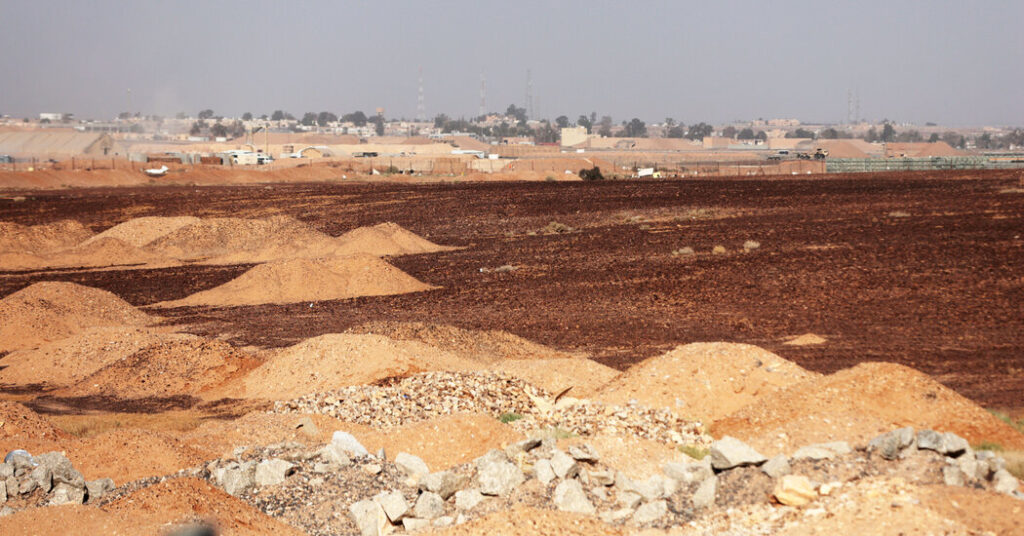
Iran’s bombardment overnight Tuesday of a military base in Jordan used by American forces resulted in “minimal” damage to equipment and caused no deaths, two U.S. officials said on Wednesday.
But the officials warned that some service members may come forward in the coming days to report traumatic brain injuries, a common feature of such strikes.
Eighteen American service members have been killed and scores have been injured since the war began more than six months ago. The Pentagon has provided little information about U.S. casualties unless they were serious, citing operational security.
The barrage of strikes on the base were the latest volley in what is becoming a regular series of tit-for-tat strikes between Washington and Tehran, as Iran’s leaders show a willingness to escalate the conflict.
Iran targeted Jordan after the U.S. military said on Tuesday that it had destroyed five Iranian oil tankers in retaliation for attempted strikes on a U.S. Navy warship.
Iran’s Islamic Revolutionary Guards Corps called the strikes a “punitive operation” and said that they would “continue,” according to Iranian state media.
The Jordanian military said that it had intercepted 18 of the 20 missiles and that two had fallen in unpopulated areas. But the two U.S. officials acknowledged that the base in Azraq, Jordan, was hit.
The attacks occurred three days after Iran made its first known attempt at striking an American military vessel.
The Islamic Revolutionary Guards Corps claimed responsibility for the attacks on a U.S. aircraft carrier and destroyer, saying it fired ballistic missiles at them for “harassing Iranian ships.”
Both countries appear to be stuck in a cycle that is draining U.S. air defenses and deepening Iran’s economic crisis.
As of last month, the Pentagon had used more than 1,500 Patriot interceptor missiles in the war and had fewer than 1,700 interceptors left, according to two people briefed on the stockpile levels who spoke on the condition of anonymity to discuss sensitive military details. The United States produced about 600 interceptors in all of 2025.
At the same time, President Trump’s naval blockade of the Strait of Hormuz, an economically vital waterway, is making it nearly impossible for Iran to ship oil, its main source of revenue.
Mr. Trump has tried to pivot from a military campaign to one focused on choking its economy, but fighting has flared in recent days as each side jostles for control of the strait.
U.S. military officials have vowed to strike three Iranian ships for every two vessels hit by Tehran. But Iran has continued to fire on ships, throttling the world’s oil supply, to preserve one of its biggest sources of leverage.
The result has been a stalemate.
The U.S. military’s Central Command said the Iranian tankers it targeted on Tuesday were “part of a multibillion-dollar shadow network that funds the I.R.G.C. and its regional proxies,” referring to the Revolutionary Guards. It said the attacks came after Iran fired ballistic missiles at a Navy warship twice in two days.
The post Iran’s Strikes on Base in Jordan Caused Limited Damage, U.S. Officials Say appeared first on New York Times.