President Trump plunged the United States even deeper into a series of costly global conflicts this week, creating new economic hazards that have rattled financial markets, risked another rise in prices and unnerved some Republicans ahead of the 2026 election.
On a day when Mr. Trump was set to rally G.O.P. voters ahead of the approaching midterms, the consequences of the president’s agenda were on full display. A trade war he initiated with Canada appeared headed toward another escalation, while a new outbreak of fighting in Iran sent oil prices above $100 per barrel for the first time since July.
Both developments threatened to unleash even higher costs on American families and businesses, which have already been stung by years of unchecked inflation that Mr. Trump has pledged to tame.
The president’s attacks on Canada — and his new bid this week to block some of its exports to the United States altogether — risked damage to American states and domestic industries that rely heavily on commerce across the border. And his ongoing war with Iran contributed to another spike in gas prices, with the average cost of a gallon of gas topping $4.22 nationally on Wednesday.
The fallout has complicated Mr. Trump’s task to convince a restive electorate that the nation is on the right track, almost two years since voters sent him back to the White House in the hopes that he would improve their finances. While the economy once might have served as Mr. Trump’s source of political strength, it has recently become his greatest liability, one that may jeopardize Republicans’ continued hold on the House and Senate in November.
The changing political winds prompted even some members of Mr. Trump’s own party to try to distance themselves from the White House this week.
As the president doubled down on his trade war with Canada, for example, Senator Susan Collins of Maine voiced her objections. A vulnerable candidate in a tough re-election fight this November, she pushed the Trump administration behind the scenes to relax a set of duties on road salt and other products that could hurt her state most.
Mr. Trump did indeed reduce some of those tariffs late Tuesday. But he also moved simultaneously to ban a subset of imports from Canada, a drastic step that could provoke further retaliation from Ottawa.
That prompted Ms. Collins to express renewed concern that the trade war between the two countries could “lead to higher costs for Maine families and uncertainty for businesses,” as she urged the administration in a statement to “de-escalate this conflict.”
The mounting uncertainty exacted a toll on financial markets, sending major indexes lower again on Wednesday. At the same time, the yields on some government bonds rose, reflecting investors’ continued anxiousness about the economy, the rise in oil prices and the government’s own financial health. Those yields remained high even after the Treasury Department announced that it would repurchase up to $6 billion of its own debt, a move meant to make federal borrowing less expensive.
Nor were the consequences contained to Wall Street. Government borrowing affects consumer borrowing, meaning that high yields and mounting uncertainty contribute to rising mortgage costs for aspiring homeowners.
The intertwined developments illuminated the serious political headwinds facing Mr. Trump. Despite his efforts to assuage Americans’ economic frustrations, majorities of voters increasingly tell pollsters that they are frustrated with the pace of progress, and that they blame the president for their financial troubles.
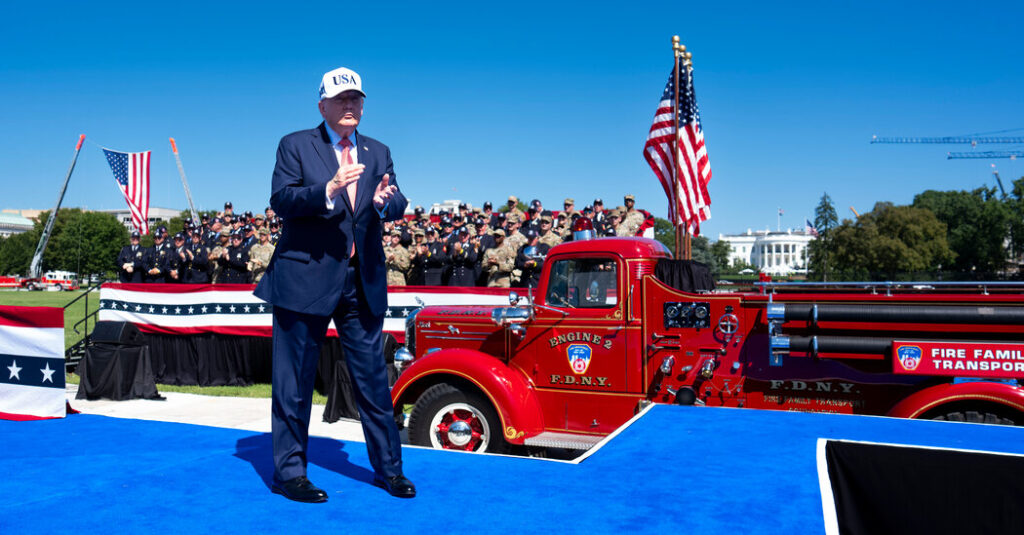
The president could try to convince voters otherwise on Wednesday. At the planned midterm convention in Texas, he is expected to reprise the message that his policies — from withering tariffs abroad, to tax cuts and deregulation at home — have grown the economy, boosted investment, created jobs and driven down prices.
“We inherited the worst inflation in the history of our country,” Mr. Trump said last week, adding “the prices are coming down.”
The data tell a more complicated story. In the nearly two years since Mr. Trump won the White House, the U.S. economy indeed grew amid a boom around artificial intelligence, while the labor market has remained strong. But those gains have been tempered by months of high inflation, as rising prices outpace workers’ wages.
For Mr. Trump, the next report card on the nation’s battle against inflation is due later this week. But the government report will offer a snapshot of prices from a month ago, a period that mostly predates the president’s latest policy maneuvers and the economic hazards he may have created as a result.
Ending a period of relative calm, Mr. Trump has recently reprised his aggressive style of trade brinkmanship. He has readied a slew of new tariffs targeting close U.S. allies, and has even suggested that Washington could take the cataclysmic step of cutting off all trade with dozens of countries with which it runs a trade deficit.
Mr. Trump has reserved his fiercest attacks for Canada in the wake of trade talks collapsing last month. Both countries have slapped each other with new duties, culminating in Mr. Trump’s move late Tuesday to announce a ban on some Canadian imports starting in late September.
The bans targeted some Canadian alcoholic beverages, dairy byproducts, mollases and motorcycles. To downplay the economic consequences, Mr. Trump’s aides described the total range of affected products as small, which would spare Americans from rising prices.
But the concern is that the tit-for-tat could still inflict direct financial damage on U.S. industries and states that are closely intertwined with Canada. That included states like Kansas, where Wichita is the U.S. headquarters for Bombardier, a Canadian plane manufacturer. As part of his retaliation, Mr. Trump has threatened to block the company’s domestic sales, a move that prompted Senator Jerry Moran, a Republican, to appeal to the White House in a bid to protect local workers.
So, too, could Mr. Trump’s actions perpetuate further retaliation from Canada, risking a cycle of more serious blowback for both economies. Atsi Sheth, the chief credit officer at Moody’s Ratings, said the risk is continued “uncertainty,” which could freeze or alter business activity during the dispute.
“It’s very hard to impose very broad tariffs that don’t damage your own economy and your own production,” she said.
The escalating trade spat coincided with another headache for Mr. Trump: the war with Iran, a conflict now in its seventh month. Renewed strikes and continued snarls in global shipping drove the price of Brent crude, the global benchmark, back above $100, marking about a 40 percent jump from before the conflict.
The recent tumult has prompted economists to project that oil will stay higher for longer than they initially thought, perhaps further constraining the global economy. A continued rise in oil could also keep headline inflation in the United States higher, said Padhraic Garvey, the head of research for the Americas at ING.
Mr. Garvey added that the continued energy shock would further carry political risks, feeding “into this idea that the Trump administration hasn’t delivered on its promise with respect to taking down prices, regardless of what the president says publicly.”
The spike in fuel costs has also added to the challenge for the Federal Reserve, which is set to meet next week to decide the next move on interest rates. Having failed for years to bring inflation back to their 2 percent target, policymakers are now openly discussing whether they may need to raise interest rates soon.
The mere possibility has enraged Mr. Trump, who in recent days has reprised his attacks on the Fed board and demanded that it cut rates, rather than raise them. Such a move could actually worsen inflation, but Mr. Trump has downplayed the consequences, as he insists the economy is strong.
“The effects of the Trump Boom can be seen across many Industries,” he said on social media last week.
The post Costly Conflicts with Canada and Iran Loom Over Trump’s Midterm Pitch appeared first on New York Times.