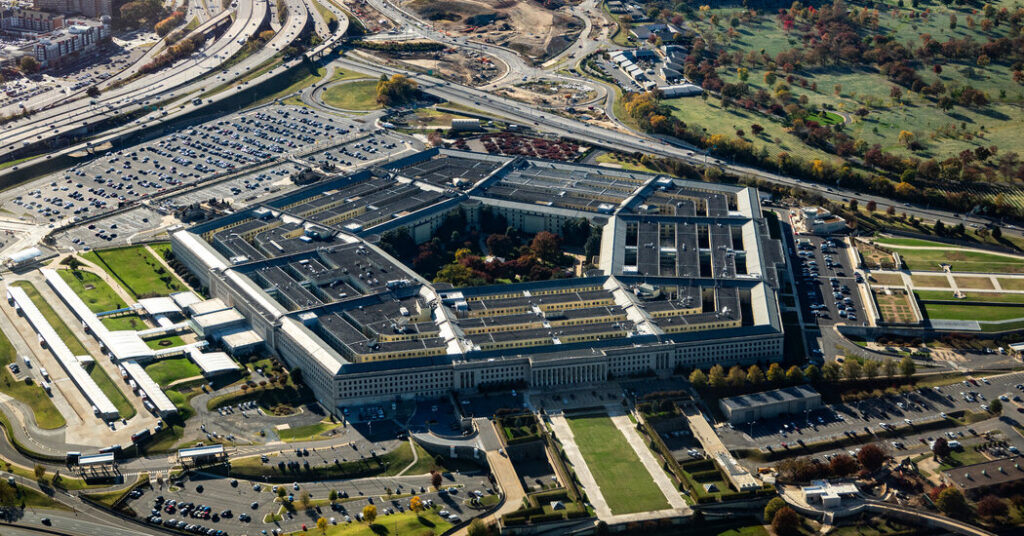
The email from the Pentagon to members of Congress, on the cleanup of toxic “forever chemicals” that have contaminated military installations across the country, opened on a decidedly upbeat tone.
“Good morning!” the email dated Aug. 31 read. “The Department of War is committed to addressing our PFAS releases and we remain dedicated to confronting this national challenge.”
Yet the news the email carried was dire. PFAS cleanups at nearly 243 military sites had been pushed back by an average of 5 years, and some as long as 19 years.
That came after rounds of previous delays, first reported by The New York Times, of work to remove the PFAS, or per- and polyfluoroalkyl substances, a group of synthetic chemicals that don’t break down easily in the environment and have been used for decades in military firefighting foam.
At many sites, PFAS has contaminated local drinking water sources, prompting the Pentagon to provide bottled water to service members as well as nearby residents.
A senior Pentagon official, who declined to be identified because he was not authorized to speak publicly, said the delays were the result of widening investigations, as well as additional work needed as investigators learned the full scope of contamination. The more Pentagon officials looked, the more necessary cleanup work was uncovered, he said.
Tighter standards adopted in recent years to control PFAS, which have been linked to birth defects as well as an increased risk of some cancers, required more extensive remediation, adding to delays, the official said.
The official said the process of investigating and cleaning up the PFAS contamination was moving forward according to the science.
The delays have now blown into a nationwide crisis, with dozens of members of Congress from both sides of the aisle demanding that the Pentagon explain why remediation was taking so long.
“Communities contaminated by PFAS from nearby military bases have waited years for D.O.D. to clean up the toxic chemicals that are harming their health,” Senator Kirsten Gillibrand, Democrat of New York, said. The delays were “reckless, dangerous, and unacceptable,” she added.
Furor over stalled PFAS cleanups has reached President Trump’s base. In May, Representative Jack Bergman of Michigan, an ally of President Trump, berated the Pentagon over its “broken promises” at current and former military sites in his district that are heavily contaminated.
“I am running out of ways to explain to my constituents why the service they trusted with their community continues to treat them this way,” he wrote.
This month, a report from the Defense Department inspector general confirmed that the Pentagon’s cleanups were exceeding time frames established by the department.
The inspector general also found that the Defense Department’s list of contaminated sites might be incomplete, and that the Pentagon could provide no documentation proving that officials had ever analyzed whether PFAS chemicals were used or released at more than 80 installations.
It noted that the Pentagon had spent $2.6 billion between 2017 and 2025 to evaluate, investigate, and address PFAS chemical contamination across military bases. Long-term remediation has yet to begin at any of those sites.
The city of Newburgh, N.Y., declared a state of emergency in 2016 after finding that PFAS from firefighting foam used at the Stewart Air National Guard Base had contaminated the city’s primary drinking water source, Washington Lake.
Although the city switched to an alternative water supply, community groups have pushed for a more complete decontamination, which had been scheduled to begin within a decade. Under the Pentagon’s new timeline, the start date has been pushed back to after 2051.
“The military has a mission, to protect the nation,” said Jennifer Rawlison, a lifelong Newburgh resident who sits on a local residents’ board that advises the base on the PFAS remediation process. “But instead they’ve done us harm, and there needs to be accountability.”
Adding to the insult, she said, local residents hadn’t been informed beforehand of the delay. Instead, they found out from news reports, she said.
The post Toxic ‘Forever Chemical’ Cleanups at Military Sites Face Years of Delay appeared first on New York Times.