Humans have dabbled with mind-altering substances for thousands of years. Our ancestors imbibed fermented alcoholic drinks like beer and mead, and experimented with psychedelic ayahuasca and the opiates found in poppies.
But in a breakthrough, archaeologists have pushed the timeline of human drug use back further than ever before by studying teeth that belonged to a hunter-gatherer who lived in Indonesia sometime from 16,000 to 25,000 years ago.
The individual’s molars, which were found in a cave on the island of Sulawesi, are marked with deep grooves that were most likely left by incessant sucking on betel nuts, which release psychoactive stimulants. Betel nut, also known as areca nut, is still chewed by more than 600 million people today.
Previously, the oldest documented evidence of drug use was beer brewed in Israel some 13,000 years ago. That means the new discovery pushes the timeline of pharmacological experimentation back by 3,000 to 12,000 years, marking “a significant shift in our understanding of human drug history,” according to a study published on Wednesday in the journal Science Advances.
“Human use of psychoactive plants, in particular, was a lot more common in the ancient past than we can appreciate at the moment,” said Adam Brumm, a professor of archaeology in the Australian Research Center for Human Evolution at Griffith University who led the study. “I think it was probably a very deeply rooted aspect of human behavior,” he added.
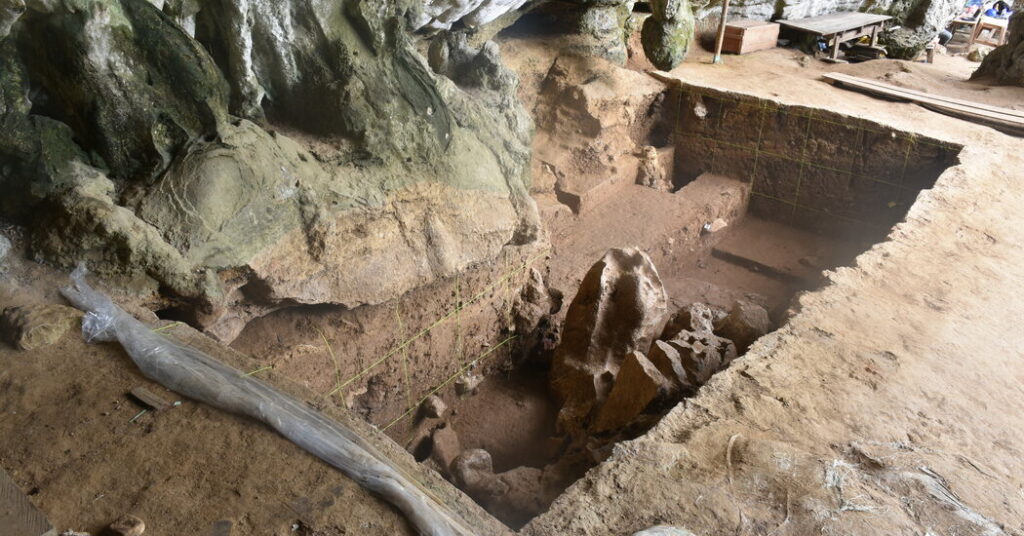
Dr. Brumm and his colleagues unearthed the jawbone and teeth of the ancient forager in 2017 at a cave called Leang Bulu Bettue. Although Sulawesi is home to the oldest known rock art in the world, dating back some 67,000 years, the discovery of the bones was the first time any skeletal remains of prehistoric humans had been found on the island.
The team was immediately perplexed by the strange dental grooves on the molars. The mystery deepened when the researchers found the remains of another forager, who lived about 7,000 years ago, in a different cave on the island. This person shared similar dental-wear patterns.
The matching markings on the teeth suggest they could have been created by a behavior that was passed down over many millenniums in the region. Betel nuts are an obvious culprit. Modern users chew the nut with slaked lime, an ingredient introduced thousands of years ago that facilitates the release of the plant’s psychoactive ingredient, called arecoline.
The prehistoric foragers instead sucked on the nut for its therapeutic effects, according to the study. The team demonstrated that sucking on the nut could release enough arecoline into the brain to create a psychoactive effect. Moreover, they identified traces of arecoline on the teeth of both individuals.
“It’s as close to a smoking gun as we can get,” Dr. Brumm said. “It’s strong evidence that this was an early form of drug use, essentially, and it appears to be what then gave rise to this modern, very widespread tradition throughout the Asia-Pacific region.”
Dr. Brumm and his colleagues speculated that the prehistoric humans used betel nuts as painkillers. This therapeutic remedy wore their teeth down to the pulp, which would have been excruciating. In this way, the teeth might also expose an early glimpse of the cycle of addiction.
“I think they were caught in a negative feedback loop whereby they started this nut sucking to treat toothache,” Dr. Brumm said. “But over time it made their dental problems much worse, and so they became more and more dependent on sucking that nut.”
He added that “it’s really fascinating to see the negative effects that drug addiction, if you want to call it that, had on ancient people before the development of alcohol, nicotine and caffeine.”
Piyawit Moonkham, an anthropological archaeologist at Chiang Mai University in Thailand who is an expert on betel-nut use, agreed that the teeth appeared to offer the oldest evidence of human drug use. But, he emphasized, betel nuts are imbued with many social, cultural and mythological dimensions that transcend the term “drug.”
“This plant is important for our cultures and our society, our social practices and ritual ceremony,” he said.
Elisa Guerra-Doce, an associate professor of prehistory at the University of Valladolid in Spain, said the study provided “robust, empirically grounded evidence for the antiquity of drug consumption.”
On the one hand, Dr. Guerra-Doce said, the results offer “valuable insights into the long-term relationships between people, plants and culturally transmitted traditions.”
“On the other hand,” she continued, “their findings invite us to reflect on the human capacity to experiment, learn and improve iteratively.”
Dr. Brumm noted that the role the drug’s consumption played for these hunter-gatherers remained a mystery.
“Modern betel-nut chewing is definitely a very social thing, and it has very deep symbolism in lots of cultures,” Dr. Brumm said. “The nut sucking itself — we really don’t know — it could have been something like that as well.”
“I tend to just imagine some lone hunter-gatherer out in the forest, hunting or whatever, and just constantly sucking on these nuts,” he added, “as if it’s like chewing gum.”
The post Scientists Discover the Earliest Evidence of Drug Use in Really Old Teeth appeared first on New York Times.