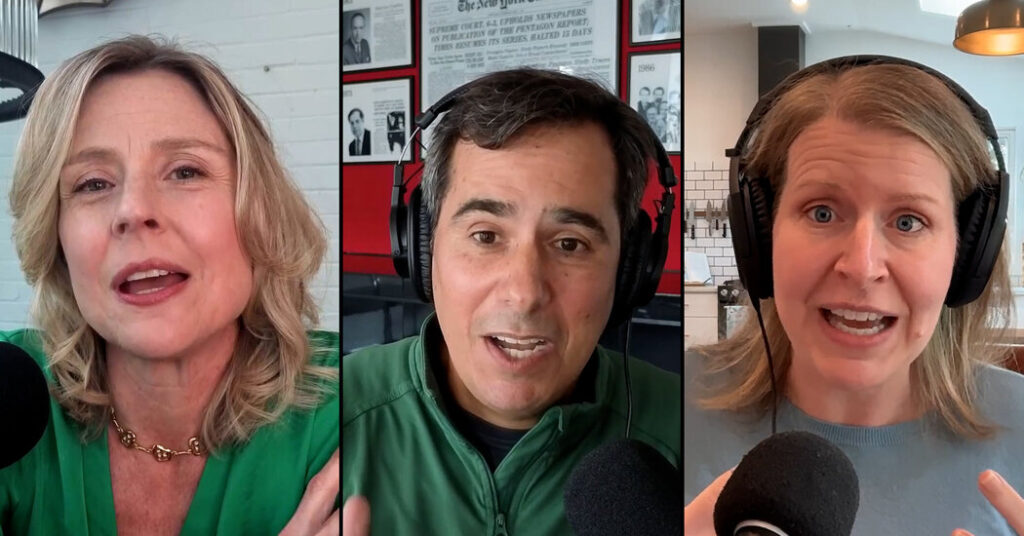
Before Donald Trump, there was the lawyer Roy Cohn. In “American Scoundrel,” the coauthors Kai Bird and Susan Goldmark examine the life and legacy of Mr. Cohn, a driving force behind McCarthyism, a pop culture villain and a key influence in Mr. Trump’s approach to power and politics. The Opinion columnist Carlos Lozada, the Opinion political writer Michelle Cottle and the Vanderbilt history professor Nicole Hemmer discuss the new book and how, even though he died in the 1980s, Mr. Cohn’s influence continues to live with us in politics and pop culture today.
Below is a transcript of an episode of “The Opinions.” We recommend listening to it in its original form for the full effect. You can do so using the player above or on the NYTimes app, Apple, Spotify, Amazon Music, YouTube, iHeartRadio or wherever you get your podcasts.
The transcript has been lightly edited for length and clarity.
Carlos Lozada: I’m Carlos Lozada, a columnist for The New York Times Opinion, and I’m here today with my colleague Michelle Cottle, who covers national politics for Times Opinion.
Michelle, it’s great to see you back here.
Michelle Cottle: Carlos, it’s always a pleasure.
Lozada: We’re also joined by the historian Nicole Hemmer, who’s a professor at Vanderbilt, and focuses on media and conservatism and the presidency. Niki, welcome. Big welcome.
Nicole Hemmer: Thank you so much for having me.
Cottle: Go ’Dores.
Lozada: The reason we wanted to have you is because, today, we’re going to talk about a figure from the country’s past who still looms quite large: lawyer and all-purpose political fixer Roy Cohn, who’s also the subject of a new biography by Kai Bird with Susan Goldmark, called — very unsubtly — “American Scoundrel.”
Cohn came to national prominence and infamy during the Red Scare of the ’50s, when he was chief counsel to Senator Joe McCarthy. So not only was he a force behind McCarthyism, and something of a pop culture villain — is what he became over time — but as Donald Trump’s lawyer in the ’70s and ’80s, he also really helped shape a lot of Trump’s approach to power, which of course we’re still living with today.
So Michelle, Nicole — this is going to be the all-Roy Cohn radio hour.
Cottle: That’s fantastic.
Hemmer: Amazing. That’s a long time to spend with Roy Cohn, but he is a figure that deserves the time.
Cottle: Right? Exactly.
Lozada: It can be tempting, when you’re reading biographies or histories, to always be hunting for the relevance to right now, right? To connect the dots from there to here. And I try to be cautious about that, so I’m not just looking at history through the lens of my own particular moment.
But when I read “American Scoundrel,” it’s very hard to not see, on just about every page, just a very clear echo and connection between Cohn’s life and work and our current era of American politics. So let’s start there. How did Roy Cohn, who died in the ’80s, influence Donald Trump and his exercise of power? What did he instill in him? Michelle, why don’t you kick us off?
Cottle: Oh, lord, you don’t have to hunt for that. It is slapping you in the face in every chapter. It is as though Donald Trump sat at his knee at a master class of how to become a malignant narcissist and dominate the world around you. I mean, whether you’re talking about big things, like Cohn’s philosophy of “never apologize” — never admit that you’re wrong, and when attacked, just hit back harder until the people crumble around you — to this idea that rules are for suckers and you should violate every protocol you come across.
You know that whole saying “It’s easier to ask forgiveness than permission”? Well, neither of those apply. It’s just take what you can get, break what you can and then dare somebody to come at you. So you have those big things, but then you also have little things, like don’t leave a paper trail, court the tabloids, don’t pay your bills unless you absolutely have to. So it’s just this brilliant guide to watching a proto-Trump create the mess that we’re in right now.
Hemmer: Yeah, and that idea of a proto-Trump, it raises some questions to me about your question, Carlos, which is about Cohn’s influence on Trump. And I think it’s hard to say how much of the similarities between the two men is because Trump was the protégé of Cohn, or just that they’re the same kind of political archetype — that they came up in the same milieu in a lot of ways. They were surrounded by amoral people and criminals, who were making tons of money, and they are sort of walking in the same footsteps. And so, because this is a biography of Cohn and not of Trump, we don’t know all of the other influences on Trump that also helped shape him into this particular type of person.
And I think the other challenge with tracing the influence question is — I don’t know if you noticed this, but in the sections where Cohn is talking about his influence on Trump, and Trump is talking about his relationship with Cohn, you’re just sitting there, like, this is like an unreliable narrator dance-off, where these two people are telling stories about their past, and you have no idea how much of it is actually true and how much of it is that they are both so practiced and adept at the art of self-aggrandizement, and so unhitched from a fealty to reality, that you just kind of get them both saying, like, these big, braggadocious things about one another, and how they shaped one another’s careers.
But that said, as an archetype — I think Michelle has hit on so many of the things — again, on every single page, it’s not a book about Trump, but you’re thinking about Trump as you’re reading it pretty much the entire time. I do think that the tabloid savviness strikes me as something that he particularly learned from Cohn.
Cohn grew up next to the people who would end up running The National Enquirer. He’s somebody who delighted in seeing his name in gossip sheets and tabloids, right? It was less about being on the front page of The New York Times and more about, like, am I going to be in these tabloids and in these papers that people are reading almost in more of a celebrity gossip kind of way.
Lozada: It’s interesting to draw that distinction that you make, between the ways their lives were similar — because they kind of grew up in a similar time, in a similar environment — and in how many ways did Cohn specifically influence Trump.
From an early age, both of them really traded on their fathers’ influence and, in Trump’s case, wealth. Cohn’s father was a New York judge, and when he was 16, one of his high school teachers got a traffic ticket, and Cohn calls the police precinct and says: Look, I’m sure you know who my dad is. Cohn was indicted a bunch of times and managed to escape. He was always under I.R.S. audit, right? It’s very similar lives that these two men led, sometimes in substantive and just sort of stylistic ways. They both had this performative populism, talking about the workingman, while Cohn is riding around in his Rolls-Royce or on his luxury yacht, which is called Defiance — which is such a perfect name for Roy Cohn’s yacht.
There’s one moment in the book where Roy Cohn is, I think, interviewed for Penthouse magazine or something, and he said that he said: “I decided long ago to make my own rules, to act according to my own choices, my own judgments and my own conscience.” And this immediately reminded me of Trump’s interview, earlier this year, with New York Times reporters. He’s asked about constraints on his own power and he says: It’s only “My own morality. My own mind. It’s the only thing that can stop me.”
And that, to me, was such a clear echo of Cohn talking about how, really, the rules don’t matter. The question to Trump was in the context of international law and the rest, and he’s like: No, forget all that stuff. It doesn’t matter. And here Cohn is saying: Look, no, it’s only my own judgment, my own conscience, my own choices.
To me, that’s one of the core parallels or similarities or lessons — however you want to adjudicate that — between these two men; that sort of ultimate self-confidence, paired with ultimate disdain for rules and traditions and norms.
Cottle: Rules are for little people.
Hemmer: That’s right. Well, it’s something that was reinforced for him his entire life. There’s this little — it’s such a small thing, but it really jumped out at me: When Cohn was at Columbia as an undergrad, he was supposed to take math and gym, and he didn’t want to take either of them. They were requirements, but he didn’t want to do it.
And so, he talks to a dean and talks his way out of it. And he talks about it later, and he’s like, “But what’s compulsory if you have friends?” Like, the rules don’t count if you’re connected enough, and you can just get out of it. And I don’t want to be, like, broken windows policing about how to keep people like Cohn from emerging as adults. But maybe not letting him get away with little things might have disabused him of the notion that he could get away with the big things when he was older.
Lozada: Leave it to the college professor who wants to keep the requirements in place for the students.
Hemmer: That’s right. Everyone, take the required classes.
Lozada: All right. So let’s step back and actually get into the meat of this book. For those listening and watching who haven’t yet read “American Scoundrel” — Michelle, what is this book actually about? What’s the story that’s being told?
Cottle: So it is a classic Kai Bird deep dive into the wild ride that was Roy Cohn’s life. I mean, Bird is great at doing these very involved portraits, so I loved some of the early stuff from his childhood and how overindulged he was by his mother. As you mentioned, just how much he relied on his father’s connections and how early he learned to be a fixer.
It takes you up through the McCarthy era, and then just everything, from his time at Studio 54 to his business shenanigans. There are chapters called “Political Shenanigans,” “Legal Shenanigans” and then “Sleazy Business Deals.”
It’s so amazing, just what a character he was. I was just constantly going through thinking, regular people, normal people are not equipped to deal with someone like this — just the kind of force of nature coming through, totally shameless. Just through sheer force of will dominating the world around them, whether it’s the Justice Department, the Dwight D. Eisenhower presidency or private law firms later on. He was just a complete monster on some level. And I do think, absolutely, that Trump is the new incarnation of that.
Hemmer: The other thing that really jumped out at me from the book is — there’s this moment early on, when he’s like 10, and he goes to Washington, D.C., and he and his dad hang out with Justice Benjamin Cardozo, and then he goes into the Oval Office and he meets Franklin D. Roosevelt. And actually, every chapter of the book is like this, where some famous person suddenly emerges, and he’s somehow connected to them as friends. It’s Barbara Walters, it’s Andy Warhol. It’s somebody in just about every single chapter, to the point where you’re just like, this guy is like the evil Forrest Gump of the 20th century.
Cottle: Exactly!
Hemmer: He’s there, everywhere, in this way that I don’t think that I had fully appreciated.
Cottle: Oh no, the story about him helping arrange Barbara Walters’s adoption of her daughter, I’m like, what? What is going on? It didn’t matter, your politics. He was completely nonideological in some ways. And so, he befriended everyone who saw that charming side. You had to kind of be important, I think.
Hemmer: Absolutely.
I was just thinking about that Barbara Walters story. He had earlier helped her dad get out of some legal trouble that he was having. He’s somebody whose relationships were deeply transactional. I don’t think that he could conceive of a friendship outside of this idea of a loyalty that is bound by the trading of favors, or him doing things for other people. That power is the metric by which he understands his relationship to other people. And his favors are the ways that he wields his power and accesses other people’s power.
Cottle: I mean, obviously, Cohn’s this character who’s been around and been profiled, and there have been documentaries and movies. He appears in “Angels in America.” He’s this figure that we all kind of have known something about. What’s new about this? What more do you think we’re getting out of this particular portrait?
Lozada: Yeah. You’re right, there has been a ton about him over the decades. There was another big book about him in the ’80s, called “Citizen Cohn.” And when you’ve been played in movies by James Woods and Al Pacino and Jeremy Strong — that’s kind of an amazing trifecta. But when I think about what’s new here, I think of it in terms of what’s new in Kai Bird’s body of work, right?
And he gets into this a little bit, toward the end of the book. You know, he’s a student of the American establishment, right? His prior subjects have been presidents like Jimmy Carter, advisers like McGeorge Bundy, scientists like Robert Oppenheimer, right? His first book was titled “The Chairman: John J. McCloy and the Making of the American Establishment.”
And Roy Cohn appears in lots of these stories, but just as this figure, lurking in the background, not the essential figure, but just kind of hovering — this sort of anti-establishment force within the establishment story. Now, especially with the rise of Donald Trump, Cohn’s politics — those rules that you talked about, Michelle — they’ve won, right?
The establishment has been dispatched or co-opted, or emasculated or remade in some ways. Bird at least writes, in the end, that the establishment is gone, and what remains is what he calls the “subversive counternarrative” of American power that someone like Cohn embodies. So, to me, when I think of the novelty factor, I kind of think of it in terms of how this fits in the story of America that Kai Bird thought he was telling all along, but now has to pivot in a new direction.
Cottle: I think one of the things that I find fascinating about Cohn, though, is that he exists in this space that I don’t think is unusual. And Niki, you probably can think of other people over the course of history who’ve done this. The establishment always has to have these figures who they turn to, when they need stuff done that isn’t quite kosher. You have these dark, gluey figures who hold these things together.
Like, when your dad is in trouble and you need to have something fixed, or when you’re in financial difficulties, or you’ve got a scandal, or — you know, Cohn did a lot of divorce work. When you have these ugly things pop up, the establishment people need to be able to keep their hands clean and hand this off to somebody as their fixer, their attack dog — their whatever — and he was the consummate one of those.
Hemmer: It’s interesting to think about his relationship to the “establishment,” because he is a member of it. I mean, again, like, he’s hanging out with Supreme Court justices and presidents as a kid, and his best friend is going to be a magazine mogul. He is deeply seated in the heart of the American establishment. It’s just not the establishment that gets celebrated, right? In the same way that McCarthy was part of the American establishment, in the same way that Nixon ends up being part of the American establishment; and from within that position of being part of the elite, I think that Cohn, much more so than somebody like McCarthy or Nixon, was part of the elite his entire life, that even from within the elite, he has this collection of grievances that form the basis of his worldview.
He feels no loyalty to the values that the establishment expresses, about things like rule of law or things like dignity, or factuality or objectivity, or any of those things. He’s not interested in those kinds of things.
Cottle: Truth, honesty, that sort of thing.
Hemmer: Right. So that, that sets him apart, but he’s still — like, this is a man who had access to all the money he wanted, all the connections he wanted, but still, like Donald Trump, was weighed down his entire life, or motivated his entire life, by just endless grievances.
Cottle: So bitter. So bitter.
Lozada: Niki, I want to just go back for a second, and ask you what you felt was new in this book, because you see it differently, as a historian, than these mere journalists here, who read the book and sort of can’t get out of the presentism of right now.
Hemmer: Well, I too found it hard getting out of the present moment with this book, because it speaks so strongly to it. But I do think that there are historical stories, stories about the past that we carry with us about things like McCarthyism. We have a very neat story to tell about McCarthyism; that it is at full strength in the early ’50s, and then there’s the Army-McCarthy hearings, and Joe McCarthy is ultimately censured.
He dies in disgrace just a few years later, and that’s the neat, tidy arc. There was this bad man who did bad things, and then it came to an end.
Lozada: “Have you no sense of decency, sir?” Yes, yes.
Hemmer: Exactly. But Roy Cohn didn’t go away. Roy Cohn wasn’t held responsible for his perjury, or any of his bad acts, during the McCarthy era. Even though it tarnished his reputation — boy, did a lot of establishment liberals get over that in their desire to have some kind of relationship or access to Cohn’s ability to get them and people around them out of trouble, or to do things for them.
So I think part of what it tells us, if not new, at least really reinforces, is that McCarthyism doesn’t go away. It just transforms, given the changing politics of the era. McCarthy himself goes away, but here’s the guy who was the beating heart of McCarthyism, who does not slink away in disgrace, but continues to be a pivotal figure in U.S. politics, and in U.S. elite culture, for all of these years.
Cottle: Yeah, demagogues whipping up the masses over some kind of paranoid fantasy is still very much alive in politics — especially in the midterms. Now we even have our own fresh round of Red-baiting. So it’s gone nowhere.
Lozada: I’m so glad you guys teed this up, because this gets to the heart of an aspect of this book that I think will get less attention — because so much of the attention will focus on the sort of Cohn-Trump relationship, as we’ve discussed at length here, right? But Kai Bird really gets into the legacy of McCarthyism, and he says exactly what you’re saying — that McCarthy was discredited and died shortly after those hearings, just a few years later, but that McCarthyism endured.
He writes that “the paranoia persisted as a routine feature of life in America.” That kind of got me thinking about, OK, like, what are the ways that McCarthyism still influences American life, in a paranoid style kind of way, right? But also it got me thinking about, as we’re getting closer to the end of the Trump presidency, to what extent will Trumpism, in some form or another, outlast Trump himself?
And just the way McCarthyism kind of mutated — became something else, but really kind of remained as this undercurrent of American politics — how Trumpism might do the same? That’s a question that kept coming up for me, as I was reading those portions of that book.
Hemmer: I agree. Not only does it not go away, but you think about something — like in 1964, Walter Jenkins, who was so close to Lyndon B. Johnson, his right-hand man in many ways, ends up losing his job because he is arrested for having same-sex sexual contact with a man. You have all sorts of people who are deemed too radical, people who lose their passports by the U.S. government because of their ideas, or in the age of the war on terror, the ways that a new McCarthyism against Muslims in the United States emerges, or, even more recently, against Palestinian activists.
Like, it is a persistent feature in U.S. politics. We organize it in the 1950s under McCarthyism, and I think that kind of leads into your question about Trumpism, which is that Trumpism becomes a kind of organizing framework for a bunch of different ideologies and impulses that are fairly constant in U.S. life. But because it is all present in Donald Trump and in the MAGA movement, that does give it more power, and it gives it more institutional space, right? It is embedded, at the moment, in a number of different U.S. institutions; and if Donald Trump wasn’t president tomorrow, would we still have a militaristic immigration deportation state? Almost certainly. Would we still have an anti-trans movement? Would we still have the sort of Islamophobia that we see today? I think that would very much still be the case. The question is, like, how long would it cohere as something that we call Trumpism? And if you look at McCarthyism, it seems like it has the potential to have very long legs.
Cottle: Yeah, and Trump has drilled home the idea that institutions cannot be trusted. His cult of personality rests on the idea that only he is the voice to follow. So you’re going to have huge chunks of the country who don’t trust the electoral system, who believe the deep state, you know, those are the new communists, right? The communists in the State Department — you have the deep state at work against the American way of life.
The president has been busy trying to tear down guardrails and promote anti-democratic ideas, destroying checks and balances, stiff-arming Congress, politicizing the Justice Department, that sort of thing.
All of these things will take a lot of time to unwind, and the best-case scenario is that over the next couple of years, Trump gets wildly discredited, because he’s doing such a poor job as president, and his party starts to abandon him. But even then, he still has a very loyal core following that is going to take some doing to kind of forget the damage he’s done.
Hemmer: And to kind of bring it back to Cohn as well, one of the things that I was thinking about, when I was thinking about Cohn’s influence on Trump, is that Cohn serves as a kind of proof of concept — that you can stiff your vendors and get away with it; that you can lie blatantly about your life, and the tabloids will print it, and your fame will grow, and you will benefit from that.
And in a lot of ways, Trump is a proof of concept for the folks who come next, right? That he has not only sort of embedded that idea — that institutions can’t be trusted — but also that you can get away with a lot of stuff that people just didn’t think you could get away with before. There are ways to use presidential power. There are ways to use the attention economy to enrich yourself personally and also to get power for yourself; and he is going to have quite a lot of imitators because they’ve seen it work for him.
Cottle: So one of the things that I thought was interesting with both men is that the way that they sometimes get stopped, or at least have their basic trajectory derailed, is through the court system.
Cohn did lose cases. He had this famous episode, where he basically went in to try and change this guy’s will and add a codicil to it. He took the guy’s hand, who was in a vegetative state, and scrawled some chicken scratch and then tried to pass it off —
Lozada: That was an amazing moment.
Cottle: That did not go through. He had some failures there. And same thing with Trump. It’s like, while the political system seems to have no interest in slowing Trump down, certainly not the Republican Congress, the courts will on occasion slap him down.
Hemmer: I was reflecting on this too: How is he ever held accountable? The courts are one way, and then, of course, there’s that famous Army-McCarthy hearing, “Have you no sense of decency, sir?” And that was also a rare moment. And I was wondering, why did this work? And there are lots of historical reasons, but I think one reason it works is because Joseph Welch, in that moment, was putting forward a different moral universe to the McCarthy-Cohn moral universe.
And that there’s real power — in pointing out the sort of amorality of the people like Cohn or Trump. And that people can recognize the gulf between the sort of impassioned, ethical care and concern that Welch is expressing in that moment for an associate at his firm, and the universe in which somebody like Cohn lives.
He sees the law as a tool for expressing support for his friends and for attacking his enemies, and doesn’t see any other real use for the law.
And so, when he is under the pressure of a lawsuit or under a court, he sees it through the same framework. If he’s being attacked by the courts, or being held accountable by the courts, it’s not because he did something wrong, it’s because his enemies are out to get him, and Donald Trump has that exact same view. It’s just more poisonous because Donald Trump is president.
Lozada: So just to follow up on Niki’s point here, there are ways in which people and institutions tried to challenge Cohn in those moments. I mean, you mentioned, Michelle, how it was just hard for regular people to be able to deal with these kinds of forces of nature for whom rules did not seem to apply.
But there’s a whole chapter in this book about how Robert Morgenthau, who was the U.S. attorney for the Southern District of New York, pursued Cohn extensively — obsessively, right? A colleague says that Cohn was Morgenthau’s white whale. Cohn was also eventually disbarred, shortly before his death, in the State of New York. And it could seem sort of meaningless, happening at that point, but his own identity as a lawyer really mattered to Cohn, and that was a big deal, right?
So I’m thinking, when is it institutions, when is it people? The journalist Jacob Weisberg has a book coming out, called “Profiles in Cowardice,” that I’m reading through right now, and it’s about a series of institutions and individuals who basically have buckled during the Trump era, particularly the second term: law firms, that sort of thing.
To say that, “Oh, well, they’re cowards,” is almost too simple an explanation sometimes. But there is something to what you were saying, Niki, about how simply trying to exert some moral authority, standing up to bullies, revealing them for what they are, still has some purchase, still has some power, and once one person does that, it’s easier for others to do it as well.
Hemmer: I think you’re right, that cowardice doesn’t open the door enough for us to empathize and understand why people are making the choices that they’re making. But you do kind of have a lot of portraits of cowardice in this book as well, right? You have somebody like Dwight Eisenhower, who time and time again just would not take on McCarthy.
Is it because Dwight Eisenhower is a coward? Is it because of his political calculations? Who knows? But he doesn’t meet the moment. And I think it too, in these personal relationships, I wouldn’t call it cowardice, but people make choices that they benefit from, being in a relationship to Roy Cohn, and therefore they don’t feel like it’s necessary to point out the ways in which he is a moral failure and a —
Cottle: Monster.
Hemmer: Criminal fraud. I mean, you think about somebody like Barbara Walters, and we’ve talked about the favors that he did for her, but she even talks about it too; where her dad was going to be arrested for some tax charges, and Cohn gets him off. And she’s like: I don’t want to weigh in on the ethics of this, it’s my dad. Like, he helped me out. So no, I’m not going to focus on the fact that he’s a monster. And she would be his friend for decades, right through his death.
And I feel like that’s the failure of so many people in this book. Like, they perceive Roy Cohn through their personal relationship, and that elite clubbiness that they share, and that sort of like, well, you know, we’re all part of this circle of powerful people, and therefore we give grace to the other people in this circle.
It strikes me — as somebody living in the aftermath of a world that Cohn helped create — that that was a real failing. And that had they behaved differently in those decades, maybe we would be living in a different kind of culture than we live in today.
Lozada: So I was listening to an interview that Kai Bird gave recently about this book, and he said that he spoke, briefly, with Trump about the book. And I think Trump asked him, or Trump sort of implied that the book was going to be more significant now just because Trump is president again. And he even offered to promote the book. He’s like: But only if it’s fair, right?
And Trump is not a big reader. In fact, there’s a moment in this book, too, that suggests that Cohn was also not a very big reader — just not super reflective in that way. But it got me wondering: What do you think Donald Trump would say if he read this book? How would he feel about the story that’s being told in it?
Cottle: I think he’d kind of love it, right? I mean, we’re talking about Roy Cohn being presented as all-powerful and infamous and untouchable, and the master manipulator, and just not giving two shits about what anybody thinks about him. I mean, Trump loves all of that. I mean, if you watch him, that’s what he lives for. So I think, obviously, he has very thin skin, but still, this kind of attack on Cohn is exactly the sort of thing that Trump wouldn’t necessarily see as a bad thing.
Hemmer: Right, if they’re talking about you, you’re winning, I think, would be his approach.
Cottle: Exactly. All publicity is good publicity.
Hemmer: But also, to the extent that there is a judgment of Cohn here, and I think that there is, the idea that he is kind of a monstrous figure, lurking through the background of U.S. history for some 40 or 50 years — Trump just doesn’t agree with that, right?
He doesn’t see him as a monstrous figure. He agrees entirely with the view of power that Roy Cohn carries throughout his life. So if he read it — which he won’t, but if he read it — he likely wouldn’t see anything wrong with it, other than those moments when Kai Bird and his co-author are like: This isn’t great.
Cottle: That seems bad.
Lozada: I think there’d be almost a sense of nostalgia for when you could just be this way, and it was fine, and he was just coming up and kind of coming into his own. I think he misses Roy Cohn, right? There’s two moments that show us that, right? One is the famous “Where’s my Roy Cohn?” moment, when early in his first term, he’s pissed off because Attorney General Jeff Sessions isn’t protecting him the way a personal lawyer would, you know? And he clamors for “my Roy Cohn.” But the other moment is the last line of the book, which really struck me.
It’s right after the 2016 election, and Trump is on the phone. And remember, Cohn died 30 years before this, right? And Trump is on the phone with Roger Stone after winning the election. And he says to Stone, “Wouldn’t Roy love to see this moment? Boy, do we miss him.” Right? And it was so stunning to me, that in that moment, the person he’s thinking about — and of course, it’s because Roger Stone and Trump both had a relationship with Roy Cohn. And so, it’s a natural kind of reminiscence. But in that moment, he would think, like, God, I wish Roy were around so he could see me win. He would love this, but also I kind of want him to see that I achieved everything and more than what he hoped I would achieve.
Cottle: Plus, Trump is a guy who’s clearly feeling his own mortality. He’s spending all his time building monuments to himself, and he’s always missed the ’80s. I mean, he’s stuck in the ’80s in a very, very specific way.
Hemmer: The stuckness, I think, point is very much correct, in that he identifies so strongly that period with Roy Cohn. Like, those were the golden days. When he thinks about Make America Great Again, he’s not talking about 1950s housewives. He’s talking about Studio 54.
Cottle: When he was young and hot.
Lozada: Yeah. And you know, it’s interesting, Cohn died in ’86, which was even before “The Art of the Deal” was published, right? That’s how long ago, how early, Cohn was that kind of influence in Trump’s life.
Well, Michelle, Niki — I feel like we could keep talking about this guy and this period of American history and politics for a long time, but maybe we can wrap it up there. I loved the feeling of this book club, so I hope we can try to do it again sometime.
Cottle: Oh, yes, please.
Hemmer: That would be amazing.
Thoughts? Email us at [email protected].
This episode of “The Opinions” was produced by Derek Arthur. It was edited by Kaari Pitkin. Mixing by Gautam Srikishan. Video editing by Brandon Belk-Yee. The postproduction manager is Mike Puretz. Original music by Isaac Jones and Pat McCusker. Fact-checking by Michelle Harris and Kate Sinclair. Audience strategy by Shannon Busta, Kristina Samulewski and Kristin Lin. The director of Opinion Video is Jonah M. Kessel. The deputy director of Opinion Shows is Alison Bruzek. The director of Opinion Shows is Annie-Rose Strasser.
The Times is committed to publishing a diversity of letters to the editor. We’d like to hear what you think about this or any of our articles. Here are some tips. And here’s our email: [email protected].
Follow the New York Times Opinion section on Facebook, Instagram, TikTok, Bluesky, WhatsApp and Threads.
The post Roy Cohn: ‘The Evil Forrest Gump of the 20th Century’ appeared first on New York Times.