The dead man lay in a pool of blood, a few yards from the truck that he had parked in the village.
Witnesses said the driver had stopped on a recent Friday night to repair a burst tire, intending to continue east the next day along the unpaved highway that connects the cities of Bunia and Kisangani in the Democratic Republic of Congo.
The next day, they saw him buy juice from a kiosk in the village, Marabo, and sit down on the broken tire. He stood up, staggered a few paces, collapsed and threw up blood, according to Etienne Sanyobo, the leader of the village youth council.
A crowd gathered to stare. Nobody knew who the man was. But they kept their distance. Vomiting blood can happen in the final stages of Ebola, and his blood was still seeping into the dirt.
“I heard that a driver died so I came,” said Esperance Nganabo, a mother of nine. “I don’t know how he died, but it’s important to fear Ebola.”
Dr. Duabo Musubi Desire received an emergency call at the nearby hospital in Nyankunde. Knowing the risk that the man’s body posed — Ebola victims remain contagious even after they have succumbed — he said he had to act quickly.
He ordered the immediate assembly of a team of trained volunteers.
What happened over the next 24 hours showed the challenges that health workers face as they confront Congo’s most serious Ebola outbreak ever. It also showed the professionalism of Congolese teams who risk their lives in the face of a virus that has killed more than 2,500 people in around 100 days.
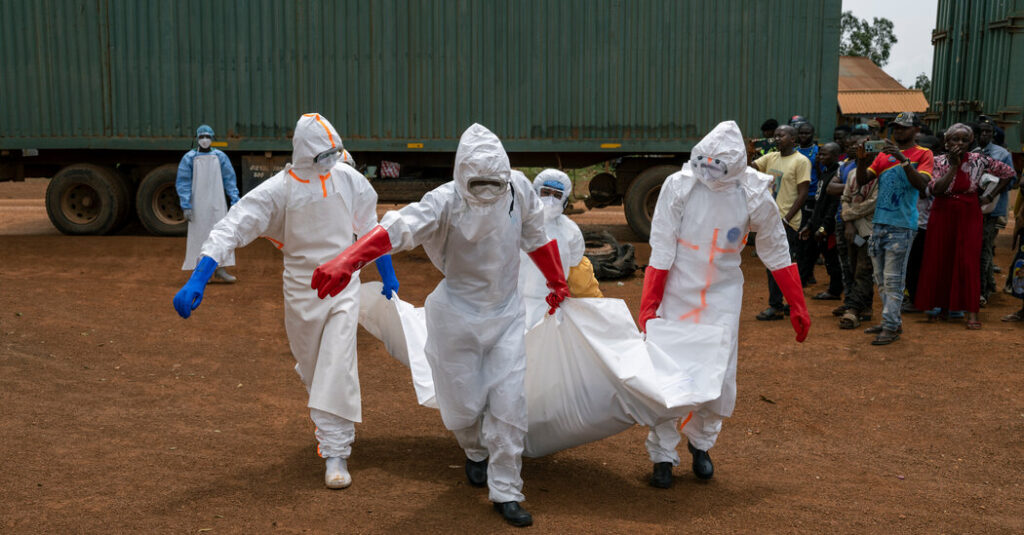
When the health workers arrived, the man had been dead for less than 30 minutes. They donned protective gear and approached him cautiously. They sprayed the area with chlorine, took a swab of saliva from his mouth to be tested, gingerly zipped him into a white body bag and carried him to their pickup truck.
They also retrieved the man’s I.D. card from his pocket, giving it to a police officer. The card identified him as Taylor Okito, 34, born in the city of Goma on Congo’s eastern border.
Complications arose. The truck driver’s assistant, Patrick Muhindo, 25, had called the man’s colleagues to report the death and three men arrived on motorbikes. They demanded the body for burial. Health workers refused, saying the man needed to be taken to the hospital until his body had been tested for Ebola.
With no obvious resolution, the health workers consulted the village chief, Jean-Pierre Lemabo, who sided with them, arguing that the man’s body should only be released if it proved negative, for fear of contaminating the community.
A truck driver who had arrived from out of town and then died presented a worst-case scenario for health workers. Under Ebola protocols, the contacts of any infected person should be traced and placed under surveillance, or in quarantine. That was not possible under these circumstances. Even Mr. Muhindo, who was potentially infected, was wandering around in the village talking to people.
For more than an hour while the dispute unfolded, the body lay in the medical workers’ pickup truck, parked under a mango tree.
Resolving the dispute amicably was crucial. Health experts say that securing the consent of relatives and friends of Ebola victims is necessary because violating their wishes can breed mistrust and imperil medical staff.
The health workers, who had risked infection to retrieve the body, were determined to see Mr. Okito treated with respect.
“I wasn’t afraid because it’s my job as a rescuer to help everyone,” said Emile Yombe, a Red Cross volunteer who was part of the team that retrieved the body.
When the outbreak first began in Ituri province, Congolese health experts struggled to identify it as Ebola because the species of virus causing the current epidemic, Bundibugyo, is uncommon and requires a specific test.
Since then, the World Health Organization has distributed testing kits to many laboratories, enabling them to return results for Bundibugyo on site. Faster testing facilitates rapid triage, a crucial step toward containing the virus.
The test at the hospital came back negative for Ebola.
Some health experts have said that, while the rapid tests are reliable, false negatives happen and the copious bleeding in the minutes before Mr. Okito’s death pointed toward Ebola or another hemorrhagic fever.
“We worry about the risk of false negatives,” said Trish Newport, the head of the Ebola response in Ituri for Doctors Without Borders, the medical charity. She was speaking of Ebola testing overall, rather than a specific case.
The negative result meant that the hospital had no further involvement in the case and there would be no attempt to trace Mr., Okito’s contacts. “Now it’s negative, it’s up to the family to take the corpse,” said Dr. Kashindi Makuta Charles, the hospital’s medical director.
Mr. Okito’s colleagues transported his body to a private morgue in Bunia late that night, but workers there refused to accept it because it was zipped in a body bag, something only done for Ebola victims.
Their suspicion intensified when they opened the bag and found the body drenched in blood, said Thierry Mumbere, one of the friends.
They then took the body to the city’s main hospital, which accepted it.
The next day, when family members and colleagues of Mr. Okito arrived at the hospital’s morgue to retrieve the body for burial, the mourners wanted to open the coffin and the body bag to check that it was indeed Mr. Okito inside. But they did not end up opening the coffin.
Even though the body had returned a negative test, health workers still drove the body to the cemetery. Their vehicle was followed by a phalanx of friends and colleagues on motorbikes.
Burials have emerged as a significant flashpoint in the Ebola outbreak. Sometimes families have attacked burial teams to gain access to coffins, which they then open for a last physical contact with the deceased. The practice violates health protocols and risks spreading the virus.
When Mr. Okito’s coffin arrived at the burial ground in the hills outside Bunia, a furious argument ensued.
After the health workers lowered the coffin into the ground, mourners then drove them off with threats of violence, shouting that they wanted to open the coffin to make sure their friend was really inside. A preacher delivered an impromptu message, urging honor for the deceased and praising his life.
Amid cries of protest from Mr. Okito’s family, two of his friends climbed into the open grave. It had only been a day since Mr. Okito had died. Despite the unknowable consequences, his coffin was unsealed.
The post A Driver’s Mysterious Final Hours Expose Congo’s Deep Ebola Fears appeared first on New York Times.