The reporter may have misheard the comment, or maybe the person being quoted actually said it, or something odd happened in the editing process.
Whatever: This is what appeared in the Feb. 20, 1985 edition of the Oakland Tribune, quoting a UC Berkeley professor about a protest against immigration sweeps in the Bay Area.
“This probably won’t stop the Iron Ass [federal government] from making raids in the Eastbay.”
“Iron Ass” is how someone might hear the acronym INS, the Immigration and Naturalization Service, the forerunner to ICE.
And now, 40 years on, it fits right into the kind of angry, derisory language many Americans use for the present-day hammer-handed operations of federal immigration officers, around the country, especially here in California.
California has always been — and that’s a couple of centuries of “always” — at the fulcrum of the immigration-deportation seesaw in the U.S., with national policies yo-yoing between kicking workers out and inviting them in. Consider the foreign-born who joined the Gold Rush, the Chinese railroad workers, and still and always the Latino population along the long, wide international border.
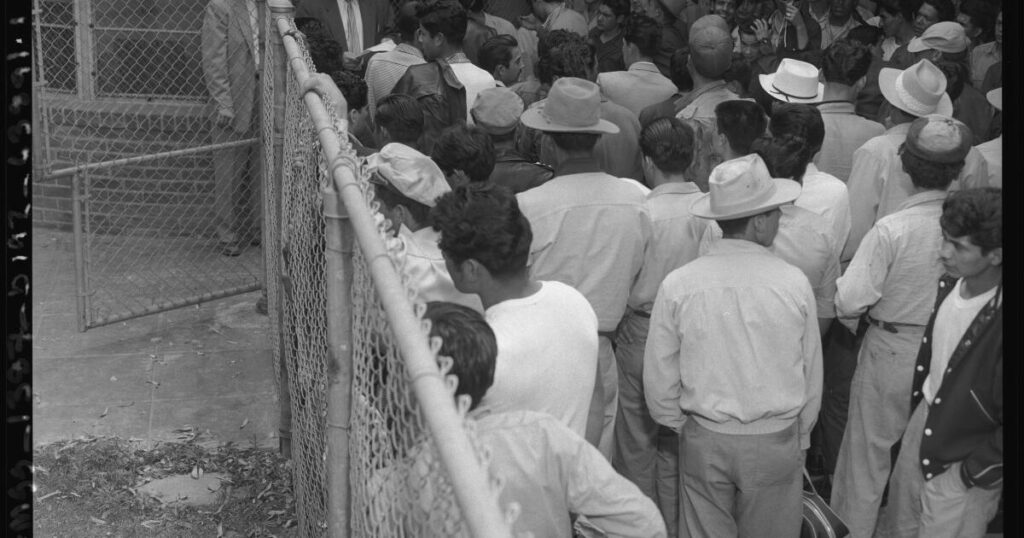
That underlies the name of a new exhibition at the California Museum in Sacramento, “Help Wanted/Leave Now!” about the “revolving door” of programs and practices that have alternately enticed and expelled workers, legal and undocumented.
The U.S. border with Mexico represents a political borderline but it cannot sever many decades of complicated history and culture. And it’s left us with endless paradoxes and contradictions of who belongs where, with the U.S. government shifting to and fro on deciding and enforcing that, depending on the American economy, and American politics.
Sean Mainwaring is curator of the exhibit. “We have historically recruited foreign workers who set down roots, become members of the community, and then, when there’s an economic downturn or it becomes politically expedient, it’s kind of a revolving door.”
The endless argument is that undocumented immigrants, who work for less because of their needs and their vulnerability, take jobs that Americans will, or that Americans won’t do. Something else Americans won’t do: pay higher prices for food, 90 years ago or now.
Last year, the Kansas City Federal Reserve bank, one of 12 regional Feds, noted on its website, “Historically, the supply of U.S.-born farm workers has not been sufficient to meet demand for farm jobs at the going wage rate, contributing to a largely foreign-born workforce.” Even the H-2A legal process for hiring seasonal foreign workers “would likely be more expensive than employing undocumented workers.”
A 1924 immigration law that created the Border Patrol also revealingly put it under the control of the federal labor department. Cheaper Mexican workers had been welcomed during World War I, and were still coming north more casually back then, even as a U.S. labor group was beginning to agitate for organizing American migrant farm workers.
But when the 1929 market crash and the Depression knifed the American economy, the blame for unemployment in the southwest and California in particular fell on these Mexicans, and the government’s “Mexican Repatriation” program sent hundreds of thousands back to Mexico, some voluntarily, some not, and some numbers of them American citizens.
Once, border migration patterns resembled a loop: thousands of laborers, mostly men, commuted here once or twice a year from Mexico to jobs in the fields, then on to other jobs once harvests were over. Then they’d take their earnings home to Mexico as breadwinners and comparatively rich men, and stay until the next year’s season.
But as U.S. policies over decades squeezed the border shut on this back-and-forth commuting, some workers chose to stay on the side of the border where they could find work, and a number brought their families north to settle, legally or otherwise.
And then that pendulum swung again. In 1942, Americans by the millions left their peacetime jobs for the war and wartime industries, and the “Bracero” program — from “brazo,” the Spanish word for “arm” — filled in the gaps in the domestic workforce with contracts for employers of Mexican workers, usually in agriculture or on railroads.
Under the program, the U.S. screened Mexicans for aptitude for the work, and for attitude. Mainwaring shared with me the notes of Henry P. Anderson, a historian and farm labor organizer, who took a guided tour of a Calexico bracero processing center in 1958:
“Those deemed expendable were described one at a time: this one is too tall, he is too ‘cocky,’ that one a ‘loafer,’ another ‘lazy and irresponsible,’ he’s a ‘smart aleck,’ this one a ‘ladykiller’ and not ‘peon’ enough. On the other hand the ‘right man,’ according to the guide, was ‘built right. He’s a farm worker, you can tell that … he hasn’t got any big ideas. He’s got the right attitude. He’s humble, not fresh and cocky. He’s an Indian type, probably from Jalisco or Guanajuato.’”
Through the bracero program’s 22-year span, as many as 4 million workers came in and presumably went home — though not always; a generation of families came here, or were born here, and stayed. About 15 years after it ended, a former Texas labor commissioner and ranking Labor Department official overseeing the program went public. He characterized wages for braceros as unconscionably low, the food substandard and the housing prison-like. “It was not altruistic at all. The bracero program was definitely created by the farmer who needed to make a dollar.”
And then America’s policy yo-yoed again: in 1953, even as the bracero program was still operating, the federal government launched “Operation Wetback,” to rid the country of undocumented immigrants.
With its heavy-handed “sweeps” of labor camps and factories, American citizens were indiscriminately caught up in the operations, just as ICE is doing now.
Consider the breezy tone of a 1931 story in the Los Angeles Evening Citizen News, reporting on 1,200 Mexicans deported from L.A. County in a day, with the casual note that “virtually none of them” was “an undesirable alien — many are American citizens.”
“L.A. was really ground zero for these raids during Operation Wetback and the Mexican deportation,” said Mainwaring. Those 1,200 deportees were among at least 50,000 deported from LA County in five months of 1931 — as much as a third of the county’s Mexican and Mexican American population.
Emilia Castaneda was no more than 10 years old when her Boyle Heights family was deported in the 1930s. In an archival videotaped interview made when she was in her late 70s or 80s, and now part of the exhibition, she remembered being teased by the girls in the parochial school she ended up attending in Mexico. “You’re not one of us,” they mocked her. “Go home.”
Just like today, as agriculture and other food chain businesses were hard-hit by Trump’s aggressive deportations, some industries and regions in earlier “sweeps” also asked for carve-outs and exemptions.
“I wouldn’t say there was a backlash but it really impacted agricultural networks across California and Arizona,” said Mainwaring. “We came across specific requests from county officials like in Yuma, Arizona, asking for exceptions because they needed these workers, they didn’t have enough help.”
What’s called the Texas Proviso was a wink-and-nudge agribusiness-friendly federal loophole crafted in the early 1950s that for more than 30 years made it a crime to harbor or transport undocumented immigrants — but not a crime to hire them. [Federal law criminalized that in 1986.]
The 1950s enforcement drive also put the word “wetback” into casual use. Official statements and news stories used it to mean anyone here without documentation. It was derived from the people who waded across Texas’ Rio Grande into the U.S., but it was sometimes used interchangeably with any Latino workers. Sometimes it just got clipped to “wets.”
In 1961, as astronaut Alan Shepard sat aboard his Redstone rocket waiting to become the first American launched in space, hours of delays forced him to urinate in his space suit. “Well,” he remarked nonchalantly, “I’m a wetback now.”
Not much has changed. Court records released this July confirmed that ICE agents had been referring to immigrants during raids with such slurs as “wet” and “tonk,” the last term reportedly derived from the sound an agent’s utility flashlight makes when hitting a migrant’s head.
A 1956 crime drama called “Wetbacks” was a B picture about a human smuggling ring victimizing the undocumented. The Los Angeles Examiner’s movie reviewer called it a “tedious, amateurishly made picture [that] supposedly deals with how illegal Mexican immigrants are smuggled into this country.”
One of the paradoxes of these periodic anti-undocumented worker campaigns is how they divided Latino communities: the “I did it the right way” people who managed to get visas, the people whose forebears may have come illegally but are now themselves established, and the paperless people who have just arrived, or who have lived here for years under the radar.
César Chávez lived that paradox. The co-founder of the United Farm Workers — along with Dolores Huerta, an adviser on this exhibition — was a U.S. citizen. In the 1960s and into the 1970s, he wanted immigration officials to keep out undocumented workers, believing they’d be exploited as strikebreakers for growers and erode his union’s bargaining power. By the 1980s, though, he was endorsing immigration reform and protections, especially in the face of President Reagan’s recession-era 1982 “Operation Jobs” sweeps.
A Los Angeles Times survey that same year found that within three months of those raids, 80% of the booted-out workers were back on the job. Many of the Americans hired to replace them soon quit. They didn’t like the wages or the working conditions.
The employment manager of B. P. John furniture maker, in Santa Ana, told The Times, 75 of the American-born workers soon quit on him. “They told me they found another job, that the work was too hard, that there wasn’t enough pay.”
In June 1954, The Times covered the Border Patrol’s plans for LA. Herman Landon, the local immigration chief, described a “stockade” being built in Elysian Park to “imprison illegal Mexicans flushed out” of factories, hotels, and “skid row saloons” at the rate of a thousand or two per day.
Farmers had once requested immigrant workers from smugglers by the truckload, and counted by “the head,” like livestock. When the feds moved in, workers were deported south of the border, sometimes far south, by bus, by ship, by plane. The feds briefly charged each worker $10 each for the cost of being deported.
The caption of a June 1952 photo in the McAllen, Texas, Evening Monitor that showed men boarding a deportation plane read, “It’s a quick bite to eat then off into the wild blue yonder for these wetbacks.” The newspaper offered a $5 prize in a contest to name the airborne deportations. Not all readers were cheering. One acidly suggested calling it “Truman’s Gestapo Airlift.”
The human numbers for any of these programs, coming in or kicking out, are hardly ever confirmed, but over all this time we are talking about the movement of millions — and the deaths, still uncounted.
Trump said he always planned to model his deportations on the Eisenhower-era operation.
“We’re rounding them up in a very humane way, a very nice way,” Trump told “60 Minutes.”
In July 1954, under Eisenhower, 88 workers died of sunstroke in the desert below Calexico, where they’d been deported.
In the first 17 months of the second Trump administration, at least 52 people died in ICE custody. ICE agents have shot and killed at least six more people, some in their cars, and some right out in public, like Alex Pretti in Minneapolis, and Keith Porter Jr., shot last New Year’s Eve in front of his L.A. apartment building by an off-duty ICE agent.
The deaths recall a deportation sweep in 1948, when a plane carrying 28 workers back to Mexico, with a crew of four, caught fire and crashed near Coalinga. The press coverage then identified the crew but not the dead Mexican workers, whose individual stories were finally told 70 years later in Tim Z. Hernandez’s book “All They Will Call You.”
The title is a line from Woody Guthrie’s celebrated song “Deportees,” about the crash, and what it signified in a nation that used and used up its foreign workers, and it ends like this:
“Is this the best way we can grow our big orchards?/Is this the best way we can grow our good fruit?/To fall like dry leaves to rot on my topsoil/And be called by no name except ‘deportees’?”
The post “Help Wanted/Leave Now!” How U.S. immigration policy remains maddeningly consistently inconsistent appeared first on Los Angeles Times.