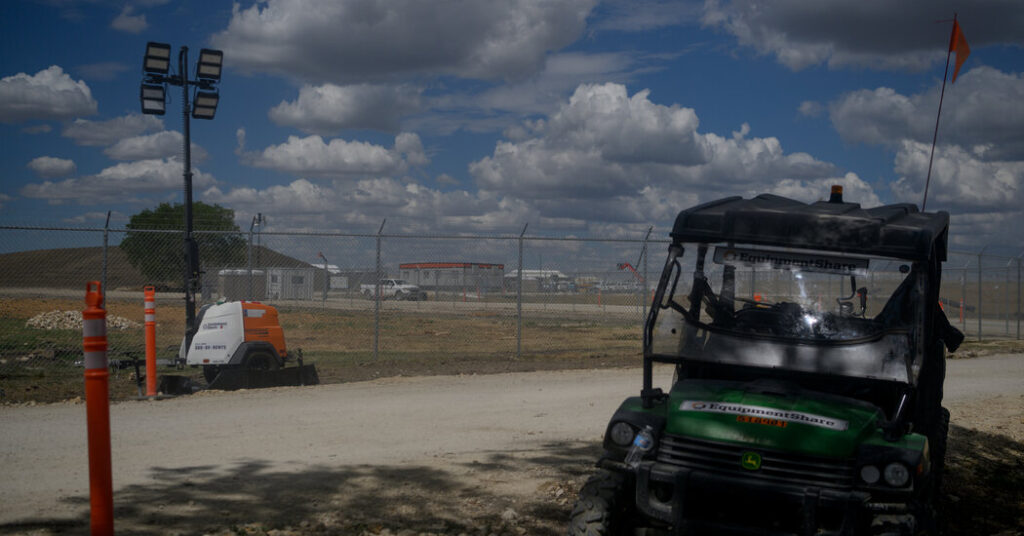
Construction trucks bound for a data center site near Hillsboro, Texas, clattered through the town square on a recent morning, drowning out conversation and tossing dust onto the outdoor tables of Kelley and Michael Ivy’s burger restaurant.
“People can’t even sit outside,” Ms. Ivy said, watching the seemingly nonstop caravan.
“They’re ruining the beautiful countryside,” Mr. Ivy added.
Both longtime Republican voters, the couple opposed the nearby construction, southwest of Dallas, because of concerns about its impact on the landscape and local water systems. They blamed Republican state leaders, like Gov. Greg Abbott, who they felt had allowed the data center industry’s headlong expansion. They wanted a change.
Would they vote for a Democrat in the fall? Neither said they would.
“It’s one of those things I pray about,” Ms. Ivy said. “What do you do?”
The rush of data center construction has fueled a potent bipartisan backlash across the country this year, creating unusual political alliances ahead of the November midterms. Democrats hope the anger will weaken Republicans among some of their most reliable rural voters. Republicans are betting that although those voters may dislike data centers, they are not ready to abandon the party over them.
The stakes are particularly high in Texas, home to more data centers than any other state except Virginia and where Republicans face the biggest political threat to their statewide dominance in years.
It is hard to overstate how important Texas is to the tech industry, whose growth depends heavily on building data centers in a state that, until recently, made such development relatively easy. Late last year, Mr. Abbott crowned Texas the “epicenter of A.I. development.” Up to half of the nation’s new data center capacity predicted from 2027 through 2030 is expected to be built in the state, according to Jefferies, an investment bank.
Then last month, Mr. Abbott abruptly called for a pause on connecting hundreds of large data centers to the state’s power grid until the projects underwent a full audit of their local impacts, including energy and water use. That process is likely to stretch beyond the election in November.
Public backlash against data centers has also extended to energy projects in Texas, imperiling longtime plans to build high-voltage transmission lines across the state. Without new transmission lines, the Permian Basin — home to the Texas oil industry — is at risk of rolling blackouts, according to the Electric Reliability Council of Texas, the grid manager.
Mr. Abbott’s decision last month to seek a pause on new data centers was a sign of just how fraught the politics have become for Republicans. Many of their own voters have turned against the projects. Some have even joined with Democrats to fight them.
“Hey guys, it’s OK, we can work with Democrats,” said Elena Voytko, a conservative Christian who has been an outspoken opponent of data centers in Temple, Texas.
At the same time, Ms. Voytko said finding common cause with Democrats on data centers had not changed how she planned to vote.
“They are bringing in data centers,” she said of Republican leaders. “But if we bring in Democrats, they’re going to not only change the fabric of Temple and Bell County, but of the whole state.”
Democrats hope the anger over data centers will dampen Republican turnout and even push some voters their way. They have seized on comments from President Trump, including his remark on Monday that communities that oppose data centers “want to end up being backwards and poor.”
For Republicans, the bet is that the issue, while important to those who live near the enormous construction sites, will not motivate enough average voters.
A recent survey from the University of Texas at Austin found Republicans split on the issue, even when asked about data centers in their own communities, while independents and Democrats were decisively against.
But only about a quarter of voters in rural areas supported data centers in the survey — a potential warning sign for Republicans who rely on turnout in these communities to overcome the advantage Democrats have in Texas cities.
“It’s an issue that just isn’t bubbling up as a top concern yet,” said Dave Carney, Mr. Abbott’s top political strategist. Voters do not rank data centers ahead of the economy or cost of living, he said. “But you say, ‘What do you think about data centers?’ They say, ‘Oh, they suck.’”
Still, Democrats want to capitalize on what they perceive as an advantage. Gina Hinojosa, who is challenging Mr. Abbott, has called for an immediate moratorium on data center projects. James Talarico, the party’s nominee for U.S. Senate, has called for tighter regulation.
Republicans face a particular challenge because their party has long supported the industry, said Sid Miller, the Republican agriculture commissioner who has sparred publicly with Mr. Abbott.
“The Democrats, they’re right on the issue,” Mr. Miller said. “We’re going to lose some seats over this.”
For months, anger among residents of rural Hill County — which favored President Trump 82 to 18 in 2024 — has grown over the data center projects popping up around the area. County leaders, frustrated by their inability to do anything on their own, looked to the state for guidance, said Judge Shane Brassell, the county’s top executive. They received none.
So the county issued its own one-year moratorium on data center construction. Some Republican politicians, including State Senator Paul Bettencourt of Houston, quickly said the county had no power to do so. One of the data center companies filed suit, personally naming Judge Brassell and other county leaders. The county quickly rescinded its moratorium.
“One of the ultimate goals was trying to get the state to become involved,” Judge Brassell said, seated in his office at the Hill County courthouse.
Mr. Bettencourt said the State Legislature would take up the issue in its session next year. “There’s clearly going to be top-down regulations from the state,” he said.
In a telephone interview, Mr. Bettencourt stopped short of criticizing data center development broadly.
“I’m not going to say that data centers are bad because they’re literally being used right now to support our phone call,” he said. He added that the 2026 election was the “frothiest” he had ever seen.
Attorney General Ken Paxton, who is running for U.S. Senate, has also sought to address the backlash, unveiling his own plan for data centers last month. He said he supported Mr. Abbott’s pause and, if elected, would introduce federal legislation to make data center companies criminally liable for “A.I. chatbots that undermine children’s safety.”
Part of the challenge for Republicans is that some of their own voters do not believe the proposed changes will halt the industry in Texas.
Despite Mr. Abbott’s pause on grid approvals, many data center projects are still moving forward with construction in the meantime. The pause also won’t affect companies planning to generate their own power off-grid.
Allison Clements, a former member of the Federal Energy Regulatory Commission, is among those who see the pause on new data center permit approvals as a temporary delay, rather than a step toward banning new projects. (New York, in July, became the first state to enact a moratorium on data center development.)
“There is so much significant development going on in Texas for the governor to single-handedly turn off the switch,” Ms. Clements said. “It’s almost unthinkable.”
Publicly, many tech and power companies have supported Texas’ new data center review process. Few can afford to alienate the governor of a state so critical to their growth plans.
“As far as timing goes, Texas is a get-things-done state,” Robert J. Gaudette, chief executive of Houston-based power company NRG Energy, told Wall Street analysts in August. “I expect them to work through stuff to get to a higher quality understanding of the projects.”
In Hubbard, Texas, last week, trucks formed a steady line of traffic en route to the sprawling site of a particularly large data center under construction outside town.
Jennifer Gentry, 56, moved to Hubbard several years ago. It was a quintessential small Texas town with parades on holidays and an old Victorian home that she had long admired. The arrival of the data center had changed all that, she said.
First came the boomtown feel of the construction: the noise, the traffic, the lights at night. Even after its completion, she feared, the town would be “something else,” never the same again. She is preparing to put her home on the market.
“They allowed it to happen,” Ms. Gentry, a Republican voter, said of Mr. Abbott and other state leaders. “They allowed them in, and they didn’t protect us.” She said the changes he proposed were “too late.”
Still, she said, she would probably not vote for any Democrats in the fall. She felt Democrats had “sold America out” when it came to immigration.
“With the Republicans, at least I know what I’m getting,” she said. “Even if it is something I don’t agree with.”
The post Texas Republicans Are Turning Against Data Centers. Will It Matter in November? appeared first on New York Times.