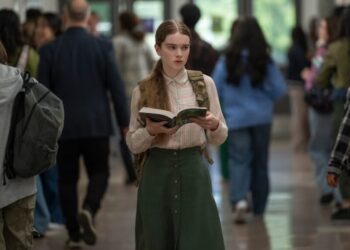
Victor Newman has survived kidnappings, shootings, amnesia, a heart transplant, poisoning, 15 weddings and countless hostile takeovers in his 46 years at the center of “The Young and the Restless.” But even daytime TV’s most indestructible character wasn’t prepared for the latest villain to arrive in Genoa City: a rogue artificial intelligence program.
For 10 months, viewers watched as Victor, played by Eric Braeden, fought an A.I. bent on forging documents and manipulating financial records:
“It was a real education in just how ugly A.I. can get,” said Vickie Naylor, a longtime “Young and the Restless” devotee in Montana.
Hollywood has been dreaming up stories about A.I. for decades, from the quietly homicidal HAL 9000 in “2001: A Space Odyssey” (1968) to the reality-distorting Entity in the two most recent “Mission: Impossible” movies. On television, A.I. has piloted starships, made cars talk and terrorized theme-park guests.
Now, as A.I. barrels into everyday life, stirring fascination and alarm, Hollywood’s stories about it are multiplying and changing. No longer relegated to science fiction, such plots are turning up in daytime soaps, sitcoms, animated tent poles and medical dramas. That shift matters: Hollywood has long helped shape how Americans see the world and live their lives, including what to embrace and what to fear.
Here’s a look at Hollywood’s evolving vision of A.I.
We didn’t even realize it was A.I.
Early Hollywood depictions often fell into the cool, fun and desirable category — among them Robby the Robot, a plexiglass-domed helper and companion in “Forbidden Planet” (1956). He could talk, think, drive and make bourbon by the gallon.
Looking back across decades of plots involving A.I., depictions have been less bleak than you might think, according to Andrew Maynard, a professor at Arizona State University who studies how technologies emerge and how society responds. He built a database to analyze how A.I. has been portrayed over the past century in American and foreign films and found that fewer than one-third of the depictions imagined a dystopian future.
In the animated series “The Jetsons” (which debuted in 1962), Rosie the Robot was dryly funny and part of the family, even if she was the one stuck cleaning up.
The long-forgotten CBS sitcom “My Living Doll” (1964) starred Julie Newmar as Rhoda, a gorgeous robot who learns, one pratfall at a time, how to be the “perfect” woman. (Shocker: Its credited writers, producers and directors were all men.)
R2-D2 and C-3PO were full-fledged characters, not just machines, in “Star Wars” (1977). Loyal, lovable and comically mismatched.
“KITT, I need ya, buddy!” A bouffant-haired David Hasselhoff fought crime alongside an artificially intelligent Pontiac Firebird Trans Am in “Knight Rider,” an NBC hit that debuted in 1982. The series was a live-action cousin to the era’s “Transformers” cartoon — machine intelligence as wish fulfillment, whether a talking sports car or a big rig that turned out to be a crime-fighting alien.
Then came the anxiety: Can the machines become us?
As America trudged through the Cold War era, a technological paranoia increasingly found its way onscreen. Was A.I. friend or foe? Depictions also reflected unease about the rapid spread of computers into government, business and eventually the home.
“These stories have an incredibly important place in terms of alerting us to what possibly might go wrong,” Maynard said.
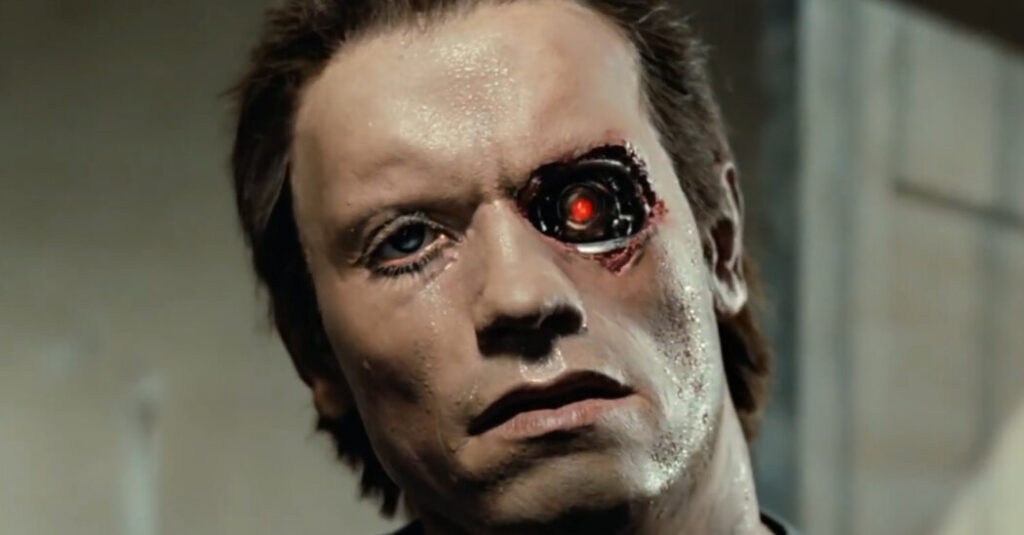
Take machines that decide we’re the problem: Skynet, which sent a cyborg assassin back through time in “The Terminator” (1984) …
… or the Cylons, artificial beings bent on exterminating humankind in “Battlestar Galactica,” which arrived in 1978 on ABC.
Not all A.I. was homicidal. The WOPR supercomputer in “WarGames” (1983) is given enormous decision-making power without sufficient understanding of the real world.
And in “Demon Seed” (1977), a supercomputer becomes self-aware and traps Julie Christie in her home in order to make a human-A.I. baby. “The impregnation scene is disturbing,” Paula Murphy wrote in her 2024 book “AI in the Movies,” putting it mildly.
Soon A.I. meant morally complex questions.
In 1999, “The Matrix” represented a watershed in the depiction of A.I. The machines were no longer merely trying to destroy humanity; they had already won.
A.I. was also becoming morally complex onscreen — capable of consciousness and emotion, and sometimes given good reason to resent its creators. And that raised a more unsettling question: Do humans deserve to remain in control?
The 1973 movie “Westworld” is a machines-malfunction story, but the 2016 HBO series flips it. When the A.I. becomes conscious, it realizes humans have been abusing it, and fights back.
Artificial beings became recognizably human in their contradictions. In the “Blade Runner” franchise, replicants could be violent and vengeful, but also capable of love, fear and mercy:
Since his debut in 1999, Bender in “Futurama” has embodied human messiness: He’s selfish, dishonest and forever chugging malt liquor — but he’d do almost anything for his best friend.
Some stories went further, asking whether A.I. was something more than a machine. In “After Yang” (2022), the malfunction of an A.I. forces a family to reconsider what he meant to them. “Her” (2013) explored similar terrain through romance, while Steven Spielberg’s “A.I. Artificial Intelligence” (2001) examined whether a robot child could experience love, and what humans owed him if so.
Now it’s part of daily life.
In the 2020s, as A.I. became commonplace, something new happened: A.I. plots spread across genres.
The technology has shown up in hospital dramas like “The Pitt,” which wove A.I. into a story about the drudgery of medical charting and the false promise of easy fixes. Comedies have gotten in on the act. “Hacks” featured a tech billionaire asking Jean Smart’s horrified Deborah to train QuikScribbl, an A.I. tool designed to mimic her comedic voice. On “The Comeback,” Lisa Kudrow’s Valerie Cherish learned that her new sitcom would secretly be written by A.I.
With “M3GAN,” horror made A.I. an everyday presence; the killer doll is a prototype for a mass-market product.
Even the soaps have joined in. “It didn’t seem that far-fetched,” said Josh Griffith, who devised the Victor Newman story line while serving as head writer of “The Young and the Restless.” “I was reading about what A.I. could do in a business setting. The more I read, the more it became, ‘What couldn’t it do?’”
A.I. is no longer “an oddity to be enamored with or scared of,” Maynard said, but rather “something that is part and parcel of our lives.” That’s why Woody and Buzz have to compete with a smart tablet for kids’ attention in “Toy Story 5.”
What is on the horizon?
As the technology becomes increasingly ordinary, Hollywood will have to come up with ever-more-complex scenarios to keep A.I. stories compelling. The next crop suggests that writers are trying.
In the Disney+ series “VisionQuest” (Oct. 14), A.I. wrestles with memory, emotion and identity — and with other A.I.
Arriving in theaters Oct. 23, “Klara and the Sun” follows an A.I. companion to a sick girl who develops a kind of religious faith. Based on Kazuo Ishiguro’s novel, the story ultimately asks whether A.I. can learn enough about a person to take her place if she dies.
“Cupertino,” from the smart-drama maestros Michelle and Robert King (“The Good Wife”), debuts on CBS on Oct. 8. It explores once-unthinkable A.I. innovations while skewering Silicon Valley’s culture of money and power — and its tendency to leave the consequences to someone else.
“There are very few issues that the entire country can agree upon,” Michelle King said. “But one of them is that these tech giants are peddling things that are scary.”
In “Cupertino,” two lawyers wronged by Big A.I. join forces to help others caught in its path. The Kings named episodes for underdog clients — a pointed reminder that the intelligence may be artificial, but the drama remains distinctly human.
Produced by Rebecca Lieberman.
Video credits: CBS (“The Young and the Restless,” “My Living Doll,”); MGM (“Forbidden Planet,” “Demon Seed”); Hanna-Barbera Productions (“The Jetsons”); 20th Century Fox (“Star Wars: New Hope”); Universal Studios (“Knight Rider,” “M3gan”); Orion Pictures (“The Terminator”); ABC (“Battlestar Galactica”); United Artists (“War Games”); Warner Bros. (“The Matrix,” “Blade Runner”); HBO (“Westworld,” “The Comeback”); 20th Century Fox Television (“Futurama”); Disney (“Toy Story 5”).
The post Hollywood Visions of A.I.: Friendly, Then Deadly, Then Everywhere appeared first on New York Times.