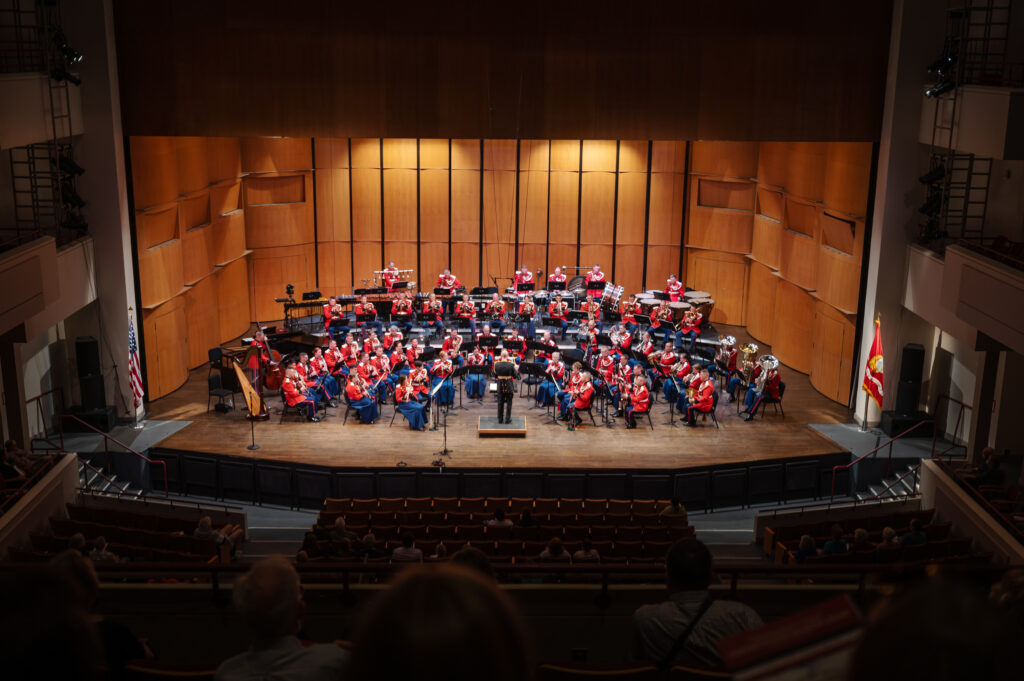
The National Symphony Orchestra is going on tour — sort of. With the Kennedy Center facing a temporary closure, the NSO’s 2026-2027 season will travel to six venues in the region: two each in D.C., Maryland and Virginia.
The NSO is embracing the mindset, with plans to tour nationally and globally, too.
“The fact that we are out of the Kennedy Center, to be a touring orchestra, that will help us to reach out with the idea that music should be taken to where people are,” Music Director Gianandrea Noseda told The Washington Post last month.
This season finds the orchestra exploring the work of Johannes Brahms, Gustav Mahler, Ludwig van Beethoven, Igor Stravinsky and more classic composers with the help of such guests as violinist Leila Josefowicz, conductor Leonard Slatkin and opera singer Will Liverman.
Many performances will be staged at multiple venues, bringing the NSO to new places and making the shows more accessible to the broader D.C. region than ever before. With so many venues to choose from, we put together a guide to help you navigate each performance space and decide where to see the season’s different programs.
Center for the Arts
4373 Mason Pond Dr., Fairfax, Virginia
Composer and conductor Marvin Hamlisch, one of the few people to achieve EGOT status, hosted opening night at George Mason University’s Center for the Arts in 1990. Managed by the College of Visual and Performing Arts, the center has hosted more than 120 Grammy winners alongside student performances and is currently in the midst of planning a modernization project.
Capacity: 1,935, with 1,112 of those seats in the grand tier and balcony sections.
Acoustics: The center, designed by pioneering theatrical and acoustic consultant George Izenour, boasts an adjustable music shell that can be modified to enhance the acoustics for an orchestra, a chorus or a chamber ensemble.
Notable past performance: The Grammy-winning Silkroad Ensemble, led by Pulitzer-winning folk musician Rhiannon Giddens, held the world premiere of the multimedia project “American Railroad” at the center in 2023.
Non-NSO performances to catch: The Shanghai Ballet, renowned for melding classical Western ballet with Chinese theatrical tradition, will stage “Butterfly Lovers” (Nov. 7) and “Giselle” (Nov. 8).
Rachel M. Schlesinger Concert Hall
4915 E Campus Dr., Alexandria, Virginia
Funded by a $1 million donation from former secretary of defense James R. Schlesinger in honor of his violinist wife, the Rachel M. Schlesinger Concert Hall opened as a proscenium-style theater in 2001 at Northern Virginia Community College.
Capacity: 981, split among an orchestra, terrace and balcony.
Acoustics: An “acoustically superior” hall, according to the venue, that hosts orchestra, choral and dance performances.
Notable past performances: Schlesinger Hall serves as a regular home for the Alexandria Symphony Orchestra. Military bands, including “The President’s Own” United States Marine Band, the Marine Chamber Orchestra and the U.S. Air Force Band, often host free performances in the hall.
Non-NSO performance to catch: The Alexandria Symphony performs “Pictures at an Exhibition,” Russian composer Modest Mussorgsky’s piano suite that musically depicts an exhibition of visual works by architect and painter Viktor Hartmann (Nov. 7).
The Music Center at Strathmore
5301 Tuckerman Lane, North Bethesda, Maryland
Born out of a public-private partnership involving the state of Maryland, Montgomery County and the Strathmore Hall Foundation, the Music Center at Strathmore opened in 2005. Strathmore serves as one of the homes to the Baltimore Symphony Orchestra and regularly hosts rock and pop concerts, jazz legends and comedy shows in its grand concert hall.
Capacity: 1,976 seats, split among an orchestra and three balconies: a promenade, a grand tier and an upper tier.
Acoustics: The venue boasts “pitch-perfect acoustics” thanks to an adjustable sound system that can be tailored to different types of acts and was designed by the same team as Seiji Ozawa Hall at Tanglewood, home to the Boston Symphony Orchestra. Strathmore also says that the hall’s shoebox design “promotes balanced sound distribution.”
Notable past performance: A rare collaboration from Talking Heads front man David Byrne and indie rock singer St. Vincent in 2012.
Non-NSO performances to catch: In a testament to Strathmore’s diversity of performances, you can catch viral vocal arranger Jacob Collier (Sept. 28), comedian Alex Edelman (Nov. 4-5) and “Hamilton” star Leslie Odom Jr.’s Christmas concert (Dec. 5).
Lincoln Theatre
1215 U St. NW, D.C.
Once the epicenter of D.C.’s “Black Broadway,” the Lincoln Theatre opened in 1922, making it the oldest venue the NSO will visit. At one point, the venue was a movie theater. After civil unrest in 1968, it fell into disrepair before it was renovated and restored in 1994. I.M.P., the team behind 9:30 Club, took over booking the venue in 2013 and now programs a mix of concerts, comedy shows and film screenings.
Capacity: 1,250 seats in a neoclassical-style theater split among an orchestra, a balcony and balcony boxes.
Acoustics: Think more rock club than concert hall.
Historic past performances: Jazz legends Duke Ellington, Louis Armstrong, Ella Fitzgerald, Cab Calloway and Billie Holiday performed at the venue (or its now-defunct dancehall, the Lincoln Colonnade).
Non-NSO performances to catch: The breadth of I.M.P.’s booking is reflected in the theater’s upcoming calendar: a concert from rising British pop-soul crooner Sienna Spiro (Oct. 16); “Broad City” comedian Ilana Glazer (Nov. 20); and a 40th-anniversary screening of Jim Henson’s “Labyrinth” with a live band (Nov. 22).
Dekelboum Concert Hall at the Clarice
8270 Alumni Dr., College Park, Maryland
Elsie & Marvin Dekelboum Concert Hall is the biggest performance space in the Clarice Smith Performing Arts Center, the University of Maryland’s massive arts complex that opened in 2001 and houses six performance venues; the School of Music; the School of Theatre, Dance and Performance Studies; and the Michelle Smith Performing Arts Library.
Capacity: 1,096, with 126 of those seats behind the stage in the choir loft.
Acoustics: Dekelboum boasts adjustable acoustic curtains and, the university says, a unique “silent HVAC system” to ensure a quiet environment during performances and recording sessions.
Notable past performances: While Dekelboum often stages performances from student ensembles, it has also hosted concerts and lectures from civil rights icon Harry Belafonte, Kennedy Center honoree Dionne Warwick and former vice president Al Gore.
Non-NSO performance to catch: Pretend you’re at a symphony and a Terrapins game when the University Band and the Maryland Community Band join forces with the Mighty Sound of Maryland marching band (Dec. 11).
Lisner Auditorium
730 21st St. NW, D.C.
Designed by Waldron Faulkner, the architect of several George Washington University buildings, the Lisner Auditorium played a key role in desegregation at the university upon its 1946 opening and has hosted countless music legends in the ensuing decades.
Capacity: 1,400 in a classic, auditorium-style setting with recently updated seats.
Acoustics: A new Martin Audio sound system was installed in 2013.
Notable past performances: Because it was a regular D.C. tour stop for decades, many music icons have graced the stage: bluegrass trailblazer Bill Monroe, jazz legend Chick Corea, folk hero Pete Seeger, classic rock innovators Pink Floyd, Grateful Dead leader Jerry Garcia and new wave pioneers Blondie. In 1963, Bob Dylan played there on his first national tour. Portions of rock band Little Feat’s famed 1978 live album “Waiting for Columbus” were recorded at the Lisner.
Non-NSO performances to catch: Politics and Prose often uses the Lisner to host book talks, and John Green will discuss his latest novel, “Hollywood, Ending,” on Sept. 24. Ballet fans can catch the Georgian National Ballet do “Sukhishvili” on Oct. 28.
The post A guide to the National Symphony Orchestra’s six D.C.-area venues appeared first on Washington Post.