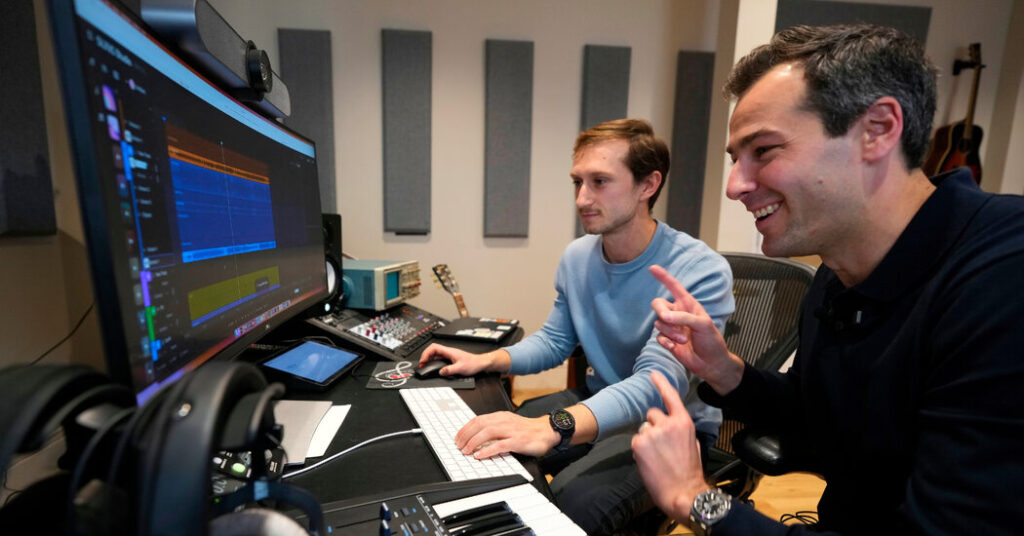
Since it arrived four years ago with the technology to generate fresh songs from a few words of text, the A.I. music company Suno has been both an innovator and a deeply divisive force in the music industry.
To Suno, its simple interface is a tool and a toy to inspire creativity in novices and professionals alike. More than 100 million people have created songs with the service, Suno says, and two million pay for an upgraded plan that includes commercial rights to the music they make with it.
“People feel really good when they’re creative,” Suno’s chief executive, Mikey Shulman, said in an interview. “The company exists to let people feel those warm and fuzzy feelings of being creative.”
But to the major record companies that are pursuing it in litigation, Suno is little more than a pirate, violating copyright law on an industrial scale. And as A.I. moves rapidly into the musical mainstream, a growing number of artists have expressed fears that their work will be drowned out by a flood of generic slop enabled by services like it.
Now, Suno wants to reset the industry debate and reposition itself as a fully fledged partner to labels and artists. The latest iteration of Suno’s service, released on Wednesday, is based on an A.I. model that was trained on songs licensed from the Warner Music Group, the home of Madonna, Led Zeppelin and Lizzo, after the music giant exited a lawsuit filed with other major labels and struck a deal that Warner executives say will open up new revenue streams for its artists.
“By being early, you have a seat at the table,” said Robert Kyncl, Warner Music’s chief, “instead of just sitting and watching what’s happening and pursuing lawsuits.”
In some ways, the fight over A.I. is just the latest chapter in the music industry’s long history of conflict and adaptation with technological disrupters, stretching from Napster to YouTube to TikTok. The difference now may be that the big labels operate in an almost entirely tech-enabled business, and music executives say they are eager to strike A.I. deals — as long as they respect the labels’ intellectual property rights.
“The relationship that the major labels have with technology is vastly improved from 20, 25 years ago,” said Drew Thurlow, a former music executive and the author of a recent book, “Machine Music: How A.I. Is Transforming Music’s Next Act.” “They are basically media companies that operate like tech companies.”
To most users, the latest version of Suno’s interface is little changed from previous ones. It can still, in a matter of seconds, transform a prompt — even one as simple as “I’m late for work, make it a country song” — into a surprisingly plausible finished track.
For Suno, the value of the new model is partly symbolic, a sign of how the company can create things “that could not have existed before, without a really big music company and a really progressive A.I. music company coming together,” Shulman said.
That may be an edge in a crowded field that also includes A.I. generators like Udio, ElevenLabs and Lyria, Google’s model. But with Suno still facing a barrage of lawsuits, and occasionally stumbling in public, much of the music business may be skeptical.
Just last week, four musicians, including the Grammy-winning singer-songwriter Jason Isbell, sued the company, saying it imitates their voices and styles without permission. (Suno said the claims were “without merit.”) And Suno withdrew an ad it had shot with Mary J. Blige in which the R&B star called the service “dope,” drawing an onslaught of criticism online. A Suno representative said the company learned it had negotiated a deal with someone who was not authorized to sign on Blige’s behalf.
Meanwhile, the biggest legal case against Suno shows no signs of slowing down.
In 2024, the three major labels — Sony, Universal and Warner — sued Suno for copyright infringement, accusing the company of pulling millions of copyrighted songs from YouTube and other sources without permission to train its machine-learning model on them.
“Suno’s service generates music with such speed and scale,” the labels’ suit said, “that it risks overrunning the market with A.I.-generated music and generally devaluing and substituting for human-created work.”
Suno has largely conceded that its model was trained on copyrighted content from the labels, but said the training is legal under the principle of fair use. That defense, which allows unlicensed use of copyrighted content in limited circumstances, is being tested in a variety of legal cases involving A.I.
Warner settled its part of the case last year and struck a deal with Suno that required the A.I. company to, within a year, retire the unlicensed version of its service. The new model was trained primarily on Warner content. “We’re starting from scratch,” Shulman said.
Suno has also agreed to implement guardrails on its output, like adding digital watermarks and limiting downloads, which the company says will cut down on slop — the tsunami of low-quality A.I. content that is overloading streaming platforms.
The company also agreed to work with Warner on a future product that will allow its artists to opt in to features like letting users remix their songs. In recent weeks, Suno has struck licensing pacts with BMG, another big label, and Believe, a distributor for independent artists; some songs from those partners were used in training Suno’s latest model. (Udio, a competing A.I. music service, has also signed deals with Universal and Warner, but not yet released a new version of its system.)
Kyncl, the Warner chief, is one of the few leaders in the music business to have lived through the tech wars from the other side, as a former top executive at YouTube.
“That experience taught me that things can be solved,” Kyncl said. “It starts by not assuming that everybody is a bad person on the other side.”
Representatives of Sony and Universal declined to comment. Both companies have struck deals with a variety of other A.I. companies, suggesting that the Suno dispute may ultimately come down to terms.
The views of artists may be critical to deciding whichever A.I. music companies succeed. And their opinions are all over the map.
Top producers like Dr. Dre and Timbaland have discussed using A.I., and the Weeknd is among the artists who have agreed to let fans remix their work on another platform, Hook. Others appear strongly opposed. In an interview in March, the singer SZA said, “I feel like I’m at war because of A.I.”
Damon Krukowski, an independent artist who is the legislative director of the group United Musicians and Allied Workers, said that for working musicians — those below the star level, which is the vast majority of artists — generative A.I. services like Suno are a threat to their livelihoods.
“No one has explained why it’s a good idea to start making music without musicians being involved,” Krukowski said.
When asked about artists’ views, Shulman said that “what is said in public versus behind closed doors are two very different things.” In July, Suno hosted a demonstration of its Studio platform at a small theater in Manhattan that was packed with producers and independent artists enthusiastic about the service.
Still, as the face of one of the rising giants of A.I. music, Shulman has been a prominent target for the incumbent music industry. He said that would not stand in Suno’s way.
“I have a particular vision of the future, which I think is a very good one and is one where people entertain themselves differently,” Shulman said.
“There can be lots of noise from the outside,” he added, “but that’s not going to deter us from achieving what we want to achieve.”
The post An A.I. Giant Made an Enemy of Record Labels. Can It Play Nice? appeared first on New York Times.