For an outdoor arts festival, the worst seemed to have already happened. It had rained. A night in the Evening Stars series of free performances in the World Trade Center plaza beneath the twin towers had to be canceled. That was on Sept. 10, 2001.
On the morning of Sept. 11, Liz Thompson, the executive director of the Lower Manhattan Cultural Council, which produced Evening Stars, finished a business breakfast at Windows on the World, the restaurant at the top of one of the towers. She took an elevator to the lobby at around 8:45 a.m. Moments later, she heard a strange sound and saw glass falling. The first plane had hit.
Thompson escaped unharmed, but by 10:30 a.m., the towers had fallen and the site of Evening Stars had become ground zero. The rest of the festival was called off.
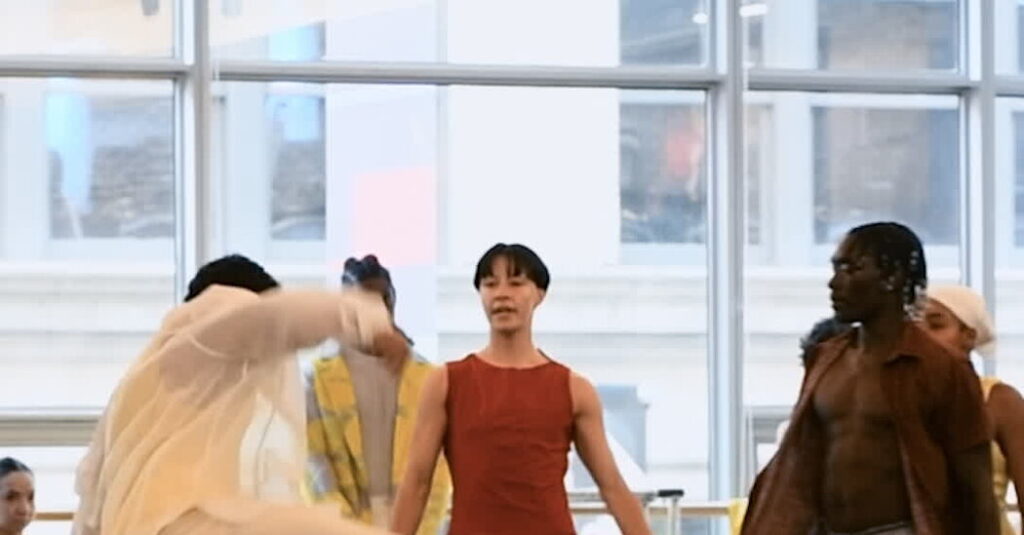
That included the performance by the Bill T. Jones/Arnie Zane Company scheduled for Sept. 12. Now, 25 years later, Jones is using the show that didn’t happen as inspiration for a new work, “Curriculum IV: Spin and Spin! Turn! Turn! Turn!” which will debut Thursday at Robert F. Wagner Jr. Park. (The free performances continue through Sunday.)
“As the 25th anniversary of 9/11 approached, I was thinking about how to honor the history,” said Moe Yousuf, the council’s artistic director and chief executive. “I saw an Evening Stars brochure in the 9/11 museum, and I thought of Bill, and I wondered, ‘What if we reflected on the thing that didn’t happen?’”
While reflecting on what did happen, Thompson said in a phone interview that Evening Stars “was very public and democratic,” adding: “Thousands of people came intentionally or inadvertently. You had C.E.O.s standing next to janitors, watching Twyla Tharp.”
The 2001 festival, the third Evening Stars, was the first to focus exclusively on dance. Its brochure advertised, “Artists who defy gravity.”
Thompson doesn’t remember much from the 2001 performances, “which is strange,” she said, “because I remember the previous years.” There’s a block.
Jones no longer remembers what he had planned for his show. David Parsons, whose Parsons Dance company was scheduled to perform on Sept. 11, can’t remember what he had prepared either. His crew was supposed to be on-site at 9 a.m. that day and hadn’t arrived when the first plane crashed.
David Gordon and his Pick Up Performance Company were the performers who were rained out on Sept. 10. Earlier that day, the dancers rehearsed a work called “[email protected],” a title that Gordon, who died in 2022, came to regret. In his diaristic Archiveography project, he recalled lying onstage and feeling dizzied by the height of the buildings, marveling that “someone thinks to build towers this tall.”
What Tharp remembers of her company’s performances on Sept. 8 was “the extraordinary sense of a stage reaching up to the sky,” she wrote in an email. “Everything seemed to echo back and forth because of the height of that space.”
On Sept. 11, Tharp canceled a rehearsal for “Movin’ Out,” her show set to Billy Joel songs that would debut on Broadway the next year, but went ahead with one the next day. The cast members arrived on foot or by bike. “The dancers wanted to work,” she wrote, “partly because they understood what ‘Movin’ Out’ was about” — Tharp saw it as a tribute to Vietnam veterans, among other things — “but also because they needed to gather together.”
“You cannot buckle under great adversity, no matter how depraved or insane it may be,” she added.
A few weeks after the Sept. 11 attacks, The New York Times published an opinion essay by Jones that looked forward to the works that might emerge, “a golden age” of prayerful, argumentative, rebellious dance.
Parsons responded to tragedy with comedy. His next work, “Too Many Cooks!” had fun with, among other things, sex stories from Anthony Bourdain’s memoir “Kitchen Confidential.” Parsons said in a recent interview, “I wanted to give people a break.”
Other artistic reactions took more time to gestate. In 2015, for the 50th anniversary of her start in choreography, Tharp made a work set to Bach’s two-volume “Well-Tempered Clavier.” On the morning of Sept. 12, the phrase “WTC I/II down” on news scrolls made her think of Bach’s “WTC I/II,” she wrote in a diary for The Times, so she called up the first prelude on her laptop and danced. The work she eventually made, she added, “shows the world as it ought to be.”
Jones, in a recent email, reflected on his 2001 essay: “It was full of hope that the tragic event might bring forth the best of us. Looking back at the last 25 years, I question that optimism.”
As research for “Curriculum IV,” he has been interviewing friends and family who lived through the aftermath of the attacks. Words like “suspicious,” “fragile” and “uncertain” keep coming up.
“My initial understanding of that moment was ‘chickens coming home to roost’ to quote Malcolm X,” Jones wrote in an email. “Now I am a bit adrift, ambivalent, though full of feelings: The memory of the event can still bring me tears and anger.”
“Curriculum IV,” the latest in a series of works examining an ethics of contemporary progressivism, is largely focused on the present, but with elegiac notes. Its score, by Samora Pinderhughes, gives the 1930s song “I’ll Never Be the Same” a collective subject: “We’ll never be the same/Never be the same again.”
“What I defiantly cling to in this moment is two words that had resonance 30 years ago, 25 years ago, and today,” Jones wrote, referring to the title of one of his best known works, “Still/Here.”
In the attacks, the Lower Manhattan Cultural Council lost its studios on the 90th floor of the north tower. The sculptor Michael Richards was working there that morning and was killed. The council also lost its offices and archives in 5 World Trade Center. For a few years, it moved from donated space to donated space. A flood of corporate and foundation money, especially from the Mellon Foundation, kept the organization afloat. Thompson stayed on until 2019.
“We did what we had to do,” Thompson said. “We pulled ourselves together again.”
From 2002 to 2009, with help from the Joyce Theater, the council presented Evening Stars in Battery Park City, with Jones, Gordon, Parsons and Tharp returning, among many others. The 2002 performances helped start the River to River Festival, an expansion, in a sense, of Evening Stars.
“Curriculum IV” is the culminating event of the 25th River to River. The council, too, is still here.
The post The Dance That Didn’t Happen at the World Trade Center Plaza appeared first on New York Times.