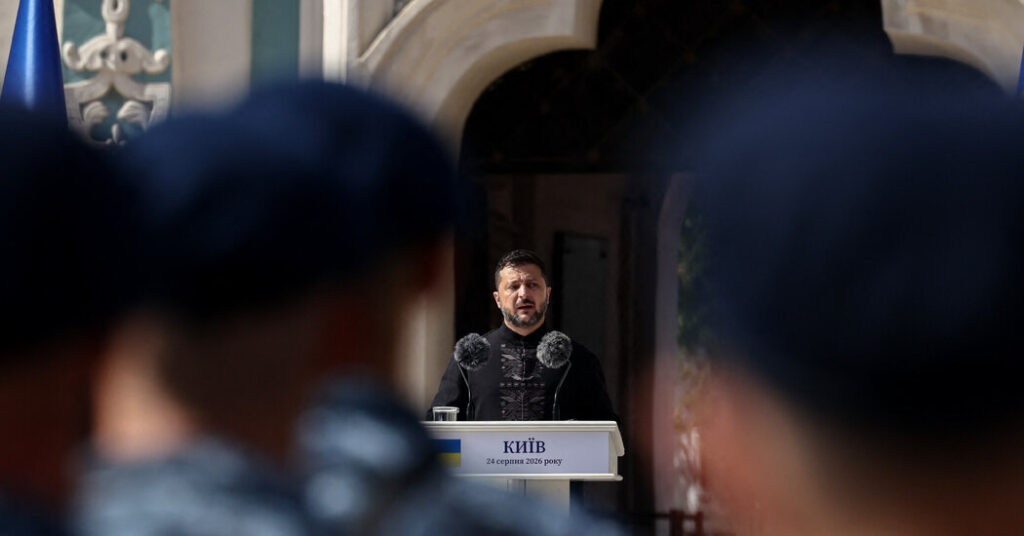
When a group of European officials arrived in Kyiv to mark Ukraine’s Independence Day last month, they got some worrying news.
The European Union, a key backer, had earlier this year finalized a loan of more than $100 billion for the country. But Ukraine now faced an unexpectedly large defense budget shortfall, President Volodymyr Zelensky told allies. To get through the year, he would need $27 billion more.
Ukraine’s request surprised and unsettled many officials around Europe at a moment when Kyiv, short on air defenses to protect itself from nonstop Russian drone and missile attacks, faces one of its most dangerous moments since 2022.
Europeans understand Ukraine is in a fight for its existence but did not expect such a large budget shortfall, according to four European diplomats who, like others quoted in this piece, spoke on condition of anonymity because they were not authorized to speak publicly. In private, some have questioned whether money is being spent efficiently, two European officials said, or whether needs are being overstated.
Now, European officials are scrambling to understand where the shortfall came from, exactly how large it is and whether, or how, to send more money this year. Kyiv is also asking Britain, Canada and Japan to help cover the gap.
The surprise request threatens to complicate Ukraine’s relationship with allies at a moment it needs their support. The United States has stepped back from backing Kyiv financially, making European money more essential. But national leaders must balance their support for Ukraine with domestic spending priorities, or risk angering voters.
Kyiv’s shortfall also offers a stark reminder that the cost of backing Ukraine is on the rise. The nation faces relentless attacks from Russia, including strikes on ports that have deprived it of a major source of revenue. It is also critically low on U.S.-made interceptor missiles capable of shooting down ballistics, and is trying to scale up development of its own alternatives.
“The war has objectively become more expensive,” said Olena Prokopenko, a Ukrainian foreign policy specialist who is a senior fellow at the German Marshall Fund, a research institute.
She said that if Ukraine can show European nations that it truly needs the money, “I believe that they will find a way — for Ukraine’s sake, but also for their own sake.”
Where did the shortfall come from?
The source of the budget gap remains unclear and somewhat contested. Speaking in Kyiv last month, Mr. Zelensky said that some of the spending had happened under former defense minister Mykhailo Fedorov, who had advocated major changes in the defense industry and was recently fired in a move that sparked street protests.
The defense ministry “used funds that had been budgeted for the end of this year, and of course, the total gap is $27 billion,” Mr. Zelensky said at a meeting of European and British leaders on Aug. 24.
Mr. Fedorov has denied that such a large shortfall existed during his tenure and said it must be tied to projects under the ministry’s new leadership.
Ukraine has not yet publicized a full breakdown of its short-term budget needs, although Mr. Zelensky told journalists last month it includes weapons, soldiers’ salaries and family payments for soldiers killed in action.
Roksolana Pidlasa, head of Ukraine’s parliamentary budget committee, said she had been warned earlier this year that a shortfall of around $7.5 billion was expected. But military expenditures increased by more than 17 percent in the first eight months of 2026 compared with the year before, Ms. Pidlasa said.
“These gaps emerge because the war is just getting more and more expensive every year,” Ms. Pidlasa said. “We have to account for the fact that the Russian tactics change and it makes it worse for Ukraine.”
She said that the increase in Russian attacks on Ukrainian industry, including metallurgical plants and the grain export corridor, had lost Ukraine around half its expected revenues last month alone.
The Ukrainian prime minister, Serhii Koretskyi, has asked lawmakers to impose austerity measures. Yet there are limits to what can be cut.
“We cannot compromise on supporting our military, because it’s about our survival,” said Oleksandr Merezhko, chairman of the foreign affairs committee in Ukraine’s Parliament. Cutting some of the largest expenses, such as soldiers’ salaries or family payouts, is a nonstarter, he said. “It should be sacred for us.”
How can the gap be filled?
Though Ukraine’s funding shortfall caught much of the E.U. by surprise, Brussels is trying to figure out how to patch it, should that prove necessary.
Valdis Dombrovskis, the E.U. economy commissioner, talked with Mr. Koretskyi on Monday. Step 1 is “to get a clear picture of what the budgetary or financial situation is,” Balazs Ujvari, a spokesman for the European Commission, said following that meeting.
Mr. Zelensky has made suggestions for how Europe could help, such as by speeding up its loan to Ukraine.
The European Union in April finalized that massive loan to Ukraine only after a bruising political process. The lifeline of more than $100 billion is meant to be paid out over two years, half in 2026 and half in 2027.
Paying it out faster may be the only workable option for getting Ukraine more cash quickly, eight European diplomats and officials agreed. Some European officials have suggested that momentum is building behind such a plan.
“We will continue to provide funding through the Ukraine support loan and, where possible, bring that funding forward where it is needed,” Helen McEntee, Ireland’s foreign minister, said following a meeting of defense ministers last week.
That is far from agreed upon, given that officials at the European Commission are only now assessing the size of the funding gap. And it would create another problem: less money for later next year.
Ukraine is also pushing the European Union to seize Russian sovereign assets — a way to rapidly raise an even larger block of funding.
There are more than $200 billion of frozen Russian assets held in the financial depository Euroclear, in Belgium. European officials last year looked at taking that cash and using it to back a loan to Ukraine, but the plan crumbled at the last minute amid opposition from Belgium and other nations.
Now, Sweden and other E.U. nations are trying to bring back the idea of using that money as a way to back Ukraine without draining national budget.
Yet the obstacles that toppled the earlier plan remain. Most importantly, Belgium remains skittish, worried that seizing a foreign nation’s assets could trigger a financial crisis by sending a signal that foreign cash can be seized for political reasons, causing those savers to pull their money out of Euroclear and other European financial institutions. Euroclear declined to comment.
Given such barriers, any agreement to use the frozen money would take months, if one is possible at all.
Andrii Sybiha, Ukraine’s foreign minister, recently urged European countries to move quickly on a decision about the frozen assets and not see them only as leverage for later.
“Negotiations are somewhere in the future,” he said, “while funds are needed now.”
Koba Ryckewaert and Yurii Shyvala contributed reporting.
The post Ukraine Says It Needs $27 Billion More. Europe Wants to Know Why. appeared first on New York Times.