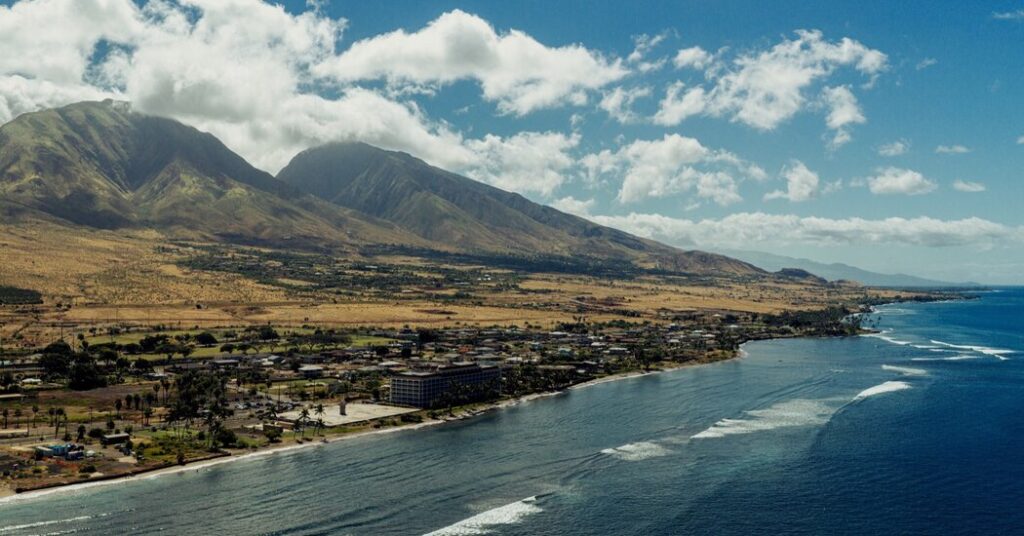
Early in the morning on Aug. 8, 2023, the Dadez family could see smoke about two and a half miles up the hill from their house in Lahaina, on the Hawaiian island of Maui. The combination of extreme winds, severe drought and the nearby dried-out fields of a former sugar cane plantation had created the perfect conditions for a fire. Still, the fire seemed far away. The family didn’t think there was any way it would travel across town and downhill, all the way to their home by the ocean.
Then, around 9 that night, Marilou Dadez heard their neighbors running outside their house. Her husband, Randy, was about 10 miles away in Kapalua, where he worked as a shuttle bus driver at a resort, but she and their four children were at home. “The sky was orange,” says Rhaliyah, their 22-year-old daughter. “It was red. It was so scary.” The five of them piled into their 2001 Honda with as many belongings as they could cram into a single suitcase.
The Dadezes’ older daughter, Rianna, 24, who was just learning to drive, had to navigate the darkened roads as embers streaked past the windshield. The flames and the smoke were accompanied by what sounded like a war outside: gas tanks exploding, windows breaking, wind ripping roofs off homes, entire homes collapsing.
They were fleeing what would end up as the deadliest wildfire in the United States in more than a century. The Lahaina fire burned 2,170 acres, destroyed more than 2,700 structures and killed at least 102 people. Some 12,000 people lost their homes overnight.
Less than a year later, 11,637 Hawaii residents were homeless, an 87 percent increase from before the fire, and the number of residents living in emergency shelters or in transitional places — ranging from FEMA-funded housing to friends’ garages — had tripled.
Hawaii, and Maui in particular, had already been confronting a serious housing problem. The booming markets in vacation rentals and second homes and the rise of remote work had made Lahaina particularly attractive to wealthy mainlanders, which drove up housing costs and shrank affordable alternatives. “These two forces — a convergence of a climate crisis and a housing crisis — were at a breaking point at the same time when these fires hit,” says Kathryn Leifheit, an assistant professor at U.C.L.A. who studies the causes of homelessness, including climate disasters. “But I think it’s emblematic of trends everywhere in the U.S. and the world.”
With FEMA scheduled to discontinue its funding for temporary housing assistance next February, many on Maui are scrambling to rebuild, while others simply won’t ever return. Those who are staying worry that the old Lahaina will be replaced by short-term rentals or single-family homes built by so-called disaster capitalists from the mainland or other countries, developers who can afford to wait however long it takes to rebuild.
For the Dadez family, the past three years have been defined by displacement and trauma. They moved eight times after the disaster. At one point, two summers ago, seven of them were confined to two hotel rooms: one for Randy, Marilou and their two youngest children, and one for their two other daughters and a boyfriend. Many of them slept on couches because each room had only one bed.
This summer, they finally moved into their rebuilt home, which is just north of Front Street, Lahaina’s once-thriving historical center. The street has a new sidewalk, benches, trash cans, streetlights and shoreline railing. But only a dozen or so commercial projects have filed the paperwork needed to start building on what used to be the heart of Front Street. A single business has officially reopened — a food truck. The Dadezes finally have their own house again, but they wonder when their neighborhood, their town — the rest of their home — will return.
For most of the first couple of weeks after the fire, the Dadez family found refuge at a church and in temporary shelters. They then spent much of the next year moving between four resort hotels: the Fairmont, the Hyatt Regency, the Honua Kai and the Royal Lahaina. It was a quick and effective solution, but flawed. Some Maui residents who were homeless or whose housing situations were unstable before the fire were also able to move into the rooms made available to fire survivors through the state’s hotel program. As a result, FEMA workers, already struggling to identify and provide vital necessities to those displaced by the fire, had a more complicated job and fewer resources.
For many Lahaina residents, the hotel program meant living at work, because the hospitality industry is the main employer in West Maui. The night of the fire, after making sure his family was safe, Kekoa Mowat returned to the Hyatt Regency, where he was head of security, to calm the 2,000 tourists staying there; later he had to coordinate their evacuation plans. Once they were gone, he had to find accommodations for displaced fire victims, his family included. For months, 56 members of his ohana, or family, occupied the entire 21st floor.
For Randy Dadez, looking after his family became another full time job, along with driving for the Kapalua Resort. His youngest child, Kobe, who was 8, woke up most nights terrified. When Kobe returned to school a month after the fire, he repeatedly asked the nurse to call his parents to make sure they were still alive. Samara, who was about to turn 13, hid in the school bathroom during recess and lunch because students at her new middle school bullied her for being without a home. Rhaliyah tried therapy, without success — most practitioners were counseling from the mainland over video calls; she felt they could never understand what she went through.
“When housing remains unstable, the disaster continues,” says Ruben Juarez, who leads the Maui Wildfire Exposure Study and published its findings this year in JAMA Psychiatry. “Obviously not through the flames but through chronic stress, disrupted sleep and repeated displacement.” He told me that one in five people he surveyed felt insecure about their housing situation — that is, they were experiencing anxiety about affording rent, facing another move or making children change schools again. These individuals, he says, were dealing with “some of the worst mental-health outcomes,” including suicidal thoughts. One study found that the combined rate of deaths by suicide and overdose in Maui in August 2023 was by far the highest it had been in 10 years.
When tourism resumed, just two months later, vacationers stayed in the same resorts as the survivors. Living next to them was complicated, Rhaliyah told me; the family wasn’t comfortable leaving their rooms, and it felt awkward to have to cope with the disaster’s aftermath while the neighboring room was occupied by a couple on their honeymoon. She says the tourists seemed intent on overlooking the fire’s devastation.
“People thought we were so lucky to stay at the Fairmont and everything,” Rhaliyah says. “But we had to keep moving so much. We didn’t know where we were going from week to week.”
When the hotel program ended, Randy had to reregister with FEMA, which provided direct financial subsidies for rentals. This required him to repeatedly file to maintain their eligibility. But because one FEMA agent after another was unable to confirm their status, Randy felt as if he was constantly on the phone with the agency. He also enrolled in the state’s Disaster Case Management Program, which created an individual recovery plan to address the family’s specific short- and long-term needs.
Finally, FEMA found and paid for a rental home for them in Napili, about seven miles north of Lahaina. The Dadezes had space — a backyard, five bedrooms, more square footage than they had ever lived in. And though they stayed there for two years, they never felt at ease because the landlord lived on the property. Rianna never unpacked her carry-on suitcase.
After a year of moving from hotel to hotel with the family, Rhaliyah settled into an apartment with her partner about 30 miles to the south, which they were able to afford without assistance. But less than two months later, torrential floods forced them to evacuate. When the immediate danger passed, Rhaliyah was reluctant to return. She was pregnant and worried about mold and any complications that might arise from the stress of living in a disaster zone again. So they moved back in with her parents.
In Lahaina today, the debris has been cleared from the 1,390 residential lots where homes were destroyed. But the time needed to complete the permitting and construction for all the new housing will most likely take two or three more years; several months after the fire, one politician estimated that it could take up to a decade or more before the town is fully rebuilt.
Still, the Dadezes consider themselves fortunate. So do the Mowats. Both families were selected for a rebuilding program run by Samaritan’s Purse, a disaster-relief Christian charity. The organization not only covered the costs of construction and labor for 41 families; it also helped with bureaucratic tasks like filing for permits, which enabled construction to begin more quickly. Many in Lahaina who didn’t get support from the charity have been waiting for insurance payouts or for a settlement that, when finalized, is expected to provide more than $4 billion to some 20,000 people affected by the fire.
For most families, though, the typical rebuilding process involves figuring out how to do things on their own, in piecemeal fashion, without support. Mowat’s brother-in-law and nephew, for example, are building their two-story house by themselves. The structure is framed and drywall is up — both of them are carpenters — but more needs to be done before anyone can live there. “It’s slow,” Mowat says. “Sometimes they run out of money, and they stop for a little bit. And they try to figure it out, get more money, and then they can start again.” In the meantime, the nephew and his family live in a tent in a friend’s garage across the street.
Lately, Mowat has been attending disaster-recovery meetings and encouraging fire survivors to apply for economic aid, especially those who distrust the process or fear the paperwork required. Maui County received a federal grant of $1.6 billion for disaster relief last year. The county set aside $298.6 million for a single-family-home reconstruction and reimbursement program and $92.5 million for a first-time home buyers program, which has received more than 3,000 applications. Mowat applied for a reimbursement grant in March, but to qualify he needs to satisfy environmental tests and inspections, which will delay his move-in date.
He hasn’t broken ground yet on his own house, but his mother-in-law’s home, on the same property, is nearly ready. Mowat, who is 56, and his son, Connor, who is 28, took me to visit it in late June. Two mobile homes were parked at the site; construction was visible on the neighboring plots. “We’re going to be in a great house,” Mowat told me. “Our property is probably going to be worth a lot, but we’ll never sell.”
Though he was eager to return home, the trip to the building site brought up difficult memories. “We want our mango trees back,” he said. “We had 10 mango trees. We had the grass. We had plants and flowers everywhere. But now we don’t. It’s gravel and dirt.”
He began to cry, which he called “sweating,” something he never did before Lahaina burned. “The fires changed everything,” he said. “But we’re going to bring it back to life. It’s going to take a lot of work. Connor’s going to bust his butt, because I’m old.”
Connor was planning to take advantage of the first-time home buyer’s grant, for up to $600,000, and move south in a few months to a town about 35 minutes away — he couldn’t afford to stay in Lahaina, even with the grant and favorable interest rates available to fire survivors.
He won’t live blocks from his parents and be as close as he used to be for family barbecues and celebrations. “One of the hardest things after the fire was knowing my son wouldn’t grow up with the same kind of childhood home that I did,” Connor said of his 3-year-old son. “He won’t have any memory of the Lahaina I knew.”
Mowat, who is an ancestral Hawaiian and was raised on Molokai, sees this moment as a potential opportunity. “Hawaiians have never had enough money to challenge invading interests, so we’ve always had to cater to outsiders,” he said, before listing examples from different eras: the whalers, the missionaries, the British, the United States military, the sugar plantations and, more recently, the tourists and real estate investors.
“When we had the fire and the tragedy,” he said, “then people understood that Lahaina wasn’t a commodity. It wasn’t just a destination. It was a community where people live, and we lost our people. But we have a voice now. The mayor has been to Lahaina more times this term than any other mayors put together.”
When we stopped to visit the Lahaina Jodo Mission, a Buddhist temple, Mowat’s wife, Surficia, described last year’s O-Bon, the annual August celebration to honor ancestors. It had been organized by the three Lahaina Buddhist temples that burned down. She tensed up as a couple of haole surfers, or strangers, approached the gate to the temple grounds, adjacent to a 12-foot-tall bronze and copper Buddha, the only thing at the mission that survived the fire. The place is sacred to Surficia — like much of Lahaina — and she has been defensive and angry since the fire. “I get super worked up thinking that they’re going to open the gate and go in,” she said. “Locals have become very protective of what’s left of the memory, because it just gets violated over and over again.”
In late June, Randy Dadez and four generations of his family moved into their new home, on land his grandfather bought decades ago. In the living room, there was a new recliner with the tags still attached, an air mattress, boxes and the black bins with yellow lids that have been ubiquitous around Lahaina, containers most families moved from place to place while they waited for a permanent home. “My wife is a neat freak, so we’re trying to get some of these containers out of here,” Dadez said as he showed me around the house. The bins were filled with donations of toiletries and cleaning supplies and the essential items the family stuffed into the car when they fled.
“I just feel blessed and grateful,” Dadez said. “One of the stresses that’s gone is not having to move anymore. I kept promising my wife we’d get back to the home, and now we have a home.”
Those who have returned to Lahaina are constantly reliving the night of the fire. But part of moving back in is finally moving on, Dadez said. His family survived; now they have a place that is theirs. As Ruben Juarez of the Maui Wildfire Exposure Study put it to me, “Rebuilding houses restores structures, but housing stability restores health, dignity and the ability to basically create your own future.”
Today, Rhaliyah and her sister each have babies about a year old. They waddle around the new living room and are coddled by three generations. For now, they are among the few people in Lahaina who will have no memories of the fire. The house they grow up in will be their memory of home.
Jaime Lowe is a contributing writer for the magazine and the author of three books, including “Breathing Fire: Female Inmate Firefighters on the Front Lines of California’s Wildfires.”
The post ‘We’re Going to Bring It Back to Life’: The Long Road to Reviving Lahaina appeared first on New York Times.