After New York State legislators were caught billing for official travel that never occurred, the Legislature adopted ethics reforms and stepped up its record keeping to ensure that the state’s generous reimbursement systems would not be abused again.
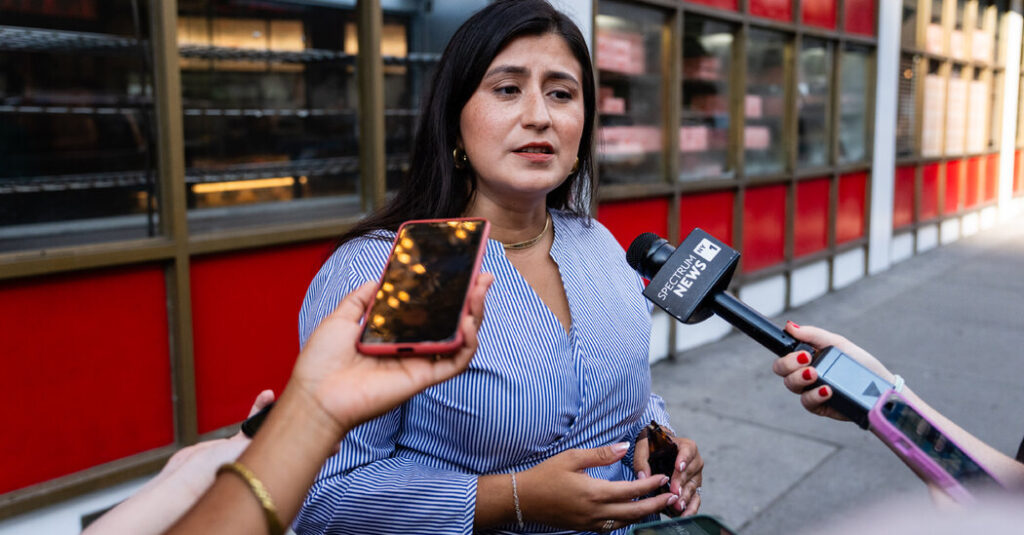
But that system, which was strengthened in 2015, appears to have missed glaring red flags in more than a dozen reimbursement requests submitted by a prominent Democratic state senator, Jessica Ramos of Queens, whose billing practices have now come under scrutiny.
The Legislature’s rules require senators to certify in writing on all reimbursement requests that they have not already used any other outside pot of money, such as a campaign account, to pay for the expenses. Purchasing train fare, in particular, with campaign money and then receiving state funds to cover the same expense would constitute a prohibited double dip, ethics and legal experts said.
Yet time and again in 2023 alone, Ms. Ramos submitted receipts suggesting that Amtrak tickets for travel to and from Albany had originally been paid for by her State Senate campaign.
The billing information on one set of those receipts listed Ms. Ramos’s campaign committee name, “Ramos for State Senate,” as the payer. In another, the last four digits of the credit card used to book the travel matched those of a campaign committee card. In still others, the committee name appears to have been partially redacted to “Ramos for State.”
Here’s a look at the voucher connected to the unredacted receipt.
The secretary of the Senate, Alejandra Paulino, approved Ms. Ramos’s expenditures despite the receipt saying that Ms. Ramos’s state campaign had already paid for the travel, and the senator was reimbursed for the costs, records show.
Ms. Ramos, who ran unsuccessfully to be mayor of New York City in 2025, did not respond to multiple requests for comment.
Mike Murphy, a spokesman for the Senate Democrats, did not answer specific questions about oversight procedures or what if any State Senate policies exist to prevent double billing for travel expenses. But in a statement, he said more stringent controls might be warranted.
“We are open to reviewing and strengthening our policies and review practices to ensure this does not happen again,” Mr. Murphy said. “This is clearly unacceptable.”
The receipts showing that Ms. Ramos used State Senate campaign funds to pay for train fare while also charging taxpayers for the same expenses emerged after a New York Times report on the senator’s billing practices.
Late last month, some of Ms. Ramos’s former aides said in interviews that it was common practice for her to bill both her state campaign and the Legislature for the same travel, but they did not have access to extensive documentation of the billing after leaving their jobs.
Neither Ms. Ramos nor the State Senate would provide the receipts Ms. Ramos submitted to receive travel reimbursements.
But, in response to a public records request, the state comptroller’s office turned over more than 200 pages of her travel vouchers and Amtrak receipts spanning the past three years.
All of the 14 receipts that contained clear signs that they might have been billed to Ms. Ramos’s campaign stemmed from travel booked by Esther Rosario, Ms. Ramos’s former chief of staff, who also worked as one of her campaign consultants.
In a statement on Tuesday, Ms. Rosario, who now serves as executive director of the pro-labor organization Climate Jobs NY, acknowledged using Ms. Ramos’s campaign credit card to pay for the senator’s train tickets to Albany.
“I did what my predecessors did,” she said. “I followed instructions in the good faith belief that I was not being asked to do anything improper, and I personally did not profit in any way.”
It was not clear who added every redaction to the receipts or whether they were already redacted when the senate secretary, Ms. Paulino, reviewed them. It was also unclear whether Ms. Paulino or her staff members raised any questions about the vouchers.
But the fact that they were eventually approved underscores how lax the oversight of travel expenditures has remained in the New York State Senate despite the reforms adopted a decade ago, ethics experts said.
Milton L. Williams, a former Manhattan federal prosecutor who was co-chairman of a New York State public corruption commission formed in 2013, said that billing twice for the same official travel was “exactly the type of conduct” that the panel was created to prevent.
“Barring a very compelling explanation, this appears to be a classic case of double-dipping,” he added. “I am extremely disappointed and hope that things will improve.”
The Legislature’s rules around travel reimbursements were strengthened a decade ago after several legislators were caught receiving stipends for trips to Albany that never took place, among other things. At least two members of the State Assembly went to federal prison.
In response, the Legislature adopted reforms requiring proof of being present in Albany, including by submitting receipts or swiping their electronic access cards in the Capitol Complex. The new rules also tightened restrictions on the use of campaign funds.
Even so, a Times analysis of Ms. Ramos’s billing from 2021 to 2025 found more than $30,000 in overlapping charges to her campaign and the state reimbursement system for travel expenses.
Apart from the Amtrak tickets, Ms. Ramos also charged hotel rooms to her campaign account while collecting per diem payments for lodging, the analysis found.
The Times could find no record of her making any reimbursements to her state campaign for travel expenses.
Although campaign treasurers are required by law to keep the receipts for campaign expenditures going back five years, Ms. Ramos’s treasurer of record before 2026 said he quit performing that job years ago and did not have them.
A day after the article was published, the State Senate made a formal referral to the Commission on Ethics and Lobbying in Government, asking the panel to investigate. The status of that investigation on Tuesday was not clear.
Government watchdogs said Ms. Ramos’s billing practices pointed to the need for even stronger oversight in the Legislature.
“The legislature exempts itself from transparency and accountability measures on the argument that they have the ability to govern themselves — and they don’t,” said Susan Lerner, executive director of Common Cause New York, a nonpartisan government accountability group.
“This is an unfortunate example of why an entity cannot police itself.”
Produced by Rumsey Taylor.
The post State Senate Approved Jessica Ramos’s Travel Claims Despite Red Flags appeared first on New York Times.