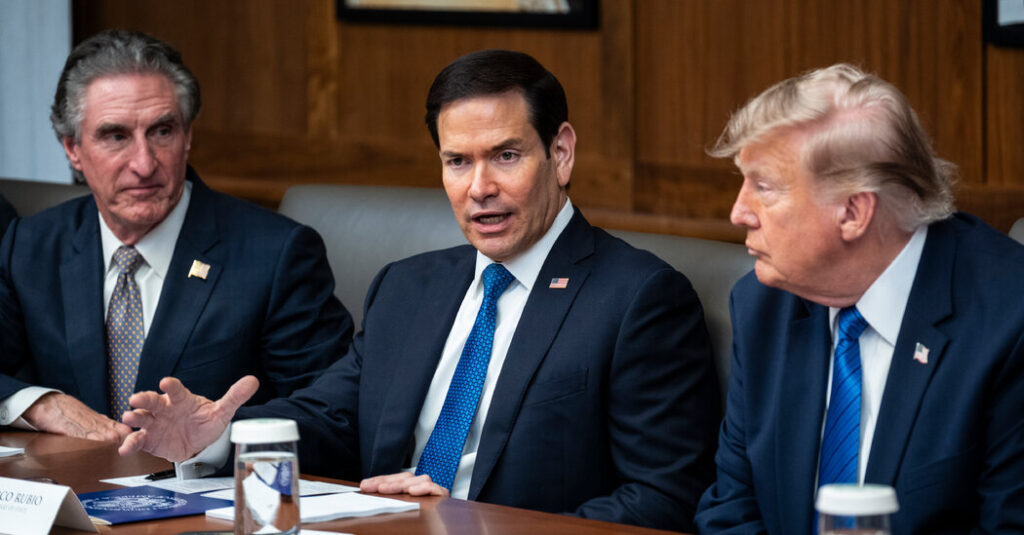
Secretary of State Marco Rubio arrived in Colombia on Tuesday, part of a three-country trip during which he said he planned to speak with leaders about taking on “transnational criminal terrorists” and “economic engagements.”
After years of strained cooperation under Colombia’s former leftist leader, Gustavo Petro, Mr. Rubio, who met with the country’s new president, Abelardo De La Espriella, said the U.S. was looking to deepen its relationship with Colombia, calling the meeting “a new era for one of our most historic partnerships.”
In Mr. De La Espriella, Colombia’s recently elected right-wing president, President Trump has found an eager partner.
“The president is a big fan of ‘the Tiger,’” Mr. Rubio said in remarks to reporters on Tuesday evening, referring to Mr. De La Espriella’s campaign moniker. “They have already spoken by phone a couple of times, and I know the president is very enthusiastic about his election.”
After the meeting, Mr. De La Espriella said he and Mr. Rubio had agreed “to strengthen regional security, combat narcoterrorism head-on, comply and collaborate on border matters, and open new opportunities for investment, development, and prosperity for our peoples.”
The State Department announced on Tuesday evening that the two countries had signed agreements to deepen cooperation on nuclear energy and critical minerals by accelerating projects through public and private financing from both countries.
Along with pursuing deals to access Latin American countries’ resources — from critical minerals to oil — the Trump administration is embarking on a militarized anti-cartel push in the region that it has likened to the offensive against Al Qaeda and the Islamic State as it seeks to exert greater control in Latin America.
Colombia, the world’s largest cocaine producer, has in recent years seen a surge in production amid soaring global demand for the drug. That has set off a spike in violence as armed groups battle to control territory and move into neighboring countries like Ecuador and Venezuela.
After Mr. De La Espriella was inaugurated, the United States announced a $1 billion dollar aid package for Colombia. The new president has since enrolled Colombia in the Trump administration’s new security alliance, the Shield of the Americas, and has pledged to make the country its regional hub. He has also committed to allowing joint military operations with the United States.
Mr. Rubio said on Tuesday that the United States was prepared to significantly expand security cooperation with Colombia by working against criminal and terrorist groups operating in Venezuelan territory, calling them a threat that “cannot continue.”
“Obviously, we want to hear in a little more detail about what ideas the president has in terms of how we can cooperate, but we’re prepared to do everything necessary within the framework of Colombian law,” Mr. Rubio said referring to the new president.
He said the Colombian government had not asked for U.S. troops on the ground and that any expansion of the relationship would be based on Colombian requests. He added that the possibility of a U.S. military base in Colombia was being studied but was at an early stage and that he was open to the idea of opening a U.S. consulate in the city of Barranquilla, which Mr. De La Espriella has made his presidential headquarters, instead of the capital, Bogotá.
“We’re prepared to help in every way possible. Whatever they ask us for,” he said. “We’re not going to impose anything.”
Mr. De La Espriella, who made crushing “narcoterrorists” a central plank of his outsider campaign, has touted military operations against trafficking groups in his first month in office. As Mr. Rubio prepared to visit, the new Colombian leader posted images of body bags holding what he said online were slain group members.
In Mr. Trump’s second term, his administration has zeroed in on the drug trade, justifying deadly strikes against people the administration claims are traffickers — often without evidence — by designating them as terrorists.
The second Trump administration has added about 20 new Latin American groups to a list of foreign terrorist organizations. They include transnational gangs like Venezuela’s Tren de Aragua; dissident factions of a once-powerful rebel group in Colombia, the Revolutionary Armed Forces of Colombia, known as FARC; and warring drug gangs in Ecuador.
Gimena Sánchez, Andes director for the Washington Office on Latin America, said that while civilians in Colombia had paid a toll in recent years as clashes between armed groups worsened, it could become still more dangerous for them if more military forces are deployed against groups. That could also lead to rights violations, she said.
Along with military cooperation, Mr. De La Espriella and Mr. Rubio discussed tariffs, with Mr. Rubio noting after their meeting that negotiations were making “good progress.” Mr. Rubio also discussed the possibility of a privately-financed reconstruction fund to help Colombia to recover from last month’s devastating earthquake.
On his next stops in Ecuador and Peru, Mr. Rubio plans to address trade relations with China as the United States seeks to open up more of Latin America to American investment.
Last month, Ecuador’s president, Daniel Noboa, traveled to China to meet with leaders, a move that risked rankling U.S. officials. Ecuador’s economy is deeply enmeshed with China, which financed a major hydroelectric dam and is the largest buyer of Ecuadorean shrimp. Mr. Noboa told reporters that business with China had to continue.
Peru, led by the recently elected President Keiko Fujimori, also has extensive trade ties with China.
José María León Cabrera contributed reporting from Quito, Ecuador.
The post Rubio Meets Colombia’s Leader, Cites Progress on Security and Tariffs appeared first on New York Times.