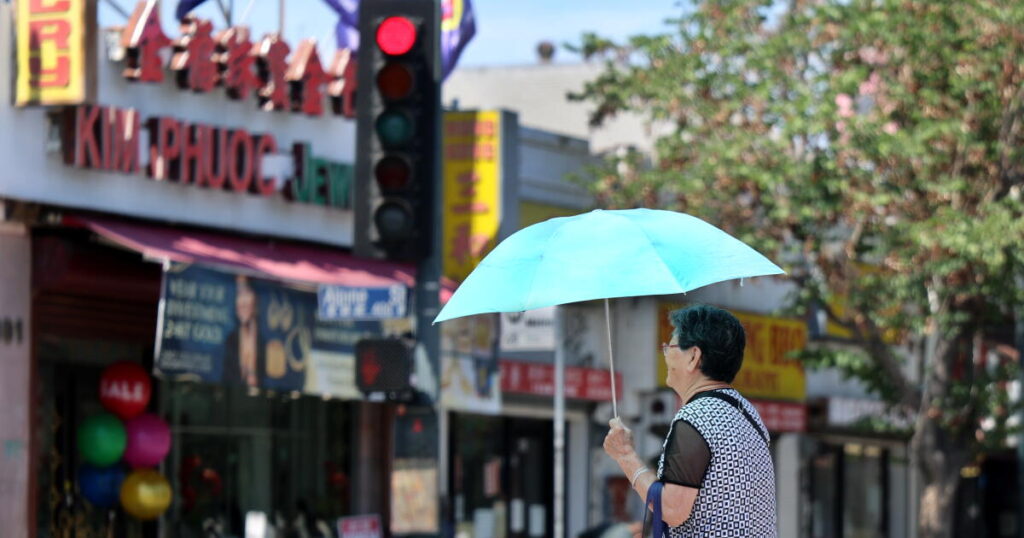
Officials are sounding alarms about the potential health impacts related to this week’s oppressive humidity and intense heat in Southern California.
Heat-related illness is a major issue in California and beyond, amid climate change and rising temperatures. But experts say the public is still getting its head around the dangers. A Times investigation in 2021 tallied 3,900 heat deaths and in California over a decade and found public agencies struggled to provide help to those in need.
Public health officials in Los Angeles County have seen an increase in emergency visits for heat-related illness during the heat wave over the summer months, according to a heat-related illness and mortality dashboard maintained by the county health department.
This week, humidity is causing temperatures to feel ever hotter.
“That is extremely humid by anyone’s definition, this isn’t just ‘Oh, it never gets humid in Southern California we aren’t acclimated,” said climate scientist Daniel Swain said. “This is an absolute humidity that is very high, and in some cases it is right up there at the ceiling of the humidity that we’ve really ever seen in this part of the world at any time of year.”
Experts have told The Times, humidity impedes the body’s ability to cool itself naturally, because the moist atmosphere doesn’t allow for sweat to evaporate as easily, causing you to continue to get warmer. If the humidity is lower, you’re less likely to succumb to a heat-related illness.
What an expert says
“Heat stress” is the total amount of heat that a person’s body must adjust to in order to keep a stable temperature in our core and organs, said Dr. David Eisenman, professor with the David Geffen School of Medicine and Fielding UCLA School of Public Health.
“Our body works best when the internal temperature is about 98.6 degrees and our body is consistently trying to hold to that number,” Eisenman said.
The source of this heat can be internal — can come from exercising — or external such as hot weather.
If it gets hotter outside and more humid outside, which keeps the sweat from drying off our body, our body has to work harder to maintain that stable temperature, he said.
Eisenman added, people can practice “skin wetting,” which means keeping as much bare skin continuously damp as possible.
Use a spray bottle, for example, to mist water directly onto a person’s face, neck and forearms. Repeat every 5-10 minutes to keep skin visibly wet.
People can also soak their clothing in cold water or apply an iced or chilled damp towel on their body.
Here is some health guidance from the Los Angeles Department of Public Health:
Basic heat humidity tips:
- Stay hydrated all day. Drink plenty of water throughout the day, even if not feeling thirsty.
- Take precautions when outdoors. If you must go out, plan your day to avoid going out during the hottest hours, and wear lightweight, light-colored clothes, and wear a hat or use an umbrella and use sunscreen (SPF 15 or higher).
- Keep your home cool. If your home becomes hot and you cannot cool it down, go to an air-conditioned space or cooling center.
- Never leave children or pets in a vehicle, even for a short time. Cars get very hot inside, even if the windows are ‘cracked’ or open. Call 911 if you see a child or pet alone in a vehicle.
- Check on those at higher risk for heat-related illness, like those who are sick or have chronic conditions, older adults, pregnant women, children, those who live alone, pets, outdoor workers and athletes, and anyone without air conditioning.
- Call 911 right away for any one of the following: confusion, fainting/passing out, hot, red skin (may be dry or damp), high body temperature (103°F or higher), fast & strong pulse, headache, dizziness, or nausea.
- If you don’t have air conditioning: Take cool showers or baths. Use your stove and oven less to avoid making your home hotter. Visit a library, cooling center, shopping mall, or other air-conditioned space. If you need help finding a cool space, call 211.
Heat illness
There are some signs of health-related illness from a guide produced by The Times:
Heat exhaustion
- Symptoms: An internal body temperature of over 104 degrees, lethargy, dizziness, inability to communicate, headache, a dip in cognitive abilities, fainting and profuse sweating.
- Treatment: Follow instructions for heat syncope, and also remove excess clothing or equipment. Wet a towel and wrap it around the trunk of the body. Call 911.
Heatstroke
- Symptoms: An internal body temperature over 104 degrees, loss of consciousness and possibly dry skin. Lack of sweat because your natural cooling system is compromised.
- Treatment: Get to a cool place and call 911.
The post L.A.’s record-level humidity can make you sick. How to survive the misery appeared first on Los Angeles Times.