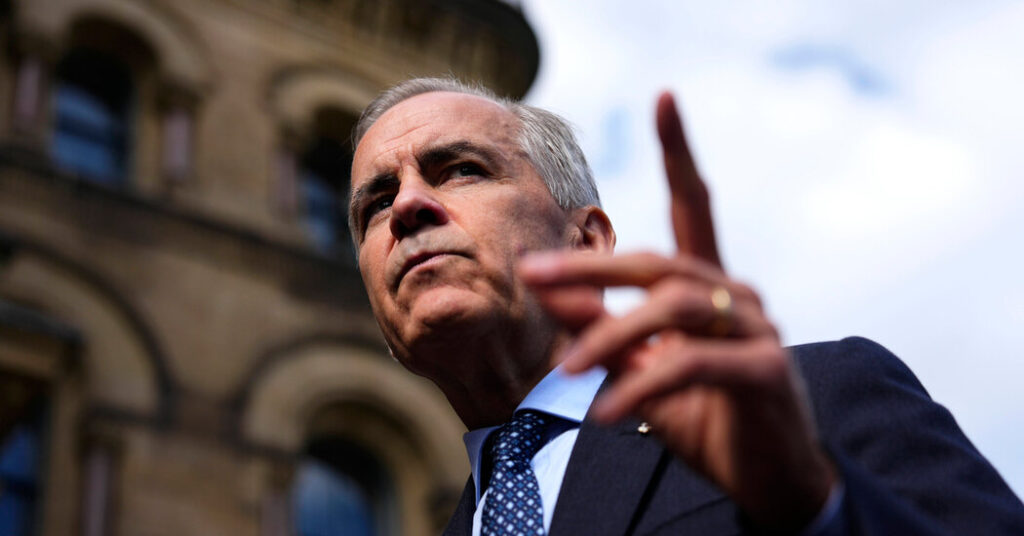
Prime Minister Mark Carney of Canada tried to get a good deal for Canada out of President Trump last month. By his telling, he came to the conclusion, after weeks of talks and hours before a deadline, that such a deal was not on offer. Since then, he has doubled down on his efforts to wean his country off its erstwhile best friend.
Mr. Carney was elected last spring on a promise to stand up to Mr. Trump, build big projects at home and deepen links with countries in Asia and Europe.
After trade negotiations collapsed in August, ushering in new U.S. tariffs on Canadian goods, Mr. Carney followed through on his promise to retaliate.
Canadian tariffs on $20 billion worth of U.S. goods came into effect on Tuesday, deepening the trade war between the two countries.
“It’s a shame,” Mr. Carney said in a video address released on Tuesday. “Because a mutually beneficial trade agreement between Canada and the United States is possible.”
But, he added, “the most fundamental issue is that the cumulative U.S. demands revealed that they wanted us to become even more reliant on them, not less.”
Mr. Carney has said he remains resolved to retaliate against U.S. tariffs, even if the Trump administration further squeezes core Canadian industries, making Canada the only country other than China to implement countertariffs against the United States.
Mr. Carney is also articulating a new Canadian narrative to the world of finance: that this is a vast land of opportunity that major global funds want to be part of.
Next week, he will welcome the world’s biggest investors to Toronto. The meet-up of U.S. banks, Gulf sovereign-wealth funds, European pension funds and Chinese investment authorities, among others, is taking place partly because of Mr. Carney’s long career as a central banker and senior finance executive.
Mr. Carney wants to convince the visitors to pour billions of dollars into his nation-building projects: roads, ports, mines, energy-generating facilities and oil and liquefied natural gas pipelines.
After the investment summit in Toronto, Mr. Carney will fly to Strasbourg, in France, to address the European Parliament on Thursday.
Together with Ursula von der Leyen, the president of the European Commission, he is expected to unveil the next stage of tethering Canada more closely to the European Union, closer than any other nonmember country.
Canadian companies are already enrolled in an E.U. program for defense investments and, while Canada cannot legally become the European Union’s 28th member state, Mr. Carney and European leaders have been working on a plan to give Canada more access to the E.U. market.
Mr. Carney has also worked to tighten Canada’s relationships with Asian countries, including South Korea and Japan, and part of his infrastructure push at home aims to increase exports to Asia from Canada’s West Coast.
Canadians continue to rally behind Mr. Carney’s plans — polling shows he has broad support, particularly for his shift away from the United States. Additionally, more than half of Canadians want their country to join the European Union.
In his video address on Tuesday, Mr. Carney thanked Canadians for making choices that back his strategy, particularly when it comes to spending their money at home.
“The most powerful actions have come from you, buying Canadian and traveling in Canada,” he said, “decisions at the kitchen table, not the boardroom table.”
Strangely, Mr. Carney has an unlikely ally in pushing his vision for Canada: Mr. Trump.
In the days since the collapse of the trade talks, Mr. Trump has doubled down on provoking Mr. Carney and Canadians: he has signed an executive order to rename Lake Ontario “Lake America”; resumed calling for Canada to be a state; and hurled accusations, many of which aren’t true, seeking to portray his country’s closest neighbor and longtime ally as a “nasty” adversary.
In the past few days, he has posted a map of North America with the U.S. flag superimposed on Canada, Iceland and other countries, as well as an A.I.-generated image of himself towering over Mr. Carney on the ice during a hockey game and calling the prime minister “governor.” (Mr. Carney played hockey for both Harvard and Oxford University while attending the institutions as a student).
”Canada came to life, in many ways, in response to American aggression,” Mr. Carney said in his Tuesday video, referencing the country’s first prime minister, Sir John A. Macdonald, who stood up to the United States in the second half of the 19th century.
“At an incredible human and financial cost, Canadians took what was a country on paper and made it real,” he added.
Mr. Trump’s provocations and menacing statements have fueled both Mr. Carney’s strategy to make Canada more economically independent of the United States, and Canadians’ convictions that he’s right.
The post Canada’s Carney Doubles Down on Pivot Away from the United States appeared first on New York Times.