Israel’s role as a safe haven for Jewish people after the Holocaust is central to its identity and values as a modern, democratic state. And so it was striking to read, in a recent story by my colleague Azam Ahmed, multiple prominent Israelis, including former military and intelligence officials, using World War II comparisons to describe what’s currently unfolding in the West Bank. “Eighty years after the Holocaust, ‘Mein Kampf’ in reverse,” one said; another called it “ethnic cleansing.”
Azam spent over a month on the ground reporting on the impunity of settlers attacking Palestinians, a source of growing concern around the world. (Before turning his attention to the West Bank, he also investigated the impunity of U.S.-backed forces in Afghanistan, and won a Pulitzer for it.) I asked him what he learned during a recent trip to the West Bank with retired Israeli generals.
The retired generals sounding the alarm over the West Bank
Azam, you recently accompanied a group of retired Israeli officials and military officers to the West Bank. How did that happen? And what did you see?
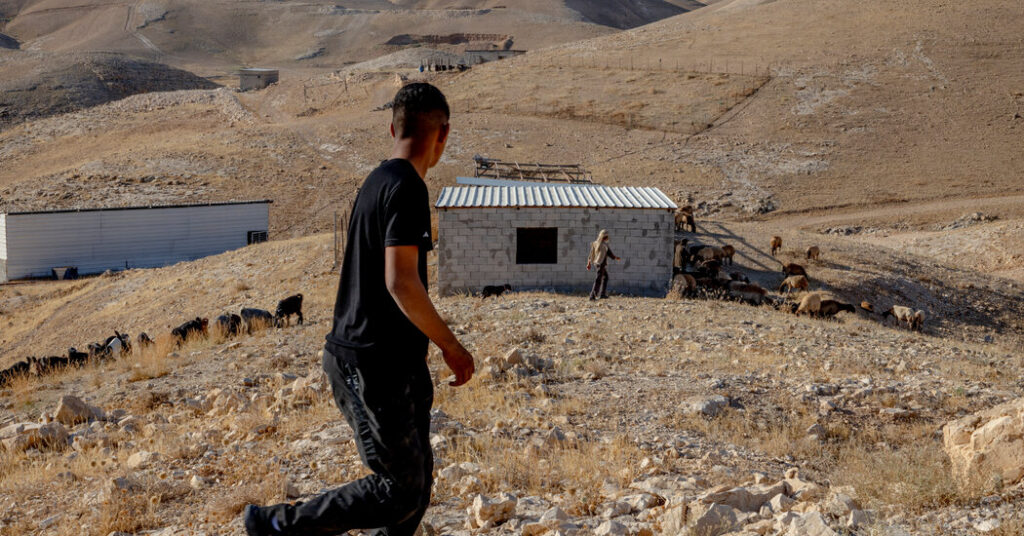
One of these generals had known our colleague Ronen Bergman for a long time and asked whether we’d like to come along. We saw villages where settler violence has cleared entire communities. You walk around and it’s like a ghost town. There are the remnants of shepherding pens and homes. But no people.
The most striking thing to me was the language these former military officers used to describe what’s happening. They openly called it “ethnic cleansing.” They also referred to “Jewish terrorism” — the idea that in the name of Judaism settlers terrorize innocent farmers, women and children, and sometimes even kill them.
The violence in the West Bank has unfolded in the shadow of Israel’s post-Oct. 7 wars in Gaza, Lebanon and Iran. But it’s not a military campaign; it’s a civilian campaign. What does that look like?
Groups of settlers have been moving into the occupied West Bank, often into containers or trailers on the hillsides. They tend to settle close to Palestinian population centers. In some cases, they attack the surrounding communities.
They come in with masks, with guns, with bats. They torch homes, and steal livestock. The Palestinians know that they’re not allowed to be armed, and that if they fight back, in many cases the military will show up and defend the Israelis, even when they are the aggressors.
These retired generals say Prime Minister Benjamin Netanyahu’s government is complicit in this violence. How so?
When they call the government “complicit,” they mean several things. In some cases soldiers actually join forces with settlers to attack a village. There was a highly publicized incident of settlers camped outside Palestinian homes in a village called Qusra, and one video shows a soldier praying with the settlers.
These officials also point out that Israeli intelligence in the West Bank is so good that it’s very hard for a Palestinian to pull off any kind of attack. So their question is: How is it that a Palestinian can’t do anything without the Israeli military knowing about it, but settlers face no consequences for violence?
That impunity creates an incentive to keep going.
Did the Israeli government offer any kind of response?
The prime minister’s office declined to respond when we asked them about these officials’ comments, and Netanyahu has played down the attacks. But international concern has been growing and he did speak out about a particularly violent attack last month.
The settlements aren’t new, of course — hundreds of thousands of Israelis have lived among millions of Palestinians in the occupied territories since 1967. So what is actually new here?
It doesn’t come out of nowhere. You’re looking at something that has been building for decades and has now been taken to an extreme by this government. Oct. 7, 2023, was a seminal moment. But so was the formation of Netanyahu’s government in 2022, because he brought in Bezalel Smotrich, Itamar Ben-Gvir and other right-wing officials who have the ambition of claiming the occupied West Bank as part of a Greater Israel.
That’s what the generals, and other critics of this government, believe they’re watching. They’re saying these violent incidents aren’t just “a handful of kids,” which is how Netanyahu once tried to frame it. They see this violence as strategic: settlers taking strategic areas, creating corridors and pushing Palestinians into densely populated cities that can be ring-fenced, so the rest of the land can be claimed.
The generals you spoke to were themselves part of military campaigns that involved violence against Palestinians. How do they differentiate between what they did and what is happening today?
In their eyes, a qualitative moral red line has been crossed. They distinguish between a continuum of state violence — violence in response to an attack, or violence designed to maintain security — and settler violence, which is just lawless individual behavior: civilians terrorizing other civilians, with the state tolerating it.
One of the men we quote, Gal Levertov, used to represent Israel before the International Criminal Court, and he said that if he were asked to defend Israel’s conduct in Gaza, he could — on the basis that there was a military objective. But he said there’s no defending what’s happening in the West Bank.
Palestinians, it’s worth noting, don’t see it this way at all. To them, this is simply a more unvarnished version of what came before.
And Azam, zooming out, what does all this mean for Israel and what it stands for as a country?
That’s maybe the hardest question here. The thing we heard time and again from these generals who care about Israel and believe in it is that Israel is ruining and destroying its values by allowing it to happen, by failing to stop it, by having citizens who are willing to do it and by not having more of a public uproar against it.
These generals are looking at it and saying: “This isn’t the Israel that I fought for. And if we’re not careful, the democratic values that we’re meant to uphold will be lost.”
MORE TOP NEWS
Canada hits back
Prime Minister Mark Carney said yesterday that Canada’s retaliatory tariffs against the U.S. had been unavoidable and that the U.S. was seeking “dependency, not a true economic partnership” from Canada.
The Canadian tariffs of 15, 25 and 50 percent on a range of products came into effect just after midnight and are Carney’s response to tariffs of up to 50 percent imposed by President Trump.
On the ground: Americans in border regions have personal bonds with Canadians, but the trade war is testing relationships.
OTHER NEWS
-
Saudi Arabia vowed to retaliate against Yemen’s Houthi militia after attacks by the group in the south of the kingdom. Oil prices climbed toward $100 a barrel.
-
Russian drones and missiles killed three people in Kyiv, Ukraine’s capital, ending a brief pause that had allowed U.S. envoys to safely visit.
-
Australia moved to allow social media users to opt out of algorithms on platforms like TikTok, Instagram and Facebook.
-
The far-right victory in a state election in Germany has plunged Chancellor Friedrich Merz into a fight for political survival.
-
Hungary expelled 10 Russian diplomats, signaling a big shift from its previously cozy relations with Moscow.
-
Scores for American students neared a 25-year low on an international test for 15-year-olds known as PISA.
WHAT ELSE IS HAPPENING
-
Black bears are taking over backyards in California.
-
Thieves stole two prized works from a museum in France that was once the home of Renoir.
-
Apple is expected to introduce its biggest change to the iPhone’s design: a foldable smartphone.
TOP OF THE WORLD
The most clicked link in your newsletter yesterday was about a 92-year-old mathematician and her teenage apprentice.
SHOWDOWN OF THE DAY
Virtual taekwondo
A contactless version of the Korean martial art — featuring V.R. headsets and controllers — is making its debut at this year’s Asian Games. Fans praise it for its safety and inclusivity. Critics call it a glorified video game.
MORNING READ
Since 2012, Jim Maroon has taken care of the reflecting pools at the 9/11 Memorial in New York. The two memorial pools cover the footprint of the twin towers that were destroyed 25 years ago in the Sept. 11 attacks.
On that day, Maroon was headed to work in Manhattan when the first plane hit. He remembers the sound of the impact, and later the sight of people jumping from high windows. He tries not to dwell on that memory: “If I thought about it every day, I’d be heartbroken.” Read more and go behind the scenes at the memorial.
AROUND THE WORLD
They wrote essays for cheaters. Then A.I. took over.
For well-educated young people from developing countries, the internet provided strange and life-changing opportunities in the crevices of the digital economy. They could make money helping college students abroad cheat.
In Kenya, for example, thousands made a living writing essays for overseas college students. Then A.I. came, and those students made a simple calculation: Why pay a freelancer in Kenya when ChatGPT could do the job? It’s an example of how A.I. is already dismantling some lower rungs of the global labor market. See who’s getting left behind by A.I.
RECOMMENDATIONS
Read: MJ Franklin, an editor on our Book Review team, recommends books to fit your mood. Watch the video.
Refresh: Back-to-school season can be a good time to set some new goals.
Watch: The historical film “De Gaulle” is a box office hit in France.
Gaze: This mountain home in Costa Rica has a light footprint amid monkeys and macaws.
RECIPE
These pupusas, corn cakes enjoyed in El Salvador and Honduras, are stuffed with a quick bean and cheese mixture. But they are a great home for leftovers. Anything can go inside.
WHERE IS THIS?
Where is this Ferris wheel?
TIME TO PLAY
Here are today’s Spelling Bee, Mini Crossword, Wordle and Sudoku. Find all our games here.
That’s it for today. See you tomorrow! — Katrin
We welcome your feedback. Send us your suggestions at [email protected].
The post Impunity in the West Bank appeared first on New York Times.