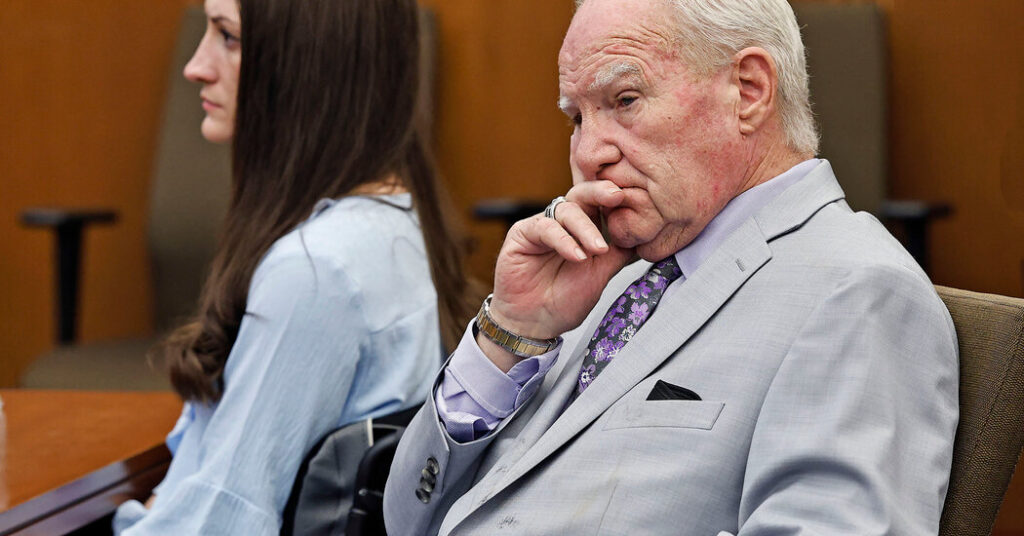
Lindsay Clancy’s lawyer on Tuesday publicly asked President Trump to pardon her on the murder charges she faces in the killing of her three young children, even though the president has no power to wipe away state charges.
“Mr. President, I would hope that you would consider this young lady and the person she is, what she’s been through, and consider a pardon,” the lawyer, Kevin Reddington, said in an interview on “Good Morning America.”
But according to the American Bar Association, there is strong consensus among legal experts that a president cannot pardon someone for a state offense, because the Constitution reserves presidential pardons for “offenses against the United States.”
Ms. Clancy’s trial, in which she pleaded not guilty by reason of insanity, ended on Friday in a mistrial after jurors were unable to come to a unanimous decision. Two legal experts agreed in interviews that Mr. Trump cannot pardon Ms. Clancy on the first-degree murder charges she still faces in Massachusetts.
“It’s not a federal case, and the pardon power only covers federal cases, and that’s very clearly established,” said Mark Osler, a law professor at the University of St. Thomas Law School in Minneapolis who specializes in clemency issues.
Elizabeth G. Oyer, who was the Justice Department’s pardon attorney from 2022 to 2025, said any pardon in Ms. Clancy’s case would have to come from the governor of Massachusetts.
“The president can only pardon violations of federal law, so he could not pardon Lindsay Clancy on the charges that the state of Massachusetts is pursuing,” Ms. Oyer said.
A spokesman for Mr. Reddington, who has tried high-profile cases for decades, said that the lawyer “knows that a president cannot pardon on a state case.”
“The comment wasn’t mean as a legal filing,” the spokesman, Dan Nardo, said. “It was more of a statement to the country that this case deserves mercy, from the White House all the way down to Plymouth County.”
Mr. Nardo said he hoped Mr. Trump might convey a message of mercy to the Plymouth County district attorney, Timothy J. Cruz, who is weighing whether to retry Ms. Clancy on three counts of first-degree murder or to seek lesser charges. Mr. Nardo noted that the president and Mr. Cruz are both Republicans.
“This administration is able to get a lot done in unique ways,” Mr. Nardo said.
Mr. Cruz’s office did not immediately respond to a request for comment on Mr. Reddington’s plea for a presidential pardon for Ms. Clancy.
Mr. Trump has used his expansive legal powers to reward and protect allies, and his Justice Department has shattered traditional norms of independence by following his orders to pursue criminal cases against perceived enemies.
And there is precedent for Mr. Trump issuing a symbolic pardon in a state case.
In December, the president pardoned Tina Peters, a former Colorado county clerk who was convicted of tampering with voting machines after the 2020 election and sentenced to nine years in prison. Mr. Trump’s pardon had no effect on its own because Ms. Peters had been convicted in state court.
But Gov. Jared Polis of Colorado, a Democrat, later commuted Ms. Peters’s sentence, allowing her to go free. Mr. Polis said that pressure from Mr. Trump’s pardon had no bearing on his decision. Instead, Mr. Polis said he had issued a commutation because he believed Ms. Peters’s sentence was “disparately harsh.”
Ms. Oyer and Professor Osler speculated that Mr. Reddington might be trying to seek a similarly symbolic pardon from Mr. Trump in order to ramp up pressure on prosecutors and the governor. “It could be that if Trump can do the same type of signaling at a federal level, then the governor of Massachusetts will follow,” Professor Osler said.
Mr. Reddington has argued that Ms. Clancy was overmedicated and in the throes of postpartum psychosis when she strangled her children in her home in 2023. Prosecutors have cast doubt on that diagnosis and argued that Ms. Clancy was aware of what she was doing, and should therefore be held criminally responsible.
Asked for its response to Mr. Reddington’s plea for a pardon, the White House pointed to remarks Mr. Trump made to reporters on Friday after Ms. Clancy’s case ended in a mistrial. Mr. Trump said he assumed there would be another trial and called it a “terrible situation.”
“Look, she did a horrible, horrible thing,” Mr. Trump said. “Can’t be worse. But you’ll find out what the price to pay is. There’ll be a price. It’s going to be mental institution or jail or something.”
The post Trump Cannot Pardon Lindsay Clancy, but Her Lawyer Asked Anyway appeared first on New York Times.