The day I saw “The Tempest” at the Stratford Festival in Stratford, Ontario, there was a ferocious storm. We saw it coming. All afternoon, phones buzzed with various alarms — “tornado likely,” these said. “Dangerous winds.”
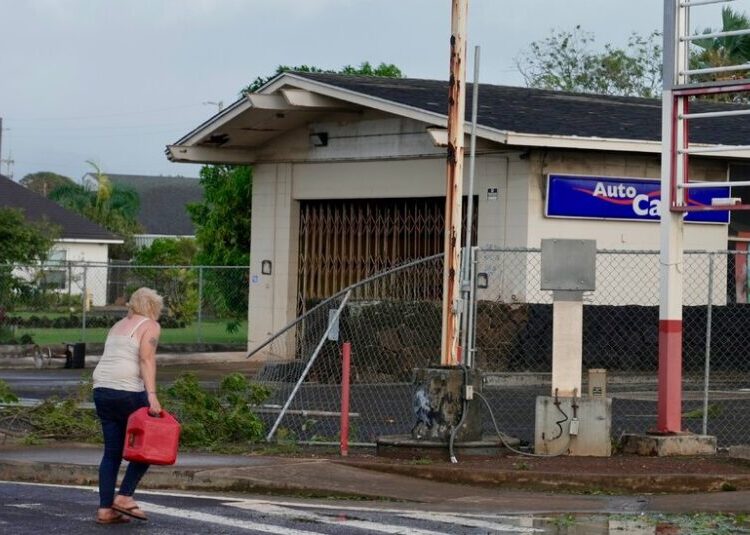
The thunderstorm raged across the Canadian province north of Lake Ontario (which my digital map was calling Lake America because of a recent executive order from President Trump), and it wound up being a wildly destructive juggernaut. Still, the real storm faced stiff competition from a pretend one that night at the Festival Theater.
“The Tempest” starts with a shipwreck, and Antoni Cimolino’s production begins with a series of lightning-fast transformations: First, in a shrieking gale, a ship’s massive sail billows over the entire stage, only to crash to the floor, where its gray silk becomes a hurricane-whipped sea. Men fall from the ship’s rigging and are flung into the dark; “Hell is empty, and all the devils are here!” one screams. And then, whoosh, the cyclone tidies itself away. The sea-silk slips into a crevice in the floor and disappears, taking its trash (ropes, ship’s wheel, weeping sailors) with it.
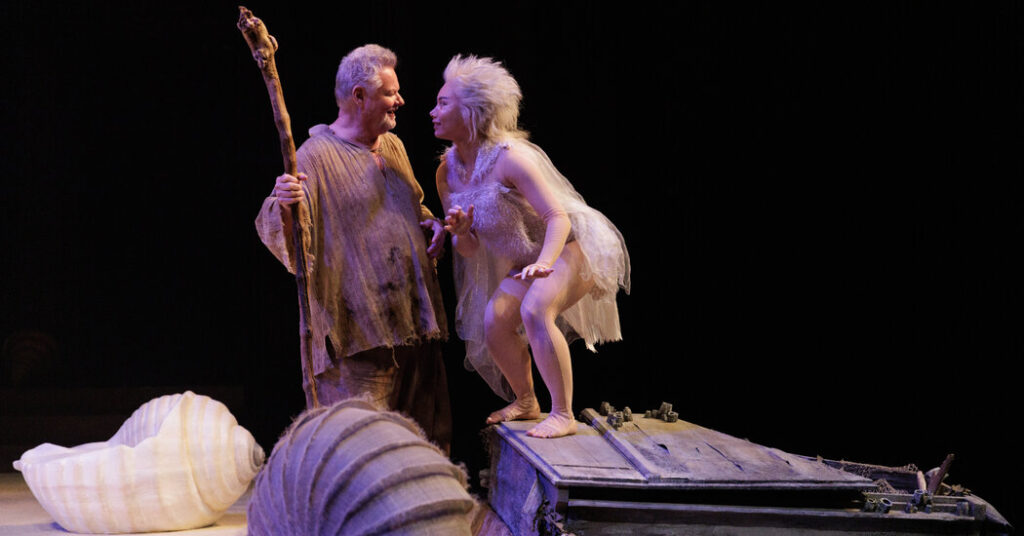
Whatever else ensues in “The Tempest,” the audience remembers this magically abrupt calm: Clearly the duke-turned-wizard, Prospero (played by the festival linchpin Geraint Wyn Davies), created this terrifying chaos just to restore order.
Some of the men on that ship were Prospero’s enemies. One is his evil brother, Antonio (Gordon S. Miller), who usurped his dukedom, so he has commanded his servant-spirit, Ariel (Marissa Orjalo), to torment them.
According to Shakespeare, Prospero does enjoy his revenge. Ariel must remind his master to let his sympathies respond as his victims suffer: “Mine would, sir, were I human,” Ariel says. Wyn Davies, though, has the kind of face that’s always falling into a smile. He downplays Prospero’s rancor and emphasizes his sweetness instead. This Prospero yearns, often in the face of continuing betrayal, to be kind.
At the end of the plot, Prospero tells Antonio that to call him brother “would even infect my mouth” — right before forgiving him. The text makes it an equivocal moment. Yet in a striking gesture, Wyn Davies here holds Miller’s face in his hands and smiles compassionately into his eyes for a long minute. Wyn Davies hugs Miller tightly, and the production stops to watch.
It’s the message of Cimolino’s “Tempest”: If your brother acts in frightening and despicable ways — even if he, say, attacks your sovereignty — hold him close.
Chaos and order, insult and forgiveness were the themes of everything I saw in Stratford, which is another way of saying I attended two days of Cimolino’s final, gracious season at the Stratford Festival. He is leaving his post after 14 seasons as artistic director and after nearly 40 years there, in multiple capacities.
Cimolino is himself a rather Ariel-like figure. He’s slight and ageless and really quick: He took me on a racing tour of the festival’s several theaters, dazzling me with rooms of golden fabrics, fantastical tales about storage (the festival has 70,000 costumes in reserve) and swiftly realized architectural dreams. The new Tom Patterson Theater, for instance, took only four years to build. It’s a glass miracle, a beautifully undulating greenhouse that shimmers amid its gardens and patios. (It opened in 2022.)
These theaters are a manifesto. What the festival builds is what it believes. In 1952, tiny Stratford was just another casualty of the dying Canadian railroad industry when a persuasive journalist named Tom Patterson thought to found a Shakespeare festival there. (It has since become the largest classical repertory in North America and a cultural nexus where various great Canadian actors, including William Shatner and Christopher Plummer, performed marquee roles.)
Back in its first days, Patterson persuaded the British superstar director Tyrone Guthrie to come to Stratford by promising to construct him an Elizabethan-style thrust stage. That same wooden circle, with the Festival Theater now erected around it, is the one I saw used in “The Tempest.” It’s among the most influential theater structures of the modern era: The shape brings the actors surprisingly close to even the farthest seat.
And now you can read Cimolino’s own manifesto in the structure of the Tom Patterson Theater: It features a luxurious lobby, a lovely thrust stage made from Canadian birch — beauty and patriotism! — and a technical system that suppresses ambient noise so that every word spoken rings clear.
There I saw Jovanni Sy’s “The Tao of the World,” a thoughtful reworking of William Congreve’s Restoration comedy “The Way of the World,” set in the milieu of the Singaporean superrich. Sy subverts his own structure at one point, letting the supernumeraries (spa attendants, maids and valets) deconstruct the narrative. Eventually, though, Sy reverts to the original’s laughing equanimity. After making outraged points about broken Covid-era promises to essential workers, the play returns to its attitude of friendship-above-all. As in “The Tempest,” even serious abuses are forgiven.
The festival’s dedication to material sumptuousness is apparent everywhere. The shows I saw contained more splendor than many New York spectacles. The director-choreographer Donna Feore’s ebullient production of “Guys and Dolls” contains all the heart and dazzle you could wish for, particularly when the dancing starts. All the flash guys in Feore’s pristine Noo Yawk can do amazing athletic feats, and the wonderful Miss Adelaide (Jennifer Rider-Shaw) and her backup Hot Box dolls seem to have a bigger budget to play with than do half the shows on Broadway.
Wyn Davies also popped up as a daffy, theater-mad uncle in Eduardo de Filippo’s “Saturday, Sunday, Monday,” which was Cimolino’s choice for his last play at the Festival. (It opened in August.) It’s a family comedy about miscommunication, a farce about how easy it is to tear a marriage apart if you avoid the deep conversations. It happens to have an exquisite apartment set, designed by Douglas Paraschuk, that would make a U.S. nonprofit weep.
Seeing these four shows (out of a repertory of 12) did encourage a certain amount of dot-connecting. Clearly, the Stratford Festival has been thinking about the duties of family and friendship for a while now. Many of its most devoted patrons are from the United States, driving up from Illinois or Michigan, year after year. When I suggested to Cimolino that international tension might manifest at the Festival, he demurred. “Art brings us together, right?” he asked.
On the morning I left, I read an essay in The Toronto Star by Joshua Chong. He had been hearing from readers furious about the Trump administration’s “51st state” rhetoric and who were proposing that Canada’s cultural organizations reject American programming in retaliation. Chong rebuts the idea. “Art — unlike steel, potash or hardwood — isn’t a commodity,” he wrote. “It isn’t something to be blocked, taxed or tariffed.”
Chong and Cimolino both seem to be meeting Canadian anger with reassurances that even deep wounds can be mitigated with continuing, unstinting cultural conversations.
But they’re not just saying that. As I drove slowly through Stratford the day after the real storm, steering around fallen tree branches, I noticed some things that the wind hadn’t budged at all. On one street corner, a banner read: “Canadians value democracy, human rights and the rule of law. Defending it begins at home.”
It made me think of Prospero. He does embrace his brother, but he also makes darn sure to take away Antonio’s power first. The wizard isn’t the one who summons the storm, necessarily, but he’s certainly the one who cleans it up.
The post At the Stratford Festival, Forgiveness Is a Power Move appeared first on New York Times.